

WORLDWIDE FREIGHT SERVICES
Email: jack@transworldcn.com

The client was a growing consumer electronics accessories brand selling products through Amazon European marketplaces.
The company manufactured products in Asia and distributed inventory across:
| Marketplace | Sales Region |
| Amazon Germany | European Union |
| Amazon France | European Union |
| Amazon Italy | European Union |
| Amazon Spain | European Union |
| Amazon UK | United Kingdom |
Before implementing a new inventory strategy, the company relied on a traditional fulfillment model:
China Factory → Ocean Freight → Amazon FBA Warehouse → Customer
This approach supported daily operations but became increasingly difficult as sales volume increased.
During normal sales periods, the company managed inventory effectively.
However, during peak seasons such as:
inventory planning became more challenging.
The company needed to balance:
Because products were manufactured in Asia, emergency replenishment required additional transportation time.
The average supply chain process included:
| Process | Estimated Timeline |
| Factory production | 15-30 days |
| Ocean transportation | 25-40 days |
| Customs clearance | 3-7 days |
| FBA receiving | Several days |
Long lead times increased the risk of stock shortages.
The company originally used one European inventory plan.
However, sales performance showed significant differences between regions.
Examples:
| Region | Demand Pattern |
| Germany | Stable demand throughout the year |
| France | Higher promotional fluctuations |
| Spain | Seasonal changes |
| UK | Independent inventory requirements |
The company needed separate inventory forecasting.
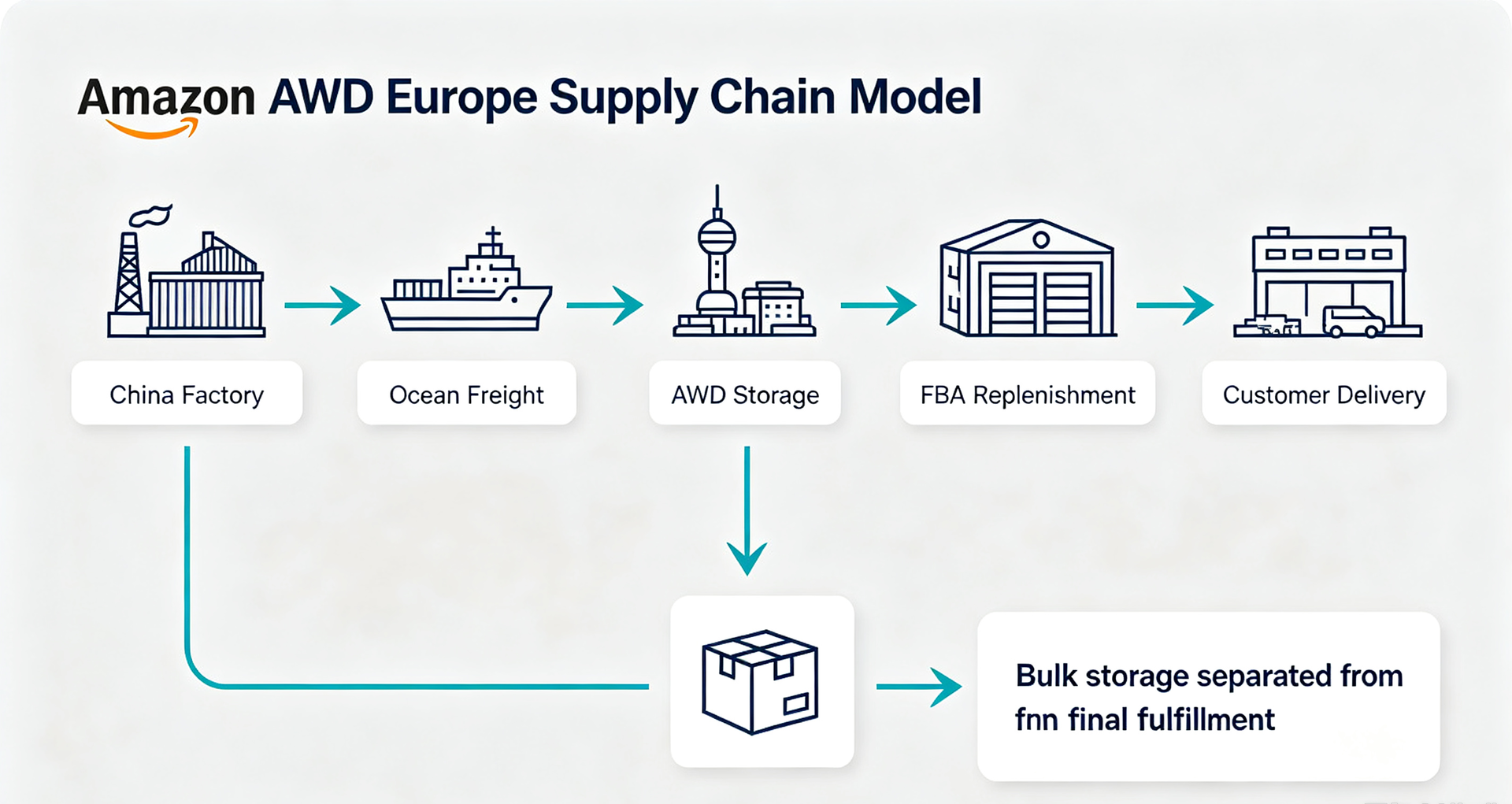
To solve these challenges, the company redesigned its supply chain.
The updated structure became:
Supplier → International Freight → AWD Storage → FBA Replenishment → Customer
Amazon describes AWD as a bulk inventory storage and distribution solution designed to support FBA sellers by improving upstream inventory management and replenishment efficiency.
The company reviewed:
The goal was to create a more accurate inventory forecast.
Because EU and UK logistics systems operate separately, the company created two inventory strategies.
Focused on:
Focused on:
This prevented inventory shortages caused by regional imbalance.
Before sending inventory into Europe, the company improved:
This helped reduce inbound processing problems.
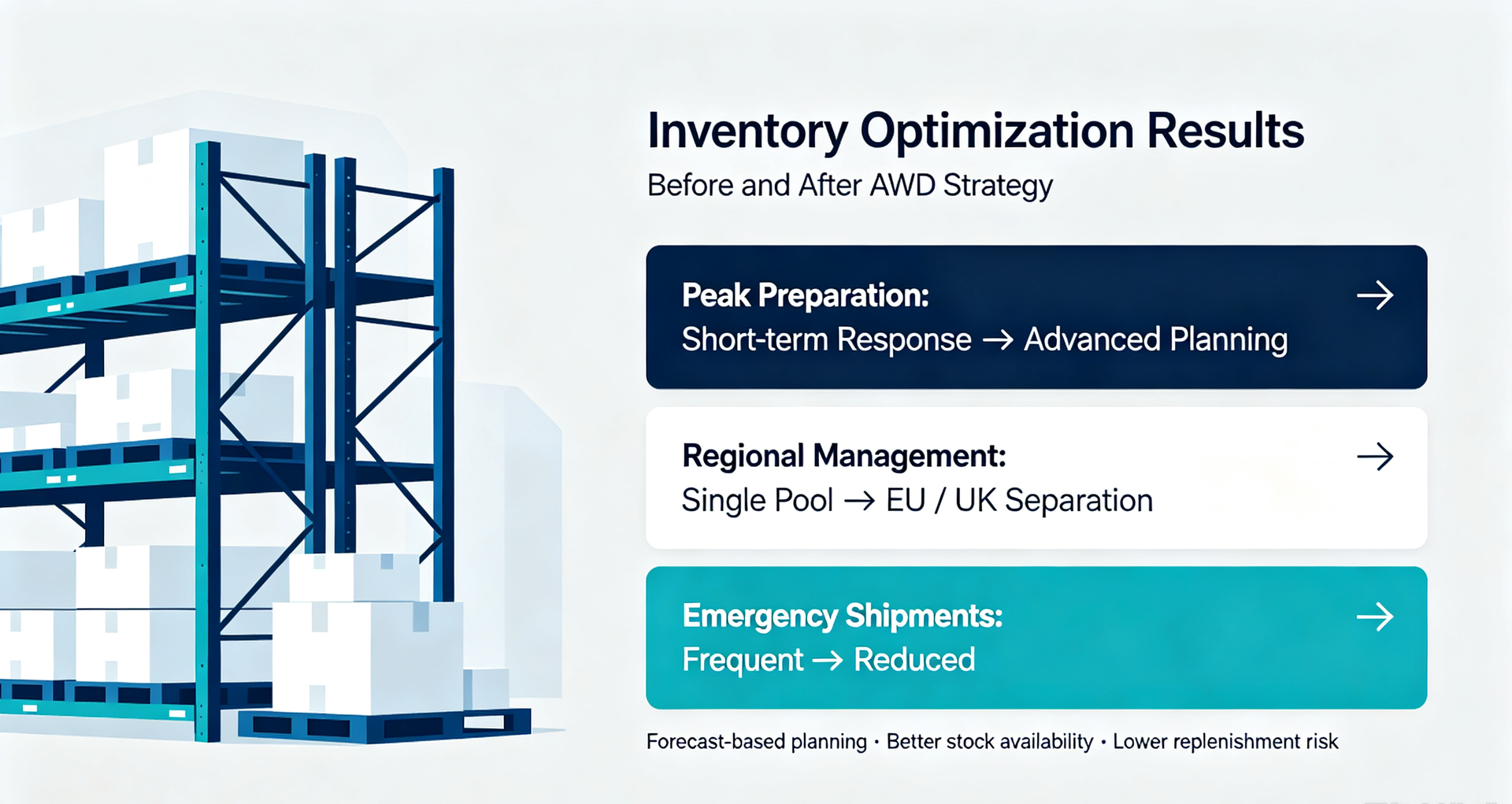
After restructuring inventory planning, the company achieved measurable improvements.
| Performance Area | Before | After |
| Inventory planning | Manual decisions | Forecast-based planning |
| Peak season preparation | Short-term response | Advanced preparation |
| Regional management | Single inventory pool | EU and UK separation |
| Emergency shipments | Frequent | Reduced dependence |
The company improved supply chain visibility and gained better control over inventory movement.
By storing inventory closer to Amazon’s fulfillment network, sellers can react faster to demand changes.
Early inventory preparation helps sellers avoid unexpected shortages during high-demand periods.
The company gained better control over:
| Solution | Purpose |
| Amazon AWD | Bulk inventory storage |
| Amazon FBA | Customer order fulfillment |
Successful sellers often combine both services.
European sellers should evaluate:
before shipping inventory.
More inventory does not always mean better performance.
The key is:
Amazon AWD Europe is Amazon’s bulk inventory storage solution that allows sellers to store products before replenishing FBA fulfillment centers.
No. AWD manages upstream inventory storage, while FBA handles customer delivery and fulfillment.
AWD is suitable for sellers who:
No. EU and UK AWD networks require separate inventory planning because they operate under different tax and customs environments.
This Amazon AWD Europe case study shows that successful European expansion requires more than simply sending products into FBA warehouses.
A stronger strategy combines:
As Amazon AWD Europe becomes part of the European fulfillment ecosystem, sellers that prepare their supply chains early will have stronger opportunities to improve inventory stability and compete in global ecommerce markets.






 Email: