
WORLDWIDE FREIGHT SERVICES
Email: jack@transworldcn.com
TL;DR
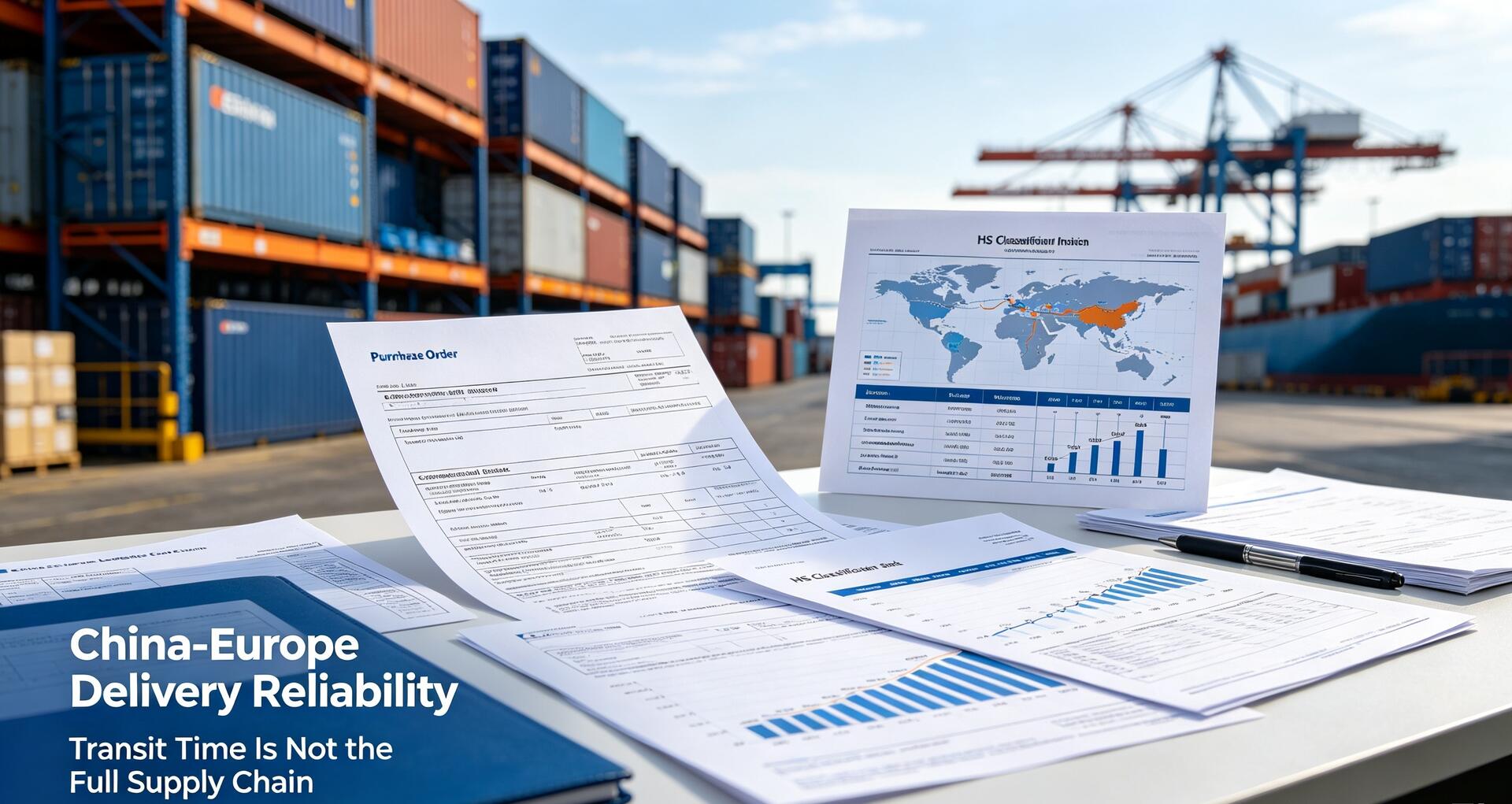
A European importer sourcing products from China wanted to improve delivery planning without automatically choosing the most expensive transportation option. The logistics team compared sea freight, rail freight, air freight, and multimodal transportation while separating main-leg transit time from the complete door-to-door delivery timeline.
The case highlights a practical lesson for businesses researching shipping time from China to Europe: transportation time is only one part of the supply-chain schedule. Export handling, carrier schedules, customs procedures, terminal operations, and final-mile delivery can all affect the actual arrival date.
This is an anonymized, illustrative logistics case study based on common China–Europe import scenarios. It does not represent a specific customer's shipment or guarantee a particular transit time.
The importer was purchasing finished goods from a supplier in China for distribution in Europe. The purchasing team initially focused on one question:
How long does shipping from China to Europe take?
At first, the question appeared to require a simple answer. In practice, however, the logistics team found that there was no single shipping time that applied to every shipment.
A China-to-Europe shipment may involve several separate stages:
The distinction between transport transit time and end-to-end delivery time has become an important part of the importer's planning process.
International transportation is a chain of connected operations rather than a single movement from one country to another.
For example, an ocean shipment may spend most of its journey on a vessel, but the total delivery schedule can also depend on cargo readiness, port handling, vessel schedules, transshipment, destination procedures, customs clearance, and inland transportation.
This matters because maritime transportation remains a major component of global merchandise trade. According to UN Trade and Development, maritime transport moves more than 80% of goods traded worldwide by volume.
For importers, that makes ocean freight an important option for larger and less time-sensitive shipments, but it also demonstrates why port and inland logistics should be included in delivery planning.
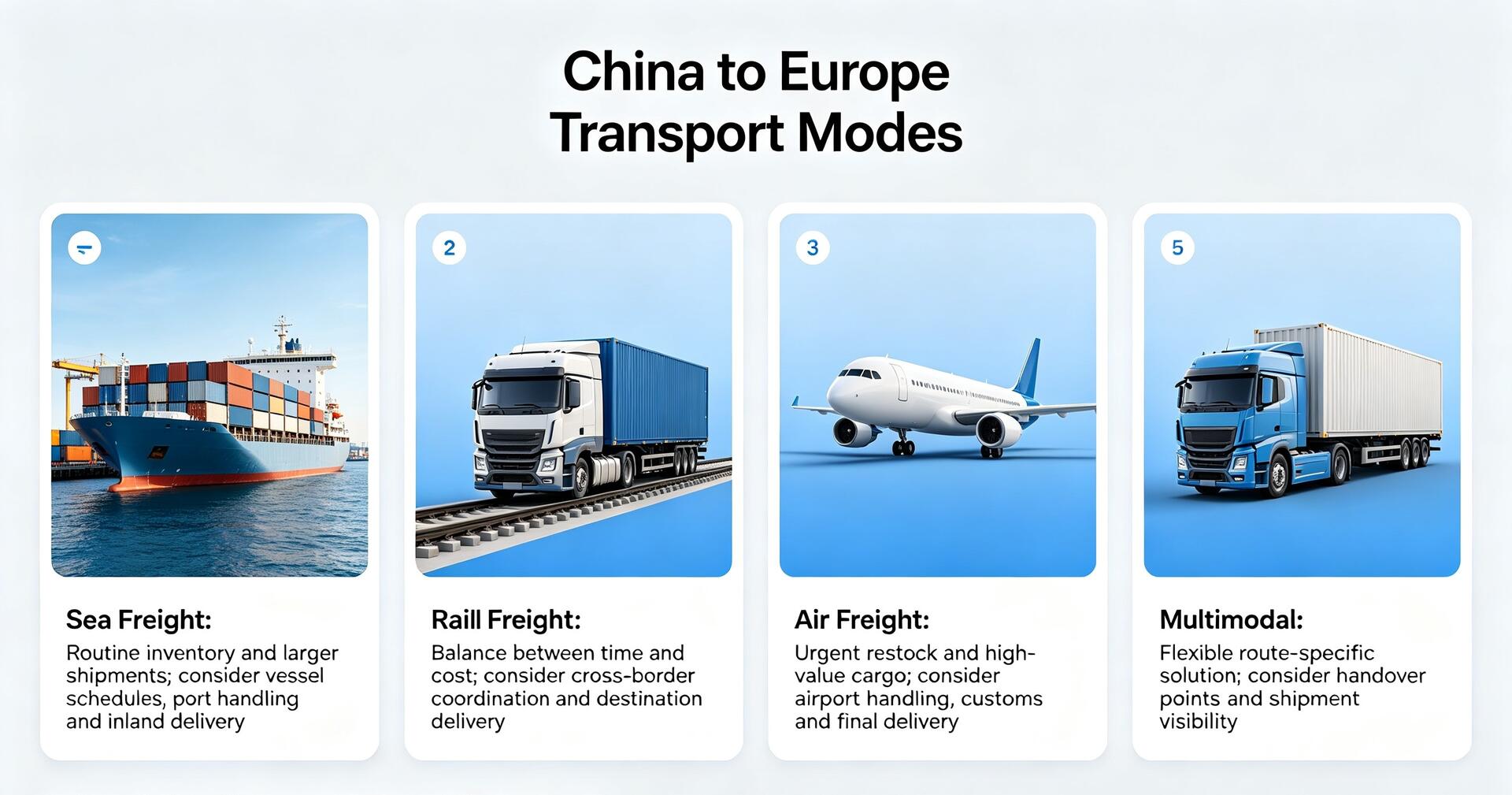
The importer compared four primary logistics strategies.
Sea freight was considered for regular inventory and larger shipments where the business could plan sufficiently in advance.
Its main advantages were its suitability for substantial cargo volumes and its established role in international trade.
However, sea freight involves more than vessel transit. Importers also need to consider:
UNCTAD's latest maritime statistics show that 12.1 billion metric tons of goods were loaded for international maritime trade in 2024, illustrating the scale of the global maritime transportation system.
Rail was evaluated as an alternative for shipments where the importer wanted a different balance between transportation time and cost.
Rail logistics can involve multiple national networks and border crossings. This means route planning and cross-border coordination can influence reliability.
The European Commission notes that around half of EU rail freight traffic crosses at least one national border, highlighting the operational complexity of international rail transportation.
For this reason, an importer should not evaluate rail solely on a quoted line-haul transit estimate. The complete route and destination delivery process should also be considered.
Air freight was considered for urgent inventory and shipments where the cost of faster transportation could be justified by the commercial value of receiving the goods earlier.
Although air transportation can provide a shorter main transport leg than ocean or rail, it does not eliminate other logistics stages.
Cargo still needs to be:
Therefore, an air-freight quotation should also be reviewed in terms of door-to-door timing, rather than only flight time.
The importer also considered multimodal transportation, combining different transportation modes to meet specific supply-chain requirements.
A multimodal strategy can be useful when the origin, destination, cargo characteristics, inventory requirements, and available transport services make a single mode less suitable.
The key challenge is coordination.
A delay during one transport stage can affect the following stage, making shipment visibility and communication particularly important.
One of the most important lessons from the case was that transportation planning cannot be separated from customs planning.
For goods entering the European Union from outside the EU customs territory, customs clearance is required before the goods can circulate freely within the EU customs territory. The European Commission also states that an Entry Summary Declaration is a safety and security requirement for goods entering the EU customs territory.
The EU also requires customs declarations to contain information about imported or exported goods. Customs declarations are generally submitted electronically under the Union Customs Code framework.
For the importer, this meant that logistics planning needed to include documentation preparation before the cargo departed China.
The team therefore reviewed:
The purpose was not to guarantee that customs clearance would take a specific amount of time. Instead, the goal was to reduce avoidable problems caused by incomplete or inconsistent information.
The importer changed its approach from asking:
“Which shipping method is fastest?”
to:
“Which transportation plan provides the right balance of time, cost, and delivery reliability for this shipment?”
The new planning process consisted of several steps.
Instead of beginning with a carrier's advertised transit time, the importer first identified when the goods needed to be available at the destination.
This allowed the logistics team to work backward from the required delivery date.
The team considered:
These factors helped determine which transportation modes were commercially appropriate.
The logistics provider was asked to compare available sea, rail, air, and multimodal options.
The importer also requested clarification regarding what each quoted transit time included.
For example, the team distinguished between:
Port-to-port transit time
and
Door-to-door delivery time
This distinction prevented the importer from treating a main-leg transportation estimate as a guaranteed final delivery date.
The importer introduced a pre-shipment document review.
The objective was straightforward: identify obvious documentation inconsistencies before the cargo reached the destination.
This is particularly important because customs declarations are formal legal acts under the EU customs framework, rather than simply administrative paperwork.
The importer stopped planning around the shortest possible transportation scenario.
Instead, the team created a reasonable operational buffer for stages that could vary, including:
This produced a more realistic delivery plan.
The most important lesson was that shipping time from China to Europe is not a fixed number.
A quoted transit time can describe only one part of the transportation process.
The actual delivery timeline may depend on:
| Logistics Stage | Potential Time Impact |
| Supplier readiness | Cargo may not be available when expected |
| Origin handling | Pickup and warehouse operations |
| Export procedures | Documentation and customs requirements |
| Main transportation | Vessel, aircraft, rail, or multimodal schedule |
| Transshipment | Additional handling when applicable |
| Destination handling | Terminal and cargo release procedures |
| Import customs | Declaration and customs processing |
| Inland delivery | Transportation from gateway to destination |
This is why experienced importers generally evaluate the entire logistics chain rather than relying on one advertised transit figure.
There is also a broader reason to evaluate China–Europe shipping as a network rather than a single route.
International shipping involves large interconnected transportation systems. UNCTAD reports that China remained the world's leading maritime-freight economy in 2024, with approximately 670 million metric tons loaded and nearly 3.0 billion metric tons discharged in international maritime trade statistics.
At the European end, rail transportation also operates across multiple national networks. In June 2026, the European Commission highlighted new EU rules intended to improve cross-border rail capacity planning, coordination, and reliability.
These figures do not provide a guaranteed transit time for an individual shipment. Instead, they demonstrate why importers should think about international logistics as a coordinated network involving ports, railways, customs authorities, carriers, terminals, and inland transport providers.
After changing its planning methodology, the importer had a clearer framework for deciding how to transport different categories of cargo.
Routine inventory could be planned around a more economical transportation method when the required delivery date allowed sufficient lead time.
More time-sensitive inventory could be evaluated for faster transportation when the commercial value of earlier delivery justified the additional freight expense.
The importer also became less dependent on a single transit-time estimate.
Instead, each shipment was evaluated according to:
Cargo + Route + Transport Mode + Customs + Destination Delivery + Required Arrival Date
This approach helped the logistics team make transportation decisions based on the actual supply-chain requirement rather than simply choosing the fastest available option.
If your business is shipping from China to Europe, the following practices can improve transportation planning:
Determine when the goods need to be available before selecting a transportation method.
Do not automatically choose air freight because speed is important. Compare the complete cost and delivery requirements of sea, rail, air, and multimodal transportation.
Always clarify whether the quoted time refers to:
Accurate documentation can reduce the risk of avoidable customs-related problems. EU customs declarations are governed by the Union Customs Code and contain formal information about the goods being imported or exported.
The shipment is not finished when it arrives at a European port, airport, or rail terminal.
The remaining customs and inland transportation stages still matter.
International logistics conditions can change. A responsible logistics provider should explain the expected transportation timeline and the factors that may influence it rather than promising an unrealistic guaranteed arrival date.
There is no universal shipping time. The actual timeline depends on the transportation method, origin and destination, routing, carrier schedule, customs processing, cargo handling, and final-mile delivery.
Air freight is generally considered when transportation speed is the primary requirement. However, the complete door-to-door timeline also includes origin handling, export procedures, destination customs, and final delivery.
Yes. Sea freight is widely used for international cargo and is particularly relevant when shipment volume is substantial and the importer has sufficient planning time. Maritime transportation carries more than 80% of global goods trade by volume.
Yes. Customs is an essential part of importing goods into the EU customs territory. Proper declarations and required information should be prepared before arrival to help avoid preventable processing issues.
No. A carrier's transit estimate may represent only the main transportation leg. Importers should also consider origin handling, customs, destination handling, inland transportation, and final-mile delivery.
The decision should consider cargo characteristics, required delivery date, transportation budget, shipment volume, destination, customs requirements, and the consequences of delayed inventory.
This case demonstrates a fundamental principle of international freight management: shipping time from China to Europe should be planned as an end-to-end supply-chain timeline, not as a single transportation number.
The right solution depends on the shipment.
Sea freight may be appropriate for planned inventory, rail can provide another option for certain China–Europe routes, air freight can be considered when speed is critical, and multimodal transportation may provide additional flexibility.
For importers, the most reliable approach is to compare transportation options based on the complete delivery process, prepare customs documentation carefully, and build realistic time buffers into the supply-chain plan.
The objective is not simply to find the fastest route. It is to select a transportation solution that balances time, cost, compliance, cargo requirements, and delivery reliability.






 Email: