

WORLDWIDE FREIGHT SERVICES
Email: jack@transworldcn.com

TL;DR
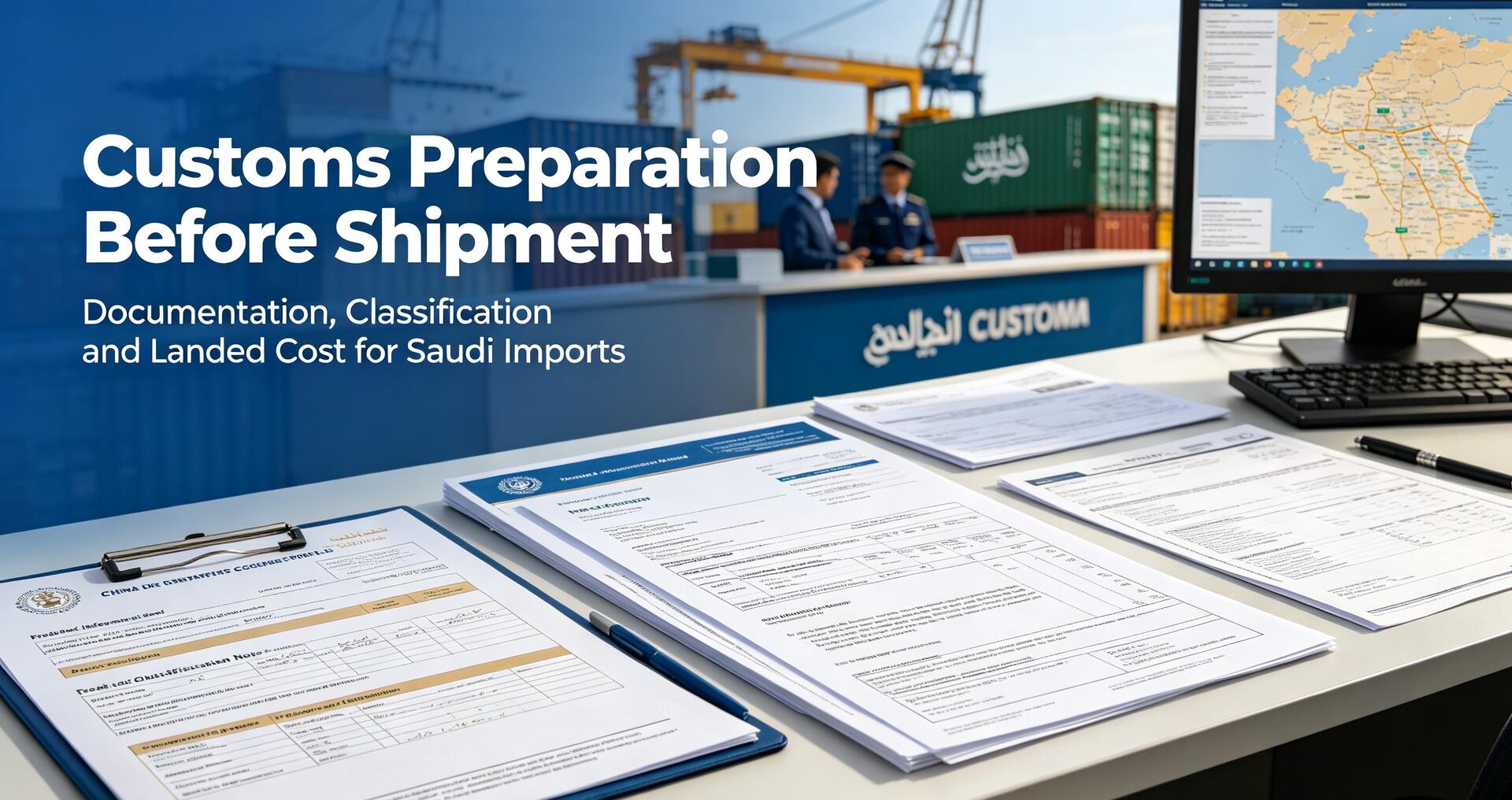
Shipping goods from China to Saudi Arabia is not only a transportation problem; it is also a customs-compliance and documentation problem. A shipment can be physically ready to move while still being unable to clear because the commercial invoice, bill of lading, product information, permits, or customs declaration is incomplete or inconsistent.
This case study examines a practical China-to-Saudi import scenario from a process and compliance perspective. Rather than presenting an invented company, shipment value, or delivery time as a real event, the case uses an illustrative commercial-import workflow and applies requirements published by Saudi Arabia's Zakat, Tax and Customs Authority (ZATCA).
For commercial imports into Saudi Arabia, ZATCA states that importers should prepare documents including a commercial invoice, bill of lading, and certificate of origin where applicable. Product-specific requirements may also include certificates or registrations depending on the goods. ZATCA's current import instructions state that customs procedures should be completed through the Fasah platform before arrival, with the current page specifying submission at least 48 hours before arrival.
Tax and customs costs also need to be considered before the shipment leaves China. ZATCA states that import VAT in Saudi Arabia is generally 15%, while the applicable customs duty depends on the classification of the goods.
The key lesson is straightforward: importers cannot eliminate customs inspections or guarantee a specific clearance time, but they can reduce avoidable delays by preparing accurate documents, confirming product requirements, selecting the correct HS classification, and submitting customs information before the shipment arrives.
International shipping from China to the Middle East often involves several parties: the Chinese supplier, freight forwarder, carrier, customs broker, importer, and destination authorities. When information is passed between these parties, even a small inconsistency can create additional questions during customs clearance.
Saudi Arabia is an especially useful example because importers must comply with customs, tax, and product-specific requirements before goods can be released into the local market.
This case study focuses on Saudi Arabia as the destination market and examines how an importer can structure the process to reduce preventable customs problems.
Important: The shipment scenario below is illustrative. The regulatory requirements and figures cited are based on official sources, but no fictional company, shipment value, transit time, or customs outcome is presented as a real customer result.
Consider a company purchasing commercial goods from a manufacturer in China and arranging delivery to Saudi Arabia.
Before the cargo leaves China, the importer needs to establish several basic facts:
These questions should be answered before shipment, rather than after the cargo reaches the Saudi port or airport.
ZATCA's current import instructions identify the commercial invoice, bill of lading, and certificate of origin as core documents for importers, while also noting that additional documents may be required depending on the nature of the goods.
For regulated or restricted products, the importer may also need approval from another competent authority. ZATCA provides a dedicated process for restricted-goods clearance because some products require authorization before release.
A common mistake is to treat customs clearance as something that happens only after the cargo arrives.
In reality, many clearance problems can be traced back to information prepared earlier in the supply chain.
For example, an importer may provide a product description such as:
"Electronic products"
That description may be too general for accurate customs processing. A more useful commercial description should identify what the product actually is, its intended use, quantity, and other information needed for classification and regulatory review.
The same principle applies to the commercial invoice. The product description, quantity, value, origin, and other shipment information should be consistent across the relevant documents.
ZATCA specifically advises importers to verify the authenticity and accuracy of information attached to customs declarations, including documents such as invoices and bills of lading.
The first operational step is to identify the product correctly.
An importer should prepare a product information sheet containing:
| Information | Purpose |
| Product name | Establishes what is being imported |
| Product function | Helps clarify intended use |
| Material | May affect classification |
| Model or SKU | Identifies the exact product |
| Country of origin | Required for customs documentation |
| Quantity | Supports customs declaration |
| Commercial value | Used in customs and tax calculations |
| HS classification | Determines applicable tariff treatment |
| Certificates | Supports regulated-product compliance |
The exact documentation requirements depend on the product category and destination regulations.
Saudi Arabia's integrated tariff system provides tools for reviewing HS classifications and tariff information. ZATCA explains that classification is governed by the terms of the relevant tariff headings and legal notes rather than simply by a product's marketing name.
That distinction is important for importers. Two products that appear similar from a marketing perspective may have different customs classifications because of their technical characteristics, function, material, or intended use.
Once the product has been confirmed, the next step is document preparation.
At a minimum, an importer should coordinate the commercial invoice, bill of lading or other transport document, certificate of origin where applicable, and any product-specific certificates or approvals.
ZATCA's current import instructions state that customs procedures should be completed through the Fasah platform before the shipment reaches the port of entry. The current guidance specifies completing the customs declaration at least 48 hours before arrival.
There is also an important historical detail worth noting for content accuracy: ZATCA published a November 2024 notice referring to a 72-hour pre-arrival declaration requirement. Its current import-instruction page, updated in August 2026, states 48 hours. For an article intended to remain accurate, the current ZATCA instruction should take priority, while older notices should not be presented as the current rule.
This is exactly why importers should verify destination-country requirements close to the shipment date instead of relying exclusively on an old shipping checklist.
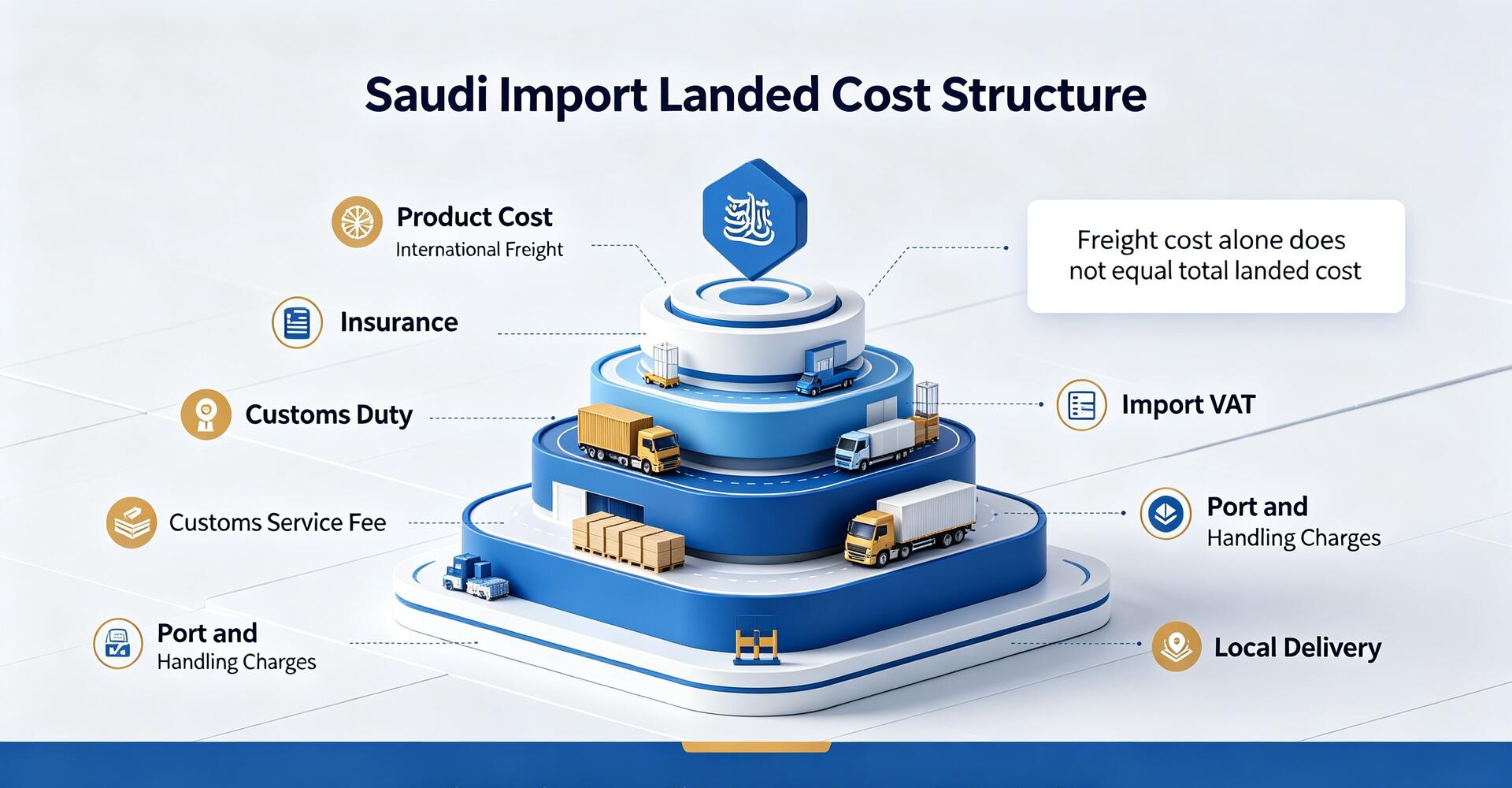
Another important lesson from the case is that freight cost is only one part of the landed cost.
Saudi Arabia applies import VAT, and ZATCA states that VAT on imports is generally 15%. The VAT applies regardless of whether customs duty is applicable, subject to the relevant legal exemptions.
The importer therefore needs to consider:
Landed Cost = Product Cost + International Freight + Insurance Where Applicable + Customs Duty + Import VAT + Customs/Port/Handling Charges + Local Delivery
The exact customs duty cannot be safely estimated from the product's retail category alone. It depends on the applicable tariff classification and relevant rules.
Saudi Arabia also introduced a customs-service fee calculation mechanism. ZATCA states that the import customs declaration processing service fee is calculated at 0.15% of the value of incoming goods, including insurance and shipping, subject to a SAR 15 minimum and SAR 500 maximum, with a special cap for certain VAT-exempt shipments.
This means a professional shipping quotation should distinguish between:
Combining all of these into a single unexplained "shipping fee" can make it difficult for an importer to understand the actual landed cost.
The commercial contract should clearly define who is responsible for transportation, customs clearance, duties, and taxes.
For example, under DAP, the seller generally arranges transportation to the agreed destination, while the buyer is responsible for import clearance and associated import formalities. Under DDP, the seller assumes much broader responsibility, including import clearance and applicable import duties and taxes.
This distinction can materially affect the importer's responsibilities.
A buyer who assumes that "door-to-door" automatically means the supplier will handle all customs obligations may encounter unexpected charges or clearance problems.
Before confirming an order, the buyer and seller should therefore document:
The Incoterm should not be treated as a substitute for a complete commercial agreement.
Before the shipment leaves China, the importer, supplier, and logistics provider can perform a document cross-check.
A practical checklist is:
Check:
Check:
Confirm whether it is required for the specific shipment and whether the information matches the commercial documents.
Confirm whether the goods require:
ZATCA specifically notes that product-specific conditions can vary and recommends checking the applicable tariff and consulting a customs broker where necessary.
The objective of this process is not to guarantee that customs will never inspect a shipment.
Customs authorities retain the right to examine cargo and verify declarations.
Instead, the objective is to reduce avoidable administrative delays.
If the documents are complete, the product is correctly described, the relevant requirements have been checked, and the customs declaration is submitted within the applicable pre-arrival window, the importer is in a much stronger position to respond if customs requests additional information.
ZATCA explains that delays can arise from late declaration submission, inaccurate information, insufficient information, or the need for approval from another authority.
That makes documentation quality an important part of logistics planning—not merely an administrative task.
This case highlights five practical lessons.
Waiting until the cargo arrives at the destination can leave too little time to correct documentation problems.
The commercial description should accurately reflect the actual goods.
The correct tariff classification affects customs treatment and should be verified rather than guessed.
Freight is only one component. Import duty, VAT, customs services, brokerage, handling, and local delivery may also apply.
Customs rules and administrative procedures can change. The current official destination-country guidance should be checked before shipment.
An experienced freight forwarder can help coordinate information between the supplier, carrier, customs broker, and importer.
Typical support may include:
However, logistics providers should not replace the importer's responsibility to ensure that the goods are legally importable and that the information supplied to customs is accurate.
The importer remains responsible for understanding its own regulatory obligations and should obtain professional customs or legal advice for products subject to special regulations.
ZATCA's current import guidance identifies the commercial invoice, bill of lading, and certificate of origin where applicable as key documents. Additional documents may be required depending on the product.
The current ZATCA import-instruction page states that importers should complete the customs declaration procedure through Fasah at least 48 hours before the shipment arrives. Importers should verify the current requirement before each shipment because customs procedures can be updated.
Generally, yes. ZATCA states that VAT is charged at 15% on imports of goods into Saudi Arabia, subject to applicable exemptions.
No shipping provider can legitimately guarantee that a shipment will not be inspected. The practical objective is to reduce preventable delays by ensuring that declarations and supporting documents are accurate and complete.
Not necessarily. DDP places significantly more responsibility on the seller, including import clearance and applicable duties and taxes. DAP generally leaves import clearance to the buyer. The appropriate Incoterm depends on the parties' commercial structure and ability to manage destination-country requirements.
Shipping from China to Saudi Arabia requires more than selecting a freight route and comparing transportation prices. Customs preparation, product classification, documentation, import taxes, regulatory approvals, and Incoterms can all influence the final cost and clearance process.
The most reliable approach is to prepare the customs file before the shipment arrives, verify the current Saudi requirements, use accurate product information, and make responsibilities clear between the importer, supplier, freight forwarder, and customs broker.
The case also demonstrates an important principle for international logistics: good customs compliance cannot guarantee zero inspections, but poor preparation can create avoidable delays.
For importers shipping regularly from China to Saudi Arabia or other Middle Eastern markets, building a repeatable pre-shipment compliance checklist can make the process easier to manage and reduce the risk of last-minute documentation problems.






 Email: