

WORLDWIDE FREIGHT SERVICES
Email: jack@transworldcn.com

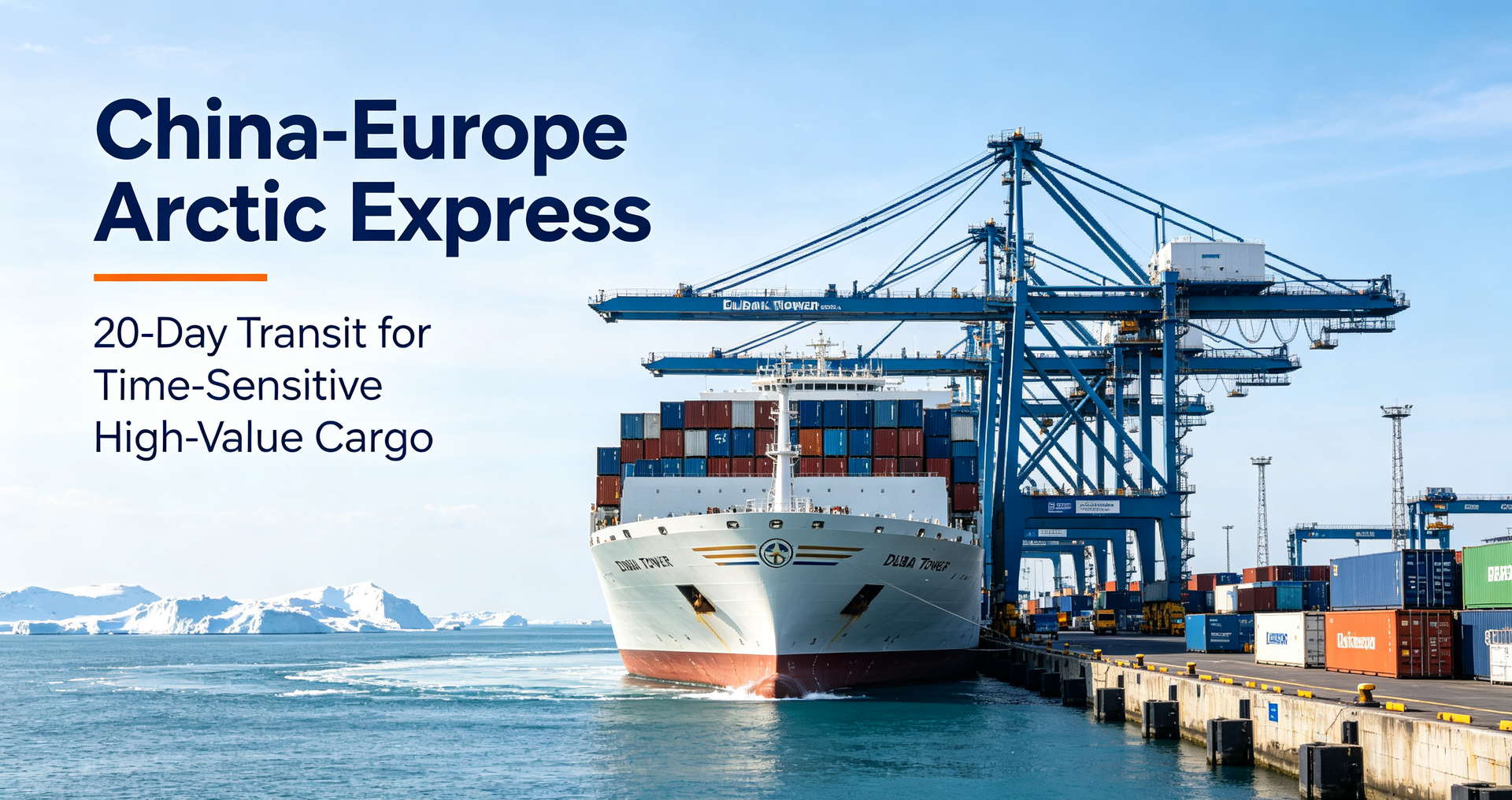
TL;DR – Case Study at a Glance
The Shipment: 27 oversized containers, 4,200+ CBM of telecommunications equipment shipped from Ningbo, China, to the UK and Algeria.
The Challenge: Time-sensitive infrastructure project with strict delivery deadlines. The traditional Suez Canal route took 40+ days; Red Sea disruptions made reliability uncertain.
The Solution: Switched to the Arctic Northeast Passage – the "China-Europe Arctic Express" – a new route opened in 2025 and entering weekly service in August 2026.
The Result: Transit time reduced from 40+ days to just 20 days – a 50% reduction. The route also cut CO₂ emissions by approximately 50% compared to the Suez Canal route.
Key Lesson: New trade routes are emerging in response to geopolitical disruption. For time-sensitive, high-value cargo, alternative routing can transform supply chain competitiveness – but requires planning and early capacity locking.
In August 2026, the "Dubai Tower" container vessel departed Ningbo Zhoushan Port, carrying 768 TEUs of cargo bound for Europe. Among the shipment was a critical order from ZTE Corporation: 27 oversized containers, over 4,200 CBM of telecommunications equipment, destined for a national infrastructure project in Algeria.
This was no ordinary shipment. The cargo was time-sensitive, mission-critical, and required exceptional delivery reliability. The solution? The China-Europe Arctic Express – a new weekly container service via the Arctic Northeast Passage that had just entered regular operation.
For ZTE, this represented a 50% reduction in transit time compared to traditional routes, transforming what had been a logistics challenge into a competitive advantage.
| Parameter | Detail |
| Shipper | ZTE Corporation |
| Shipment | 27 oversized containers, 4,200+ CBM telecommunications equipment |
| Origin | Ningbo, China |
| Destination | Algeria (national infrastructure project) |
| Vessel | "Dubai Tower" – Arctic Express weekly service |
| Transit Time | 20 days |
| Route | Arctic Northeast Passage |
| Result | 50% transit time reduction vs. traditional routes |
ZTE's shipment was not routine inventory replenishment. It was a mission-critical delivery for a national telecommunications project in Algeria. The equipment was oversized and high-value – 27 containers carrying specialized network infrastructure that could not be delayed without impacting project milestones.
Traditional shipping routes from China to Europe and North Africa face significant challenges:
Suez Canal route: Approximately 40 days transit – but subject to disruption. The Red Sea has been volatile since Houthi attacks forced commercial vessels to divert around the Cape of Good Hope, adding 10–15 days and significant cost.
Cape of Good Hope route: Safer but significantly longer – adding weeks to transit and increasing fuel costs and carbon emissions.
The risk: Any delay would cascade through the project timeline, potentially incurring penalties and damaging customer relationships.
In August 2025, the first Arctic container service completed its maiden voyage – the "Istanbul Bridge" reached Felixstowe in just 20 days from Ningbo, compared to 40+ days via traditional routes.
By August 2026, the route had entered weekly regular service for the summer navigation window (August–October), with 8 scheduled voyages. The Arctic route's value proposition was clear:
20 days from China to the UK – half the time of the Suez route and one month faster than the Cape of Good Hope route
40% lower logistics cost compared to China-Europe rail
50% reduction in CO₂ emissions compared to the Suez route
Low-temperature environment – ideal for batteries and sensitive electronics
For ZTE, this was not just a faster option – it was a more reliable one.
Step 1: Route Assessment
ZTE's logistics team evaluated the Arctic route's operational profile:
Week 1: Depart Ningbo, load additional cargo at Shanghai, Taicang, and Qingdao
Week 2–3: Transit the Arctic Northeast Passage – cold-weather-stabilized vessel with ice monitoring systems
Week 4: Arrive Felixstowe, UK, for distribution to European and North African markets
The 20-day transit window matched the customer's delivery requirements perfectly.
Step 2: Capacity Locking
The Arctic Express had limited capacity – 7 ice-class vessels operating 8 voyages during the summer window. ZTE secured space early, booking the 27-container allocation on the "Dubai Tower" voyage.
Step 3: Oversized Cargo Coordination
The 27 containers were oversized, requiring special handling. The Arctic Express's operator had established priority berthing agreements at European ports, ensuring the vessel's "fast, broad, stable" service commitment could be met.
| Route | Transit Time | Cost | CO₂ Emissions |
| Suez Canal (pre-crisis) | ~40 days | Baseline | Baseline |
| Cape of Good Hope | ~50+ days | +20-30% | +20%+ |
| China-Europe Rail | ~15-22 days | ~$7,000/container | Medium |
| Arctic Express | 20 days | 40% less than rail | -50% |
Key outcome: The 20-day transit time represented a 50% reduction compared to traditional ocean routes.
Industry sources estimate the Arctic route's transport cost is approximately 40% lower than China-Europe rail, making it highly competitive even compared to the rail alternative. For ZTE's 27-container shipment, the savings would be substantial.
The Arctic route also offers a strategic benefit: diversification. As one analyst noted, with the Red Sea disrupted and rail routes subject to geopolitical risk (Poland closed border crossings with Belarus in 2025), having an alternative ocean route is crucial for supply chain resilience.
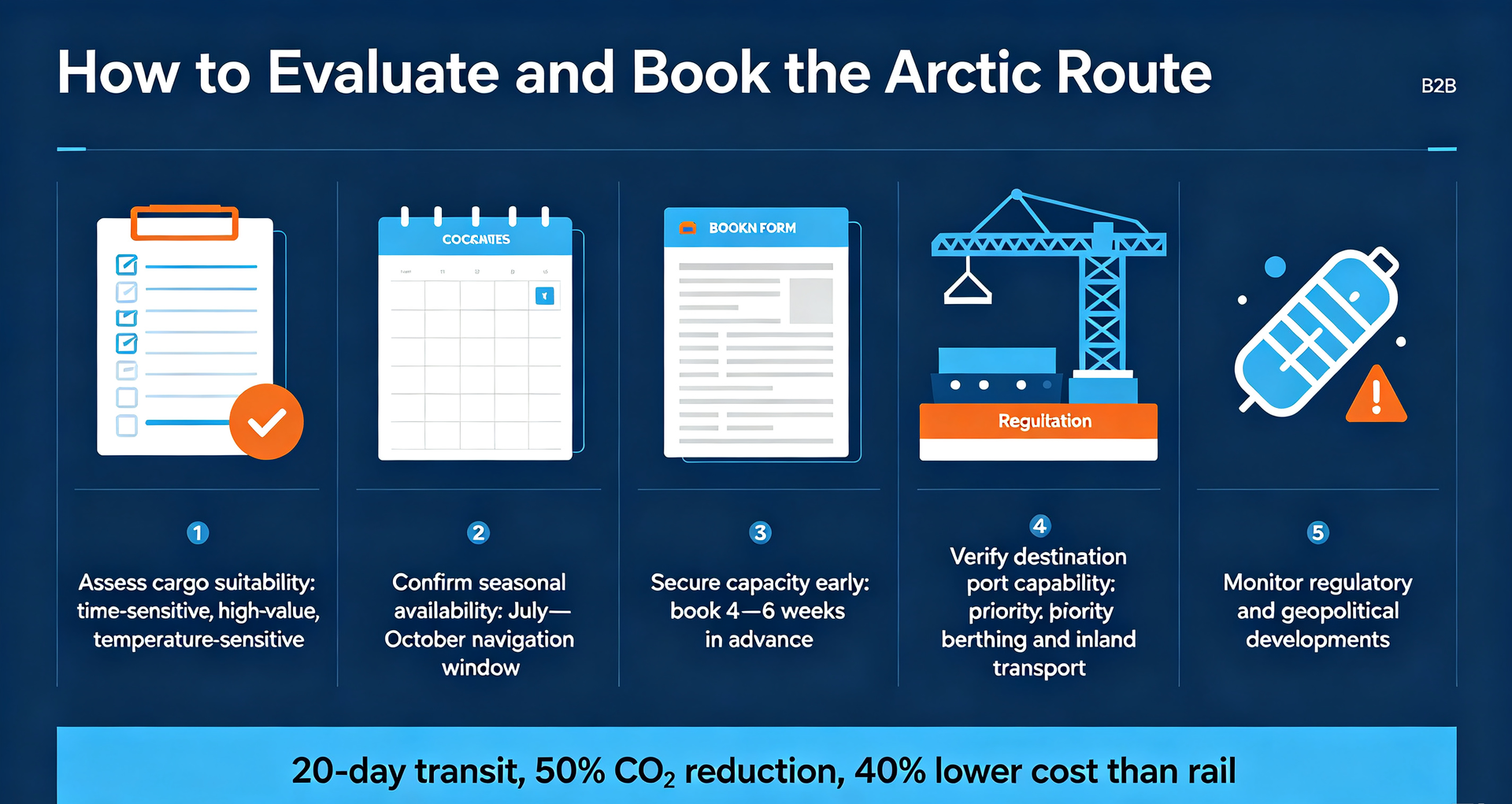
Based on this case study, follow this structured approach:
Step 1: Assess Cargo Suitability
Determine if your shipment is time-sensitive (needs <25 days transit).
Evaluate if cargo value justifies exploring alternative routes.
Consider if cargo is temperature-sensitive – the cold Arctic environment can benefit certain goods.
Step 2: Confirm Seasonal Availability
The Arctic Northeast Passage is currently navigable July–October.
Check operator schedules for the current season.
Step 3: Secure Capacity Early
Arctic Express operates with limited vessels – book 4–6 weeks in advance.
Confirm your forwarder has access to Arctic route capacity.
Step 4: Verify Destination Port Capability
Confirm your destination port has priority berthing agreements.
Ensure inland transport is arranged for oversized cargo.
Step 5: Monitor Regulatory and Geopolitical Developments
Watch for changes in Russian Arctic transit regulations.
Monitor geopolitical developments that could affect route viability.
The Arctic Express is not a one-off experiment. It's now a weekly service during the summer navigation window, with operators planning to extend the navigation season to 5–10 years for year-round operation.
Best Practice: Monitor emerging trade routes. The Arctic route may be seasonal today, but it represents a structural shift in China-Europe logistics.
The Arctic Northeast Passage is only navigable from July to October. ZTE secured space during the August–October window, timing its shipment to match the seasonal availability.
Best Practice: For time-sensitive shipments, plan production and delivery schedules around seasonal route availability.
The Arctic Express operated with 7 vessels and 8 voyages. Capacity was limited, and space was allocated to early bookers.
Best Practice: For alternative routes with limited capacity, secure space well in advance of peak season.
The Arctic route's naturally cold environment is ideal for lithium batteries, electronics, and other temperature-sensitive goods.
Best Practice: If shipping batteries, electronics, or pharmaceuticals, consider whether a cold-weather route reduces packaging and handling costs.
A: The China-Europe Arctic Express is a container service via the Arctic Northeast Passage, connecting Ningbo (China) to Felixstowe (UK) and other European ports in just 20 days – half the time of traditional Suez Canal routes.
A: The Arctic route is approximately 40% cheaper than China-Europe rail, while offering comparable transit times (20 days vs. 15–22 days for rail).
A: Currently, the Arctic route is seasonal – the navigation window is July to October. Operators are planning to extend this to 5–10 years' continuous operation, but it remains a summer solution for now.
A: Time-sensitive, high-value cargo such as telecommunications equipment, lithium batteries, electric vehicles, and consumer electronics benefit most. The cold environment also protects temperature-sensitive goods.
A: Operators have implemented priority berthing agreements at European ports and advanced ice monitoring systems. The route has demonstrated a stable 20-day transit time across multiple voyages since 2025.
A: Seasonal availability, limited capacity, and potential regulatory changes in Russian Arctic waters. The route is best suited for planned shipments rather than emergency restocking.
The ZTE Arctic Express case illustrates a broader trend: the geography of China-Europe trade is being reshaped. New routes are emerging not just as alternatives, but as competitive options that offer measurable advantages in speed, cost, and reliability.
For importers shipping time-sensitive, high-value goods from China to Europe, the Arctic route now presents a viable alternative to traditional ocean and rail options – but only if you plan, lock in capacity early, and monitor the seasonal window.






 Email: