

WORLDWIDE FREIGHT SERVICES
Email: jack@transworldcn.com
TL;DR – Case Study at a Glance
The Shipment: 374 metric tons, 1,850 CBM of breakbulk cargo from 13 suppliers across China, destined for Santos, Brazil.
The Challenge: Coordinating pickups from 13 separate locations, purchasing seaworthy containers, managing heavy-lift cargo (largest unit: 89 tons), and ensuring all documentation complied with Brazilian customs requirements.
The Solution: Full project cargo management – supplier coordination, third-party surveys at every stage, container procurement, and export documentation.
The Result: All cargo successfully consolidated and loaded aboard a vessel bound for Santos. The operation demonstrated that complex multi-supplier breakbulk shipments to Brazil are achievable with specialized project cargo expertise.
Key Lesson: For complex breakbulk shipments to Brazil, success depends on meticulous coordination, third-party quality verification at every stage, and early engagement with Brazilian customs compliance.
Not all cargo fits neatly into a standard 40ft container. Heavy machinery, oversized industrial equipment, and project cargo require specialized handling – and Brazil is one of the most demanding destinations for such shipments.
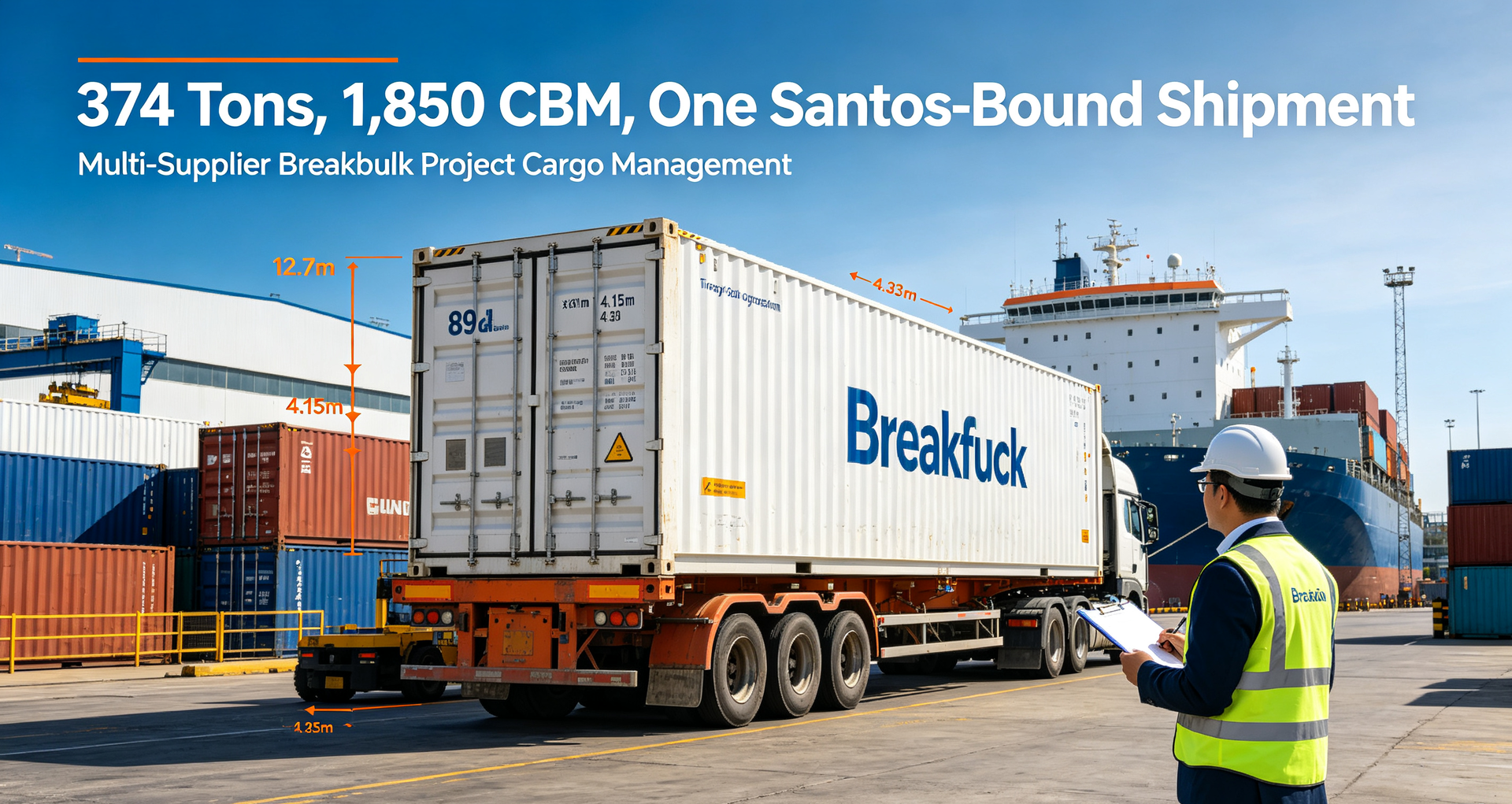
In early 2025, Topline Express Logistics (TEL) completed a complex project cargo consolidation from China to Brazil: 374 metric tons, 1,850 CBM of breakbulk cargo collected from 13 separate suppliers across China, loaded aboard a vessel bound for Santos.
The largest unit measured 12.7 x 4.15 x 4.23 meters and weighed 89 metric tons. This was not a routine LCL consolidation – it was a full-scale project cargo operation requiring meticulous coordination, specialized equipment, and deep understanding of Brazilian import requirements.
| Parameter | Detail |
| Logistics Provider | Topline Express Logistics (TEL) |
| Total Cargo Weight | 374 metric tons |
| Total Volume | 1,850 CBM |
| Supplier Locations | 13 suppliers across China |
| Largest Unit | 12.7m × 4.15m × 4.23m, 89 tons |
| Destination | Santos, Brazil |
| Service Scope | Full project cargo management |
| Key Challenge | Multi-supplier coordination + breakbulk handling + Brazil compliance |
The Challenge: Complexity at Every Level
Coordinating pickups from 13 separate suppliers across China is a logistical puzzle. Each supplier had different production timelines, loading requirements, and documentation practices. The risk of delays compounding across the supply chain was significant.
The cargo included oversized units that could not fit in standard containers. The largest unit – 12.7 meters long, 4.15 meters wide, and 4.23 meters high – weighed 89 metric tons. This required:
Seaworthy container procurement: 6 containers were purchased specifically for this shipment
Heavy-lift handling: Specialized equipment and crane coordination at origin ports
Vessel stowage planning: Breakbulk cargo requires careful weight distribution and segregation
Shipping to Brazil adds another layer of complexity:
NCM code accuracy: Brazil's 8-digit Mercosul HS code extension determines exact duty rates. Misclassification causes approximately 70% of customs delays.
Documentation requirements: Commercial invoices, packing lists, bills of lading, and import licenses must align perfectly.
Tax burden: Brazil's cascading tax structure (II + IPI + PIS/COFINS + ICMS + AFRMM) can add 60–100%+ to CIF value.
For breakbulk cargo, customs clearance is even more scrutinized – any documentation error can trigger "Red Channel" inspection, leading to 5–15-day holds and storage fees.
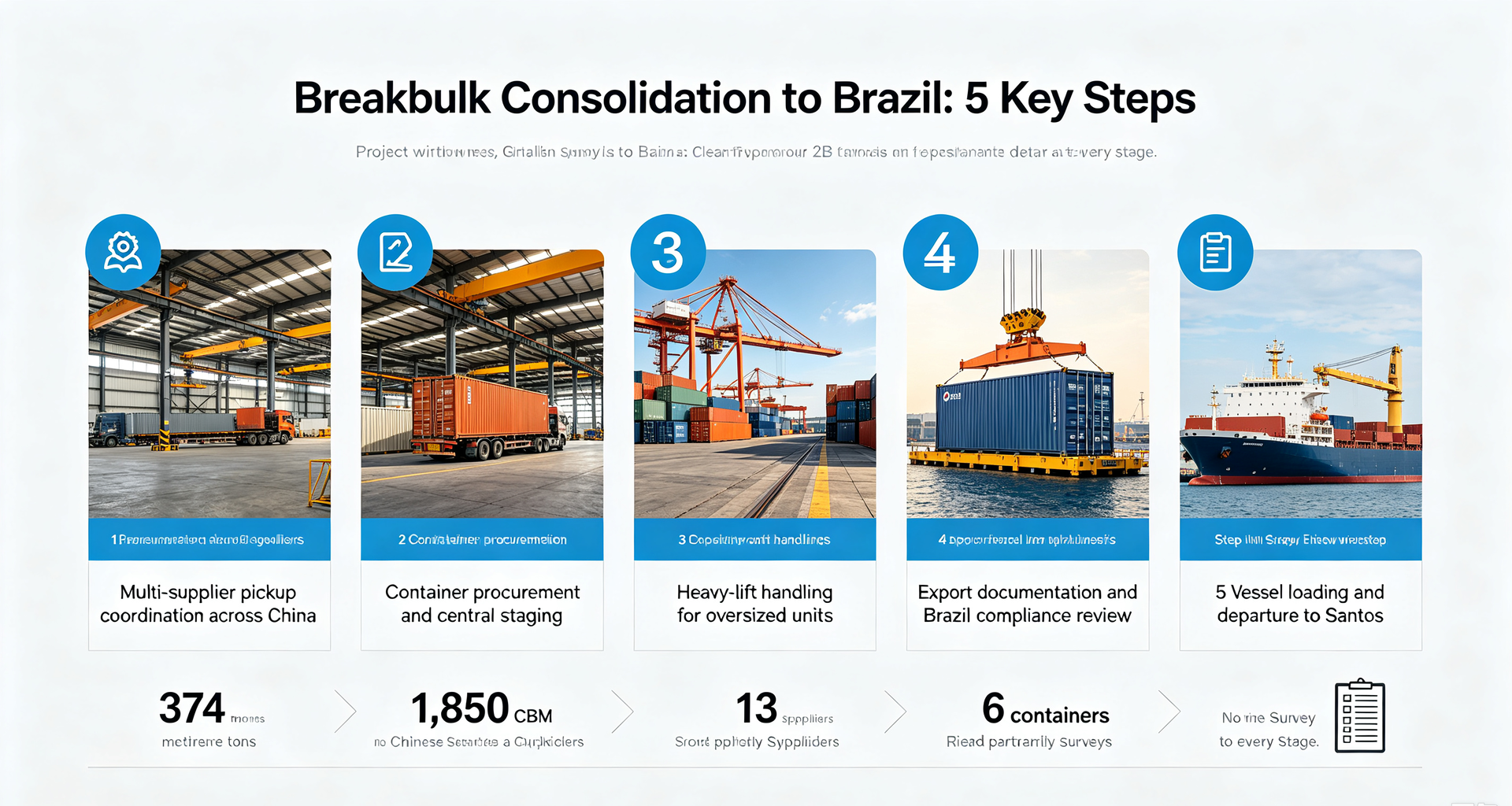
Step 1: Multi-Supplier Pickup Coordination
TEL coordinated pickups from all 13 supplier locations across China.
For each pickup, third-party surveyors were present during truck loading to verify cargo condition and quantity.
Step 2: Container Procurement and Cargo Consolidation
6 seaworthy containers were purchased to accommodate cargo that required enclosed transport.
Breakbulk cargo was consolidated at a central staging point before vessel loading.
Step 3: Heavy-Lift Cargo Handling
The 89-ton unit required specialized lifting equipment and crane coordination.
Third-party surveys were conducted during container loading and ship loading to document condition and handling.
Step 4: Export Documentation and Customs Clearance
All export documentation was prepared and submitted for Chinese customs clearance.
Given Brazil's strict import requirements, documentation accuracy was verified before vessel departure.
Step 5: Vessel Loading and Departure
All cargo was loaded aboard a vessel bound for Santos, Brazil.
Third-party surveyors documented the ship loading process to provide evidence of cargo condition at departure.
Based on this case study, follow this structured approach for your own breakbulk shipment:
Step 1: Assess Cargo Specifications
Obtain precise measurements (length × width × height) for all oversized units.
Verify if any unit exceeds standard container limits (>12m long, >4m wide, >40 tons).
Determine if cargo contains any dangerous goods components.
Step 2: Confirm Brazil Import Compliance
Verify NCM codes with a Brazilian customs broker 10+ days before shipping.
Ensure CNPJ (Brazilian tax ID) appears on all shipping documents.
Declare accurate values – Brazil's customs AI cross-references declared values against market data.
Step 3: Select a Project Cargo Forwarder
Choose a forwarder with breakbulk and heavy-lift capabilities.
Verify crane capacity, seaworthy container sourcing, and vessel stowage planning.
Step 4: Coordinate Multi-Supplier Pickups
Use a single logistics partner to coordinate all supplier pickups.
Conduct third-party surveys during truck loading, container loading, and ship loading.
Step 5: Plan Vessel Stowage
Breakbulk cargo requires careful weight distribution and segregation.
Direct routes reduce transit time by 10–15 days compared to transshipment.
Standard freight forwarders may not have the capabilities for breakbulk and project cargo. The 89-ton unit in this shipment required heavy-lift equipment, crane coordination, and careful stowage planning.
Best Practice: For oversized cargo to Brazil, work with a forwarder that has project cargo capabilities – including heavy-lift handling, seaworthy container sourcing, and vessel stowage planning.
TEL used third-party surveyors at every stage – truck loading, container loading, and ship loading. This documentation serves as critical evidence if cargo arrives damaged or if there are disputes with Brazilian customs.
Best Practice: Invest in third-party surveys for breakbulk and high-value shipments to Brazil. The cost is minimal compared to the risk of customs holds or damage claims.
Brazil's customs system (Siscomex) is unforgiving. Documentation errors that might cause a 1–2 day delay in other markets can trigger 5–15 day "Red Channel" inspections in Brazil, plus storage fees.
Best Practice:
Verify NCM codes with a Brazilian customs broker 10+ days before shipping.
Ensure CNPJ appears on all shipping documents – missing CNPJ = automatic rejection.
Declare accurate values – undervaluation triggers fines of 100–500% of cargo value.
The 13-supplier consolidation succeeded because TEL managed the entire process centrally – not leaving coordination to individual factories. For importers sourcing from multiple Chinese suppliers, a single point of coordination reduces risk and ensures consistent quality.
Best Practice: Use a single logistics partner to coordinate all supplier pickups and consolidation for Brazil-bound shipments.
In July 2026, Zhejiang's first breakbulk route to Brazil was launched, using a "breakbulk + container" mixed loading model that allows both types of cargo on the same vessel. This model reduces transshipment and cuts logistics costs.
Best Practice: For importers shipping both containerized and breakbulk cargo to Brazil, "mixed loading" can reduce costs and simplify coordination.
A: Breakbulk cargo refers to goods that cannot fit in standard containers – oversized machinery, industrial equipment, steel beams, and heavy components. These shipments require specialized handling, lifting equipment, and vessel stowage planning.
A: Container shipping uses standardized ISO containers for cargo under specific size/weight limits. Breakbulk shipping handles cargo that exceeds these limits – items over 12 meters long, over 4 meters wide, or over 40 tons.
A: Breakbulk cargo often has complex NCM code classification (Brazil's 8-digit HS code extension), multiple documentation requirements, and higher scrutiny from Receita Federal. Misclassification causes approximately 70% of customs delays in Brazil.
A: "Mixed loading" allows both breakbulk cargo and containerized goods on the same vessel. This reduces transshipment, cuts logistics costs, and simplifies coordination for importers shipping both types of cargo.
A: Verify NCM codes with a Brazilian broker 10+ days before shipping, declare accurate values, ensure CNPJ appears on all documents, and use precise product descriptions. Consider hiring a Despachante (customs broker) before your cargo arrives.
A: Santos handles the majority of breakbulk imports, but Paranaguá, Rio de Janeiro, and newer direct routes to Manaus and Salvador are gaining popularity. Direct routes reduce transit time by 10–15 days compared to transshipment via Santos.
The 374-ton breakbulk consolidation from 13 Chinese suppliers to Santos demonstrates that complex project cargo to Brazil is achievable – but it requires:
Specialized project cargo expertise – not all forwarders can handle heavy-lift and breakbulk
Meticulous coordination – 13 suppliers, 6 containers, and one vessel departure date
Third-party verification – surveys at every stage reduce risk
Brazil compliance knowledge – NCM codes, CNPJ, and documentation accuracy are non-negotiable
For importers shipping oversized cargo to Brazil, the lesson is clear: invest in experienced logistics partners, plan early, and verify compliance before departure. The cost of mistakes in Brazil is far higher than the cost of preparation.






 Email: