

WORLDWIDE FREIGHT SERVICES
Email: jack@transworldcn.com

TL;DR – Case Study at a Glance
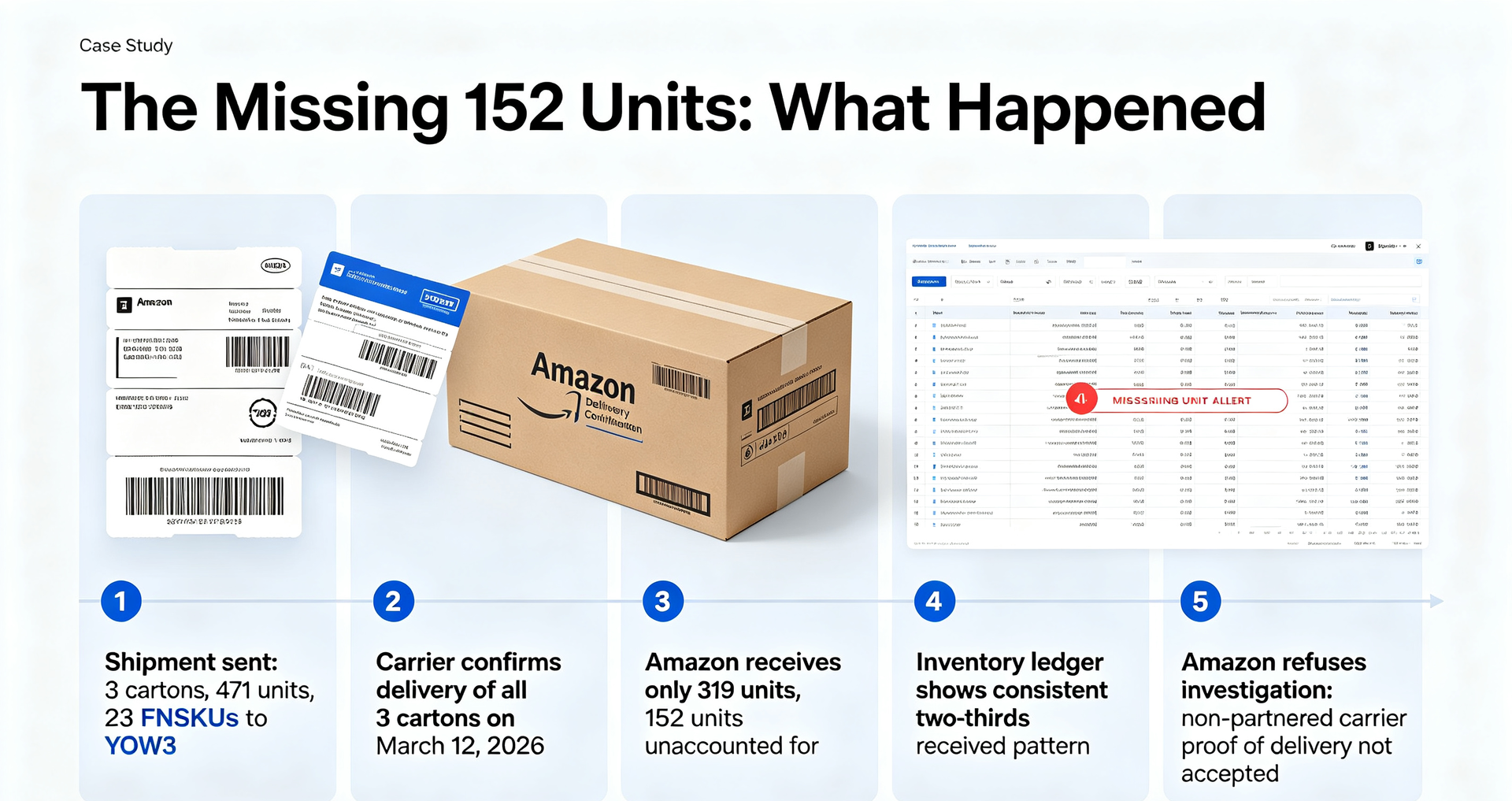
The Shipment: 3 cartons containing 471 units across 23 FNSKUs, shipped from China to Amazon's YOW3 fulfillment center in Canada.
The Problem: Amazon received only 2 of 3 cartons—152 units (approximately one-third of the shipment) went missing. The carrier tracking confirmed delivery of all 3 cartons.
The Crux: Amazon refused to investigate because the shipment was sent with a non-partnered carrier. The carrier's proof of delivery was deemed unacceptable evidence.
The Pattern: Across almost every SKU, Amazon received exactly two-thirds of the expected quantity (e.g., 15 shipped → 10 received), strongly indicating one entire carton was not accounted for.
Key Lesson: For FBA sellers, using Amazon-partnered carriers is not just about convenience—it's about risk protection. Non-partnered carrier shipments leave sellers with limited recourse when inventory disappears after delivery.
On March 12, 2026, Amazon's YOW3 fulfillment center in Canada received a shipment from a third-party carrier. The carrier confirmed delivery of all three cartons. The seller expected 471 units to be checked into inventory.
Amazon processed only 319 units. One entire carton—152 units across 23 FNSKUs—had vanished.
What followed is every Amazon seller's nightmare: no investigation, no reimbursement, and a carrier that said "it was delivered" while Amazon said, "we didn't get it." The seller's only crime? Using a carrier that was not on Amazon's "partnered" list.
| Parameter | Detail |
| Seller | Anonymous FBA seller (Canada marketplace) |
| Shipment ID | FBA198KLZ7JH |
| Origin | China |
| Destination FC | YOW3 (Amazon fulfillment center, Canada) |
| Total Cartons | 3 |
| Total Units | 471 |
| FNSKUs Affected | 23 |
| Missing Units | 152 (approximately one-third of the shipment) |
| Carrier Type | Non-partnered carrier |
| Amazon's Response | Refused investigation; proof of delivery from non-partnered carrier not accepted as evidence.e |
The seller analyzed Amazon's Inventory Ledger and discovered a striking pattern. For almost every SKU, Amazon received almost exactly two-thirds of the expected quantity:
| Shipped | Received | Missing |
| 15 units | 10 units | 5 units |
| 30 units | 20 units | 10 units |
| 45 units | 30 units | 15 units |
| 6 units | 4 units | 2 units |
| 9 units | 6 units | 3 units |
This consistent two-thirds pattern strongly indicated that two cartons were processed correctly, while one entire carton was never accounted for.
The seller downloaded and analyzed the detailed Amazon Inventory Ledger. Amazon's own records showed:
On March 12, 2026, fulfillment center YOW3 received the affected FNSKUs under shipment reference FBA198KLZ7JH.
The quantities recorded corresponded almost exactly to two-thirds of the quantities shipped.
There was no later receipt corresponding to the missing 152 units.
There was no "found inventory" adjustment remotely close to the missing 152 units.
No other inbound shipment appeared to contain the missing assortment.
The evidence was as clear as it could be: 2 of 3 cartons were processed while the third carton disappeared.
Amazon's response was stark: because the shipment was sent with a non-partnered carrier, the carrier tracking/proof of delivery was not acceptable evidence. Amazon therefore refused to investigate the missing carton.
The seller's frustration: Using a non-partnered carrier cannot mean that Amazon can receive a shipment, lose one carton after delivery, and then simply refuse to investigate because the delivery evidence comes from an independent carrier.
Amazon's stated position, repeated across similar cases, is that "proof of delivery only confirms that the carrier made a delivery at our fulfillment center and isn't confirmation that Amazon received the exact items and quantities stated in your shipping plan."
This case is not isolated. Across Amazon Seller Central forums, sellers report similar experiences:
A seller in Brazil lost 1,000 units and 384 units across two shipments—also sent with non-partnered carriers. Amazon's response was identical: proof of delivery does not confirm receipt.
A seller in India had 1 of 8 cartons "not shipped" despite tracking confirming delivery to the fulfillment center.
The common thread: When inventory disappears after delivery, sellers using non-partnered carriers have limited recourse. Amazon shifts the burden to the carrier—but the carrier says they delivered.
Amazon offers Partnered Carrier Program (PCP) options, including:
Amazon Global Logistics (AGL): Amazon's own ocean and air freight service from origin to FBA.
Amazon-partnered LTL/FTL carriers: For U.S. domestic transport.
Key advantage: When you use an Amazon-partnered carrier, the shipment is under Amazon's logistics umbrella. If inventory goes missing, Amazon is more likely to accept responsibility—and there is a clearer dispute resolution path.
For sellers sourcing from China, using a non-partnered carrier can appear cheaper. A freight forwarder may offer a lower rate than AGL or an Amazon-partnered option.
However, the cost of a 152-unit loss—including product cost, shipping cost, lost revenue, and customer trust—far outweighs any carrier savings.
In this case, the seller saved perhaps a few hundred dollars on carrier fees. The loss was 152 units of inventory plus the time spent disputing with Amazon.
Based on this case and industry best practices, follow this structured approach:
Step 1: Choose an Amazon-Partnered Carrier Where Possible
For U.S. and Canadian shipments, use Amazon Global Logistics (AGL) or an Amazon-partnered LTL carrier.
AGL integrates with Seller Central, offers instant freight quotes, and provides carton labels directly.
If you use a third-party freight forwarder, verify they use Amazon-partnered carriers for the final leg to the FC.
Step 2: Use Amazon's Supply Chain Services
Companies like Avacraft have shifted their entire supply chain to Amazon's services (AGL, AWD) to simplify operations. As Avacraft's CEO noted: "I used to spend five to six hours every day on supply chain tasks, and now it's down to five to six hours per week."
Benefits:
Pre-loaded product specifications
Automated inventory replenishment through AWD
Direct communication between AGL and manufacturers
Step 3: Label Every Carton Correctly
Each carton must have its own unique FBA box ID label.
Do not photocopy, reuse, or modify labels.
Apply labels to a flat, visible surface—not over seams or openings.
Step 4: Use a Professional Freight Forwarder with FBA Experience
A professional forwarder can help avoid common pitfalls:
Pre-shipment inspection: Carton integrity check, FNSKU label scannability verification, outer packaging confirmation.
Cargo insurance: Cover transit loss and damage risks.
DDP terms: Prepay duties and taxes to avoid customs delays.
Sorting and tracking: Provide individual tracking numbers for each carton in an Excel format for direct upload to Amazon Seller Central.
Step 5: Ship to Yourself First (for New Products)
For first-time sellers, the best advice is to ship products to yourself first. Examine everything:
Does the product count match?
Are the different SKUs labeled correctly?
Open a few at random—are they complete and working?
Only once everything is confirmed should you send to Amazon.
The 152-unit loss at YOW3 demonstrates that carrier choice is a risk decision, not just a cost decision. Using an Amazon-partnered carrier provides a clear path for dispute resolution if inventory goes missing after delivery.
Best Practice: Use Amazon Global Logistics (AGL) or ensure your freight forwarder uses Amazon-partnered carriers for the final delivery leg to the fulfillment center.
Amazon's position is clear: proof of delivery from a non-partnered carrier is not considered evidence of receipt. This means even with tracking confirming delivery, sellers have no recourse.
Best Practice: The safest approach is to ship via partnered carriers and use Amazon's own supply chain services where possible.
A professional freight forwarder provides pre-shipment inspection, cargo insurance, and compliance validation. While there is a cost, it protects against the far greater cost of inventory loss.
Best Practice: Work with a forwarder that offers FBA-specific services: label verification, carton integrity checks, and DDP terms.
For new product launches, shipping a sample order to yourself before sending to Amazon allows you to verify product quality, labeling, and packaging before committing to a large shipment.
Best Practice: Order a small quantity from your supplier, inspect everything, and only then scale up to FBA shipments.
A: Amazon's PCP offers discounted shipping rates with pre-approved carriers. When you use a partnered carrier, Amazon provides tracking integration and streamlined dispute resolution. Using non-partnered carriers—as in the case study—can leave sellers with limited recourse if inventory goes missing.
A: AGL is Amazon's own ocean and air freight service for FBA sellers. It handles the entire shipping process from origin (China) to the fulfillment center. Avacraft, a premium cookware company, uses AGL to simplify documentation and reduce time spent on logistics.
A: Amazon Warehousing and Distribution (AWD) is Amazon's bulk storage solution. It automatically replenishes FBA inventory when levels are low. For sellers shipping from China, AWD can reduce the pressure to send large shipments directly to FBA, minimizing the impact of any single shipment's loss.
A: If you used a non-partnered carrier, Amazon may refuse to investigate. Your recourse is to file a claim with the carrier—but the carrier will likely say they delivered. Best practice is to use partnered carriers and document everything.
A: For sellers with consistent regular shipment demands, AGL can reduce administrative overhead and simplify dispute resolution. The "right" choice depends on shipment volume, frequency, and your risk tolerance. For new or small-volume sellers, a professional freight forwarder with partnered carrier access may be a practical alternative.
The 152-unit FBA shipment loss at YOW3 illustrates a fundamental principle of cross-border e-commerce: shipping is not just about cost—it's about risk.
Choosing a non-partnered carrier to save a few dollars per carton can expose you to the risk of inventory loss with limited recourse. When the carrier says "it was delivered" and Amazon says "we didn't get it," sellers are left with no path to recovery.
For sellers shipping from China to North America, the safest approach is to:
Use Amazon-partnered carriers where possible—or ensure your freight forwarder does.
Leverage Amazon's supply chain services (AGL, AWD) to simplify operations and improve accountability.
Partner with an experienced freight forwarder that provides pre-shipment inspection, cargo insurance, and compliance validation.
Document everything—and ship to yourself first for new product launches.






 Email: