
WORLDWIDE FREIGHT SERVICES
Email: jack@transworldcn.com
TL;DR – Case Study at a Glance
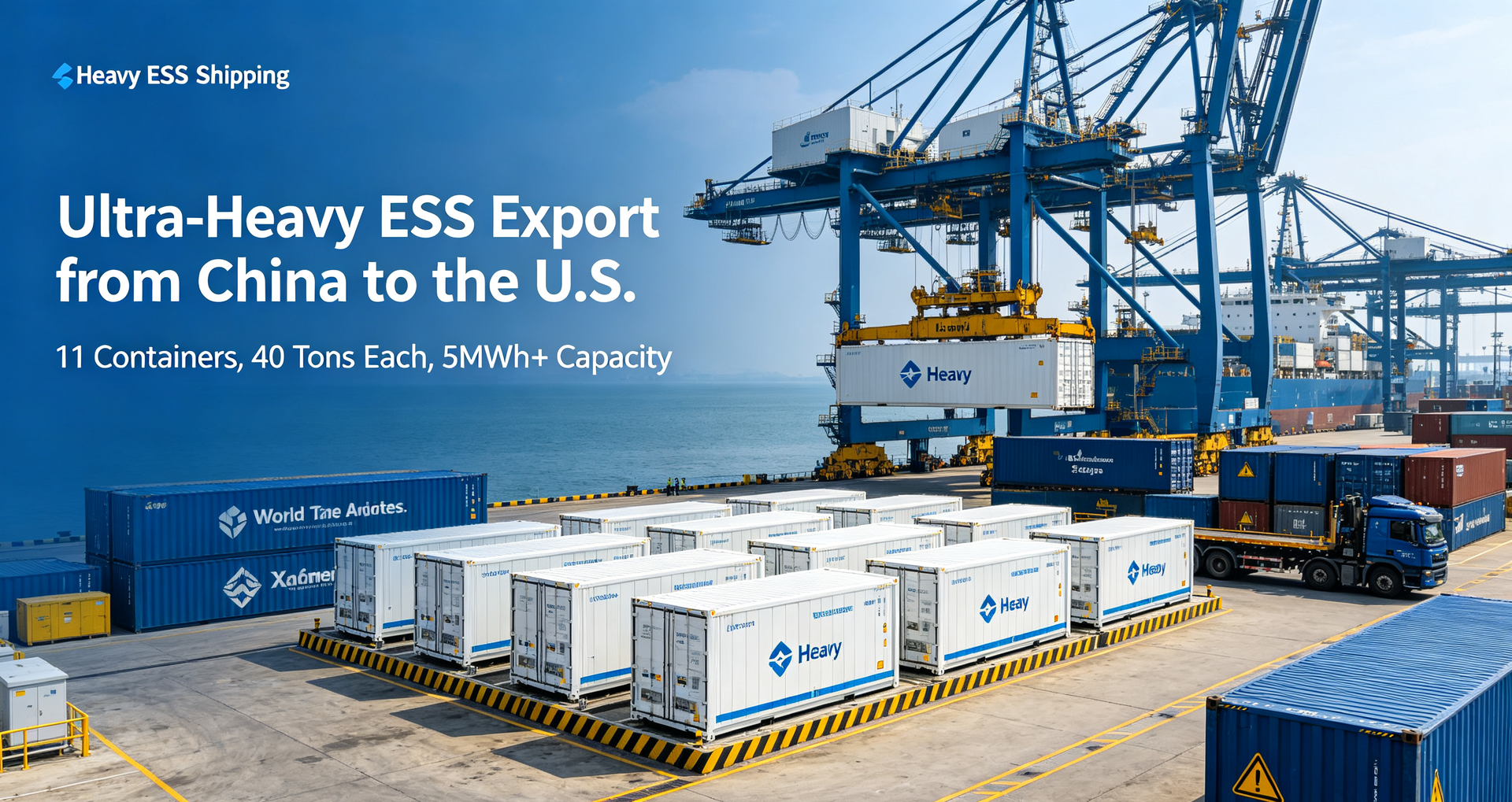
The Shipment: 11 containerized lithium battery energy storage systems (ESS), each weighing 40 tons with over 5MWh capacity – the heaviest and most powerful ESS units ever exported from Xiamen Port.
The Challenge: Each unit weighed 40 tons (exceeding standard container weight limits), contained hazardous lithium batteries, and required specialized handling, dangerous goods compliance, and coordinated port operations.
The Solution: Xiamen Port Authority, Maritime Safety Administration, and the free trade zone jointly issued China's first maritime safety transport guideline for containerized lithium battery ESS, establishing dedicated hazardous cargo storage areas, specialized lifting equipment, and vessel stowage protocols.
The Result: All 11 units were safely loaded aboard the container ship "Zhonghai Huanghai" and departed for the Port of Los Angeles – successfully opening a new export corridor for ultra-heavy energy storage equipment.
Key Lesson: For lithium battery and OOG cargo, regulatory cooperation, port infrastructure investment, and specialized handling protocols are as critical as documentation compliance.
On February 23, 2025, a shipment of 11 containerized lithium battery energy storage systems (ESS) departed Xiamen Haicang Port aboard the Hong Kong-flagged container vessel "Zhonghai Huanghai," bound for the Port of Los Angeles.
This was no ordinary container shipment. Each unit weighed 40 tons and exceeded 5MWh in battery capacity – breaking Xiamen Port's records for both the heaviest and most powerful ESS units ever exported. The shipment represented the first successful export of ultra-heavy ESS containers from Xiamen, and it required an entirely new logistics framework.
| Parameter | Detail |
| Shipper | Xiamen Hithium Energy Storage Technology Co., Ltd. – ranked third in global battery storage shipments in 2024 |
| Product | Containerized lithium battery energy storage systems (ESS) – 11 units |
| Specifications | Each unit: 40 tons,> 5 MWh capacity |
| Destination | Port of Los Angeles – for U.S. renewable energy projects |
| Departure Port | Xiamen Haicang Port – first export of this type |
| Vessel | "Zhonghai Huanghai" – Hong Kong-flagged container ship |
| Key Challenge | Exceeded standard weight limits; hazardous cargo classification; required new port protocols |
| Result | Successful export with new safety guideline established |
Standard 40ft containers have a maximum payload of approximately 26–28 tons. At 40 tons, each ESS unit exceeded typical container weight limits.
Why this matters:
Crane capacity: Standard port cranes may not be rated for 40-ton single-lift containers.
Vessel stowage: Heavy containers must be stowed on the vessel's bottom tiers, requiring precise load planning.
Chassis availability: U.S. inland transport of 40-ton units requires specialized heavy-lift chassis and permits.
Each ESS unit contained large-format lithium-ion batteries, classified as Class 9 dangerous goods under the IMDG Code. The 5MWh+ capacity meant this was not a standard battery shipment—it required specialized dangerous goods handling:
UN number determination: For large-scale stationary battery energy storage systems, UN3536 applies – requiring stowage "on deck only" with fire access maintained.
Packaging compliance: The container itself serves as the packaging and must meet structural integrity requirements for transport.
Thermal runaway risk: The sheer scale of the battery bank presented elevated thermal risk during ocean transport.
At the time of this shipment, China lacked a standardized safety guideline specifically for maritime transport of containerized lithium battery ESS. The 40-ton weight and hazardous classification meant existing protocols for standard DG cargo were insufficient.
Step 1: Establish a Regulatory Framework
The solution required collaboration across multiple agencies: Xiamen Port Authority, Xiamen Maritime Safety Administration, Xiamen Free Trade Zone Administration, and Xiamen Haicang Port.
These agencies jointly issued China's first-ever maritime safety transport guideline for containerized lithium battery energy storage systems, establishing protocols for packaging and labeling, vessel stowage and segregation, and emergency response procedures for thermal incidents.
Step 2: Upgrade Port Infrastructure
Xiamen Port invested in dedicated handling facilities: four dedicated hazardous cargo container yards for DG storage and staging, specialized lifting equipment capable of 40-ton lifts, and optimized loading/unloading protocols including controlled lowering speeds and crane positioning.
Step 3: Coordinate Vessel Stowage
The "Zhonghai Huanghai" required specialized stowage planning. Heavy ESS containers were placed in bottom-tier slots to maintain vessel stability. DG containers were stowed on deck per IMDG Code requirements for UN3536. Segregation from oxidizers, foodstuffs, and heat sources was maintained.
Step 4: Execute Loading Operations
On February 23, 2025, all 11 units were successfully loaded at Xiamen Haicang Port's Yuandai Terminal. The vessel departed for the Port of Los Angeles, marking the successful opening of a new export corridor for ultra-heavy ESS equipment.
Based on this case study, follow this structured approach for your own ESS shipment:
Step 1: Confirm UN Classification and Regulatory Status
Verify if your ESS falls under UN3536 (large-scale stationary battery systems) or other applicable UN numbers.
Confirm with your forwarder that stowage requirements (on deck only for UN3536) are feasible for your vessel and destination port.
Step 2: Obtain All Required Certifications
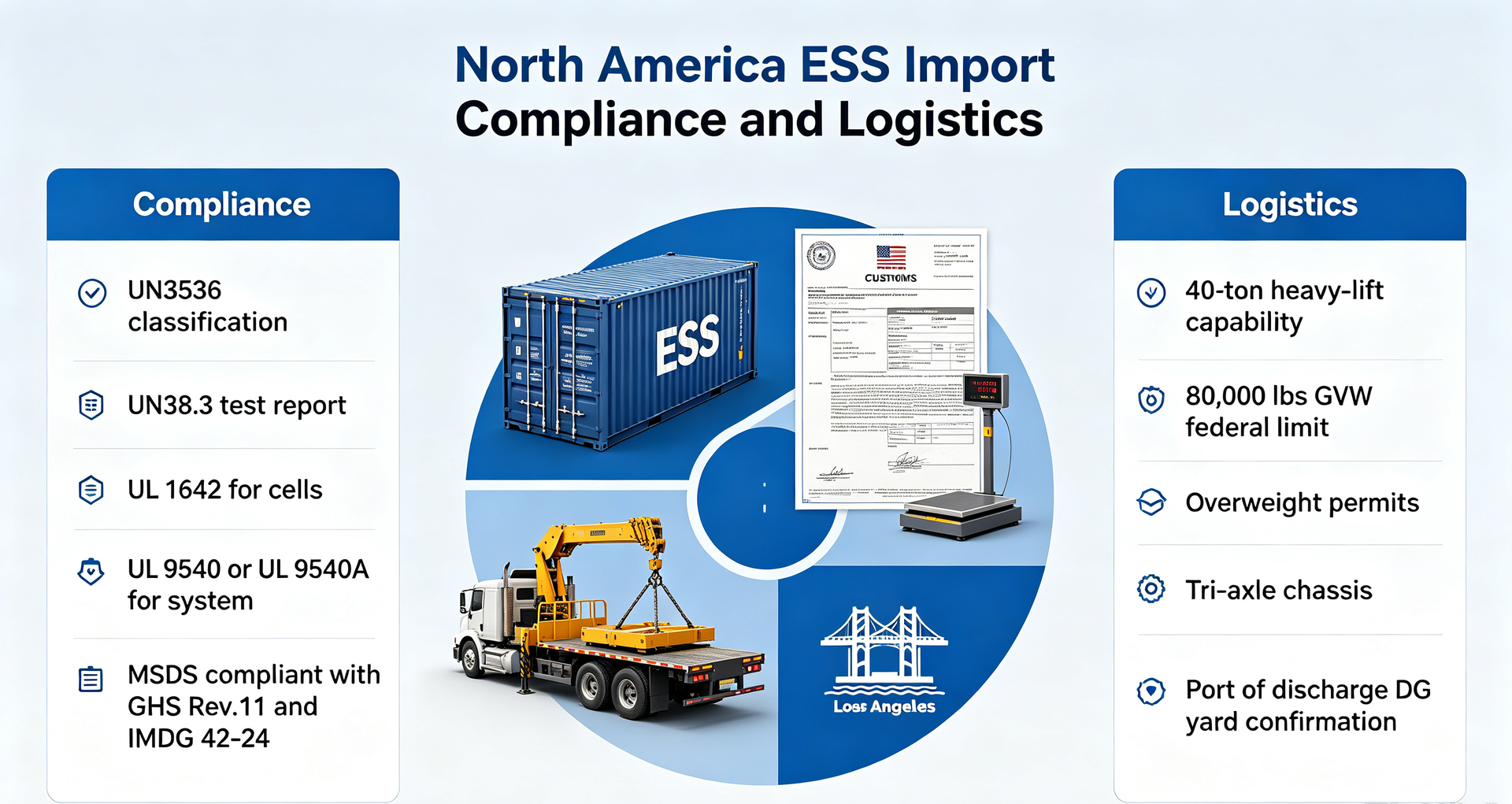
Complete UN38.3 testing for each battery cell type at a CNAS-accredited laboratory.
Obtain UL 1642 certification for battery cells – increasingly required by U.S. customs and platforms.
Obtain UL 9540 or UL 9540A for the complete ESS system (thermal runaway propagation testing).
Prepare an MSDS compliant with GHS Rev.11 and IMDG 42-24 standards.
Obtain the Dangerous Goods Packaging Use Certificate from Chinese customs.
Step 3: Verify Port Capabilities at Origin and Destination
Confirm origin port has heavy-lift cranes rated for 40+ ton single-lift containers.
Confirm origin port has dedicated dangerous goods yards and DG handling protocols.
Confirm destination port (e.g., Los Angeles, Long Beach) has heavy-lift capability and DG yards for discharging and staging.
Step 4: Plan Vessel Stowage with Carrier
Ensure the carrier can accommodate on-deck stowage for UN3536 cargo.
Confirm bottom-tier placement for weight distribution.
Verify segregation requirements are met.
Step 5: Plan U.S. Inland Transport for Overweight Cargo
Weight limit: U.S. federal truck weight limit is 80,000 lbs (36,287 kg) GVW. At 40 tons (80,000 lbs) per unit, the cargo alone reaches the federal limit.
Obtain overweight permits ($20–100 per state) before the vessel arrives.
Arrange tri-axle chassis rental ($100–300 per trip) – standard chassis cannot handle 40-ton loads.
Plan route to avoid low bridges and weight-restricted roads.
Confirm availability of heavy-lift chassis at the destination port.
Step 6: Coordinate Documentation and Customs Clearance
Submit ISF filing 24 hours before vessel loading.
Prepare commercial invoice, packing list, and bill of lading with accurate weight and DG classification.
Ensure UL 1642 and UL 9540/9540A certificates are included in the customs package.
Verify Section 301 tariff classification and country of origin documentation.
This shipment is not an isolated event. As global energy storage demand grows, U.S. importers are increasingly sourcing large-scale ESS from Chinese manufacturers. Hithium itself ranked third in global battery storage shipments in 2024, with a 10% market share – and is reportedly planning an IPO to fund further U.S. market expansion.
For North American importers, this case demonstrates that ultra-heavy battery imports are becoming a regular trade lane – but they require specialized logistics partners with DG expertise, port coordination capabilities, and U.S. inland transport planning for overweight cargo.
The Xiamen shipment succeeded because regulatory agencies created a new framework. For importers, this means:
Expect new regulatory requirements: The U.S. is also developing specialized rules for large-scale ESS imports. Stay ahead of the curve by working with forwarders who track regulatory developments in both China and the U.S.
Port readiness matters: Not every U.S. port has heavy-lift cranes and DG yards ready for 40-ton ESS imports. The Port of Los Angeles does – but importers should confirm port capabilities for their specific discharge location.
For large-scale ESS imports to the U.S., the documentation checklist goes beyond standard DG cargo:
| Document | Requirement |
| UN38.3 Test Report | For each battery cell type |
| MSDS | Compliant with GHS Rev.11 and IMDG 42-24 |
| UL 1642 Certification | Battery cell safety – required by U.S. Customs |
| UL 9540 or 9540A | Full ESS system thermal runaway testing |
| Dangerous Goods Packaging Use Certificate | Dangerous Goods Packaging Use Certificate |
| Container Structural Integrity | ISO container certification for 40-ton load |
The Xiamen shipment succeeded because the port invested in dedicated DG yards, 40-ton cranes, and specialized protocols. Not every Chinese port has this capability – and not every U.S. port does either.
Best Practice: Confirm port capability and dangerous goods handling capacity before booking an ultra-heavy battery shipment.
The Xiamen Port Authority, Maritime Safety Administration, and Free Trade Zone jointly created the first guideline for maritime ESS transport. This regulatory collaboration eliminated ambiguity and enabled the shipment.
Best Practice: For first-of-its-kind shipments, engage regulators early. In the U.S., this may involve pre-clearance with CBP, the Coast Guard, and local port authorities.
At 40 tons, these units pushed the limits of both port cranes and U.S. trucking. The cargo weight alone reaches the federal 80,000 lbs limit – meaning overweight permits and tri-axle chassis are required for any inland transport.
Best Practice: Plan U.S. inland transport before the shipment arrives. Overweight permits take time, and chassis availability can be limited. Budget for state overweight permit fees ($20–100 per state).
Beyond basic dangerous goods compliance, U.S. regulators and platforms increasingly require:
UL 1642 certification for all lithium battery cells – this is now standard for customs clearance.
UL 9540 or UL 9540A for large-scale ESS – proving thermal runaway resistance.
Proper HS code and Section 301 tariff classification – these units may face additional duties based on country of origin.
Best Practice: Verify UL certifications before the shipment leaves the factory – testing delays can hold up the entire container.
A: An ESS is a large-scale lithium battery system packaged in a standard ISO container, used for renewable energy storage, grid stabilization, and industrial backup power. As energy density increases, ESS units now routinely exceed 5MWh capacity and 40 tons in weight.
A: For large-scale stationary battery energy storage systems, UN3536 applies. Under the IMDG Code, UN3536 requires stowage "on deck only" with fire access maintained – these containers cannot be stowed inside the vessel's hold.
A: At minimum: UN38.3 test reports for individual battery cells, UL 1642 certification for cells, and UL 9540 or UL 9540A for the complete system (thermal runaway testing). U.S. Customs may also require Section 301 tariff classification and country of origin documentation.
A: The federal truck weight limit is 80,000 lbs GVW (gross vehicle weight – truck + chassis + container). At 40 tons (80,000 lbs), the cargo alone reaches the federal limit – requiring overweight permits and tri-axle chassis for inland transport.
A: Not all ports have heavy-lift cranes rated for 40-ton single-lift containers. Importers should confirm the discharge port's heavy-lift capability, dangerous goods yards, and chassis availability before booking.
A: The Dangerous Goods Packaging Use Certificate is issued by Chinese customs confirming that the container packaging for dangerous goods has passed inspection and meets transport safety standards. Without this certificate, the shipment cannot be legally exported from China.
The Xiamen-to-Los Angeles ESS shipment set a precedent: ultra-heavy battery imports are no longer experimental. They are a regular, growing trade lane driven by global renewable energy demand.
For North American importers, the lessons are clear:
Invest in compliance early: UL certifications, UN38.3 testing, and proper UN number classification take time – plan ahead.
Choose ports with heavy-lift and DG capability – not every port can handle 40-ton containers.
Plan U.S. inland transport – overweight permits, tri-axle chassis, and route planning must be completed before the vessel arrives.
Work with an experienced forwarder who understands both lithium battery compliance and OOG/heavy cargo logistics.





 Email: