

WORLDWIDE FREIGHT SERVICES
Email: jack@transworldcn.com

Amazon AWD Europe is scheduled to begin accepting inbound shipments on August 17, 2026. The service expands Amazon’s upstream inventory network into Europe, giving sellers an additional option for managing bulk inventory.
The new AWD facilities will support sellers operating across major European markets, including:
Unlike traditional FBA storage, which focuses primarily on order fulfillment, Amazon AWD is designed for bulk inventory storage and distribution.
The basic supply chain structure becomes:
Supplier → Amazon AWD Warehouse → Amazon FBA Fulfillment Center → Customer
This model allows sellers to keep larger inventory reserves closer to customers while reducing dependence on direct FBA inbound shipments.
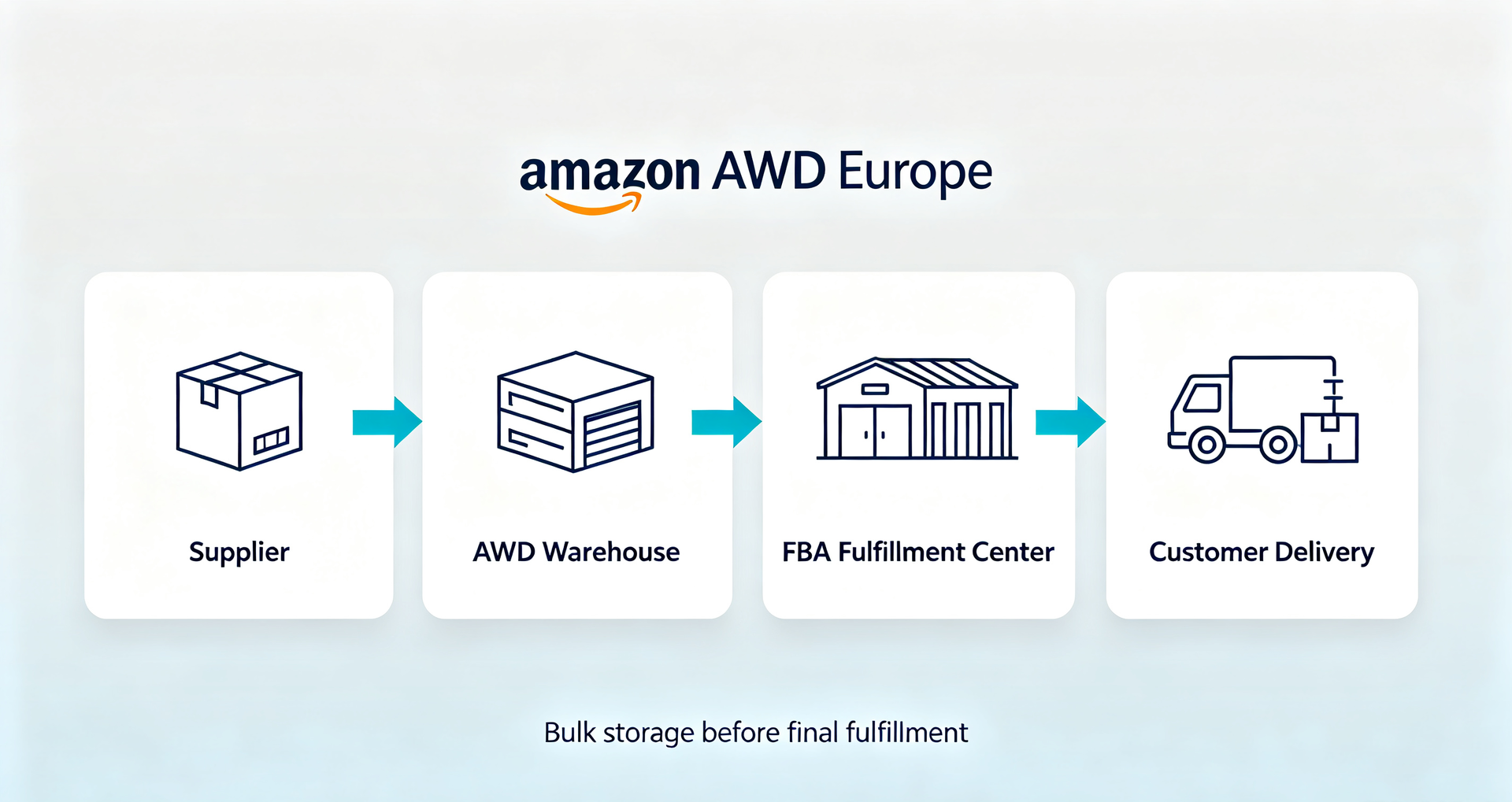
Amazon AWD Europe is a bulk inventory management solution designed to support FBA sellers.
Traditional Amazon FBA requires sellers to send inventory directly to fulfillment centers. While this model provides fast delivery, sellers may face challenges during high-demand periods when FBA storage space becomes limited.
Amazon AWD creates an additional inventory layer before products enter FBA.
Through AWD, sellers can:
For businesses selling high-volume products, AWD provides a more predictable way to manage inventory throughout the year.
The growth of European ecommerce has increased the need for more flexible inventory strategies.
Many Amazon sellers previously relied on sending large quantities directly into FBA. However, this approach can create several challenges:
Amazon AWD Europe provides sellers with another option by separating bulk storage from final fulfillment.
Potential benefits include:
By keeping inventory within Amazon’s distribution network, sellers may reduce the risk of running out of stock during important sales periods.
Prime events, holiday promotions, and seasonal campaigns often create sudden demand increases. AWD allows sellers to prepare inventory earlier.
Businesses can better coordinate production schedules, international shipping, and demand in the European marketplace.
Although Amazon AWD Europe provides new opportunities, not every seller will automatically qualify.
Sellers should review several requirements before preparing shipments.
Businesses selling through European Union marketplaces may need to:
VAT compliance is especially important because inventory stored in Europe may involve multiple tax jurisdictions.
Sellers should confirm their registration status before sending inventory to Amazon AWD facilities.
The UK AWD network operates separately from the European Union system.
UK sellers generally need:
Because the UK and EU operate under different customs and tax frameworks, sellers must plan inventory separately for both markets.
Understanding storage costs is an important part of Amazon AWD planning.
Amazon AWD charges may include:
For sellers, inventory costs should not only be calculated by product quantity.
Storage expenses are influenced by:
Large but lightweight products may incur higher storage costs because storage costs are often related to physical volume.
Therefore, sellers should evaluate inventory efficiency before moving large quantities into AWD.
Before shipping products to Amazon AWD Europe, sellers should verify all inbound requirements.
Common requirements include:
Certain products may not qualify for AWD, including:
For overseas manufacturers, these requirements should be reviewed before goods leave the production facility.
Early preparation can help reduce receiving delays and unexpected logistics costs.

For Chinese manufacturers and cross-border ecommerce businesses, Amazon AWD Europe creates new opportunities but also requires better supply chain planning.
Before using AWD, sellers should focus on four areas.
Confirm that products meet Amazon requirements before arranging international transportation.
Sellers should understand their VAT obligations before storing inventory in European warehouses.
Because EU AWD and UK AWD inventory cannot be transferred between regions, sellers need independent forecasts.
A complete logistics strategy should consider:
For many Chinese sellers, combining overseas inventory planning with reliable freight solutions will become increasingly important.
One of the biggest operational considerations is that EU AWD and UK AWD operate independently.
A seller cannot simply send all inventory to one region and later transfer products internally between EU and UK warehouses.
Businesses selling across both markets need separate planning based on:
Accurate forecasting will help sellers avoid two common problems:
Peak shopping periods create significant pressure for Amazon sellers.
During major promotional events, demand can increase quickly while fulfillment capacity becomes more competitive.
Amazon AWD provides sellers with a way to prepare inventory earlier and maintain stronger supply stability.
By positioning inventory closer to Amazon’s fulfillment network, sellers may improve:
For brands planning European expansion, inventory strategy will become a key competitive advantage.
Amazon AWD Europe is Amazon’s bulk inventory storage and distribution solution that allows sellers to store products before automatically replenishing FBA fulfillment centers.
Amazon AWD Europe is scheduled to begin accepting inbound shipments on August 17, 2026.
No. Sellers must meet Amazon eligibility requirements, including FBA participation, product compliance, labeling standards, and VAT requirements.
No. EU AWD and UK AWD inventory networks operate separately. Sellers must manage inventory allocation independently for each region.
Amazon AWD and FBA serve different purposes. AWD focuses on bulk inventory storage, while FBA focuses on customer order fulfillment. Many sellers may use both services together.
The launch of Amazon AWD Europe represents a major development in European ecommerce logistics.
By providing additional bulk storage capacity and automated replenishment capabilities, AWD gives sellers a new way to manage inventory before products reach FBA fulfillment centers.
However, successful adoption will require careful preparation. Sellers must evaluate VAT compliance, product eligibility, shipment requirements, regional inventory planning, and transportation costs.
For Amazon sellers preparing for the 2026 peak season, building a flexible inventory strategy will be essential. Companies that combine efficient logistics planning with Amazon AWD capabilities may gain a stronger advantage in the competitive European marketplace.






 Email: