

WORLDWIDE FREIGHT SERVICES
Email: jack@transworldcn.com
TL;DR – Key Takeaways for Amazon Sellers
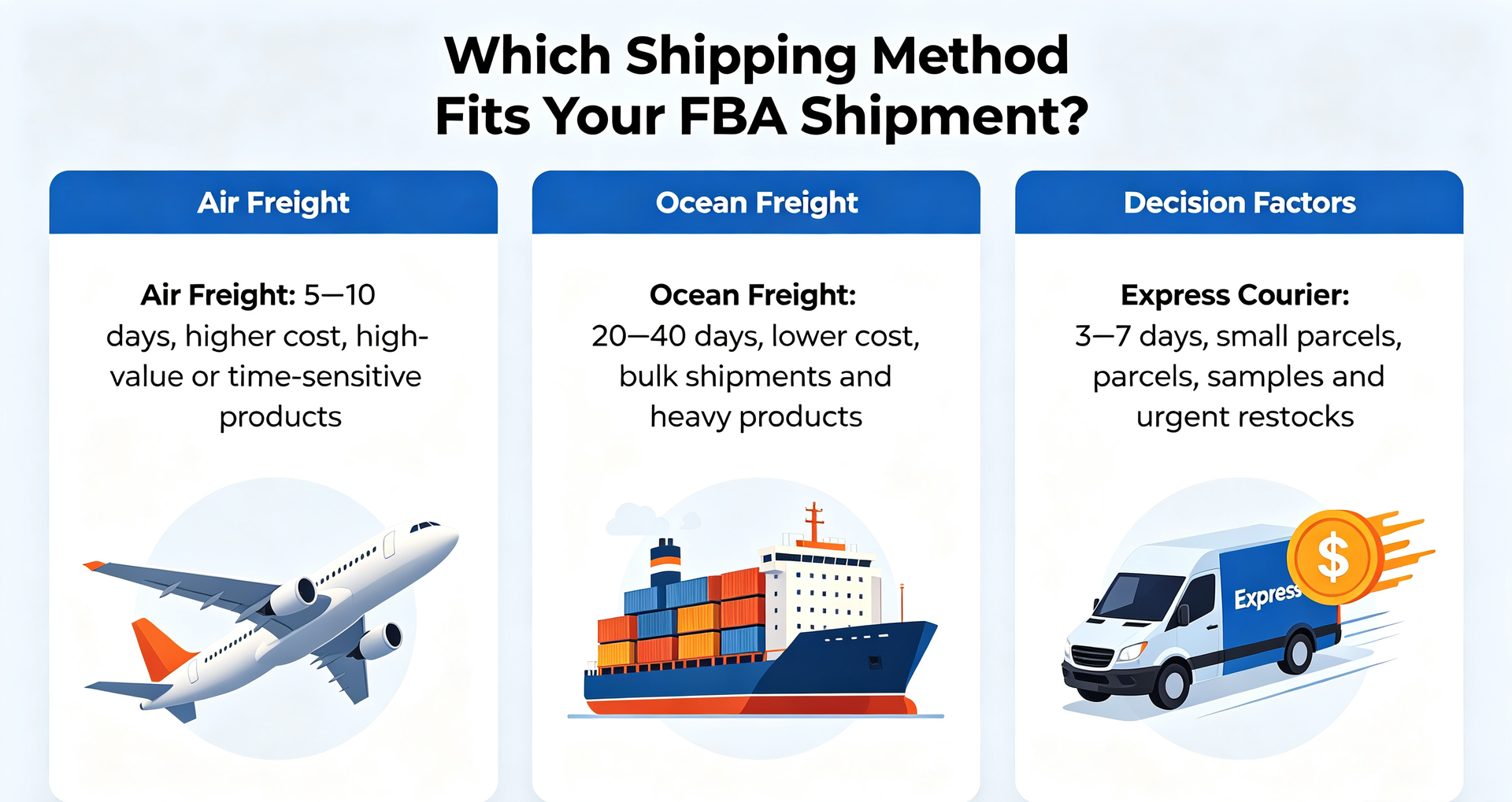
Three shipping methods: Air freight (fastest, 5–10 days, most expensive), ocean freight (cheapest, 20–40 days), and express courier (small parcels, 3–7 days). Choose based on product value, volume, and urgency.
FNSKU labeling is critical: Use Amazon’s FNSKU barcode (not UPC) to keep inventory separate from other sellers. Without proper labels, your shipment may be refused or incur relabeling fees.
DDP simplifies customs: Delivered Duty Paid (DDP) means all duties and taxes are prepaid. This reduces customs delays and surprise invoices—especially important for sellers new to importing.
Peak season planning: Start inventory planning 4–6 weeks before Q4. Amazon’s TIPS program offers 25% storage fee discounts for maintaining optimal inventory levels.
Hidden costs to watch: Storage fees, long-term storage fees, labeling fees, customs duties, and peak season surcharges can eat into margins if not planned for.
For Amazon sellers sourcing products from China, the journey from factory floor to Amazon fulfillment center can feel like navigating a maze. One wrong turn—a labeling error, a customs document mistake, or a shipping delay—can mean weeks of lost sales, frustrated customers, and unexpected costs.
This guide breaks down everything you need to know about shipping from China to Amazon FBA: the shipping options available, labeling requirements that cause the most headaches, customs clearance with DDP terms, and peak season inventory planning strategies. Whether you're launching your first product or scaling a multi-SKU catalog, this guide helps you avoid the common pitfalls that trip up even experienced sellers.
Choosing the right shipping method is the first major decision. Your choice affects cost, speed, and how much inventory you can move at once.
Best for: High-value products, time-sensitive restocks, and new product launches
Air freight is the fastest option, typically taking 5–10 days from China to U.S. or European fulfillment centers. Some expedited services can deliver in as little as 3–5 days.
Advantages:
Speed: Get products to market quickly
Lower damage risk: Less handling than ocean freight
Flexibility: Easier to adjust shipping schedules
Disadvantages:
Cost: Air freight is typically 3 to 5 times more expensive than ocean freight
Weight limits: Not suitable for very heavy or bulky items
Capacity constraints: Tight during peak seasons
When to use: If you're testing a new product, restocking a fast-selling item, or shipping high-margin goods like electronics where speed justifies the cost.
Best for: Bulk shipments, heavy products, and cost-conscious sellers
Ocean freight is the most economical option, costing roughly one-third to one-fifth of air freight. Transit times range from 20–40 days, depending on the route and destination
Advantages:
Cost efficiency: Much lower per-unit shipping cost
Capacity: Can handle large volumes and heavy products
Environmental: Lower carbon footprint
Disadvantages:
Longer transit times: Requires planning
Less predictable: Port congestion, weather, and customs can cause delays
Higher inventory carrying cost: Need to order further in advance
When to use: For standard replenishment, larger orders, and products where cost is the primary concern.
Best for: Small parcels, samples, and urgent small restocks
Express couriers offer fast delivery (3–7 days) for smaller shipments, with door-to-door service and simplified documentation.
Advantages:
Fastest option for small shipments
Simplified customs handling
Door-to-door tracking
Disadvantages:
Expensive per kilogram
Not suitable for large volumes
| Factor | Choose Air Freight | Choose Ocean Freight | Choose Express |
| Shipment Size | Small to medium | Large (LCL or FCL) | Small parcels |
| Product Value | High value per kg | Lower value per kg | High value per kg |
| Urgency | Time-sensitive | Flexible timeline | Very urgent |
| Budget | Higher budget | Cost-sensitive | Higher budget |
| Use Case | Launch, restock | Replenishment |
Samples, emergency |
Labeling is the most common source of FBA shipping delays. Amazon has strict requirements, and even small mistakes can lead to rejected inventory or additional fees.
Every product sent to Amazon FBA must have a scannable barcode. You have two options :
FNSKU (Fulfillment Network Stock Keeping Unit) – Amazon's barcode that identifies both the product AND the seller.
UPC (Universal Product Code) – Manufacturer barcode that identifies the product regardless of seller.
Recommendation: Use FNSKU labels, especially for private-label products. This keeps your inventory separate from other sellers who may sell the same product. If you use a UPC, your inventory may be "comingled" with inventory from other sellers, which means customers could receive product from another seller, potentially impacting quality perception.
1. Product Barcode Labels (FNSKU)
Apply to each unit
Must be scannable and clearly visible
Cannot be placed over seams or openings
2. Box ID Labels
Each box requires a unique FBA box ID label generated from your shipment workflow
Do not photocopy, reuse, or modify labels for use on additional boxes
Print the full set of labels—each one is unique
3. Shipping Labels
Carrier label (UPS, FedEx, etc.) must be on a flat surface
Both FBA box ID and carrier label must remain uncovered and scannable
4. Suffocation Warning Labels
Required for products packed in poly bags with openings 5 inches or larger
Minimum font size depends on bag size
5. Sold as Set Labels
If multiple items are sold as a single unit, they must be packaged together and labeled as a set
| Mistake | Consequence |
| Using UPC instead of FNSKU | Inventory comingled with other sellers |
| Placing label over seam/opening | Label damaged when box opened |
| Reusing labels | Shipment rejected at fulfillment center |
| Missing suffocation warning | Products may be rejected |
| Incorrect box ID on shipment | Processing delays, potential blocking of future shipments |
Pro Tip: Many sellers use their freight forwarder's labeling service to ensure compliance. This adds a small cost but eliminates the risk of labeling errors.
Customs is often the trickiest part of international shipping. Understanding Incoterms can help you avoid surprise costs and delays.
DDP means the seller pays all duties, taxes, and fees required to deliver goods to the buyer. For Amazon FBA shipments, DDP means :
Your shipment arrives at the fulfillment center without last-minute customs payments
No surprise invoices for duties or taxes
Simplest option for beginners—everything is bundled and managed
Alternative: EXW (Ex Works) means the buyer arranges pickup from the supplier and handles all logistics. This is rarely recommended for FBA sellers shipping internationally.
Based on standard requirements for China-to-Amazon shipments :
| Document | Purpose |
| Commercial Invoice | Value and description of goods |
| Packing List | Weight, dimensions, package count |
| Bill of Lading (BOL) | Evidence of carriage |
| Certificate of Origin | For tariff preferences |
| ISF Filing (U.S.) | Importer Security Filing, 24 hours before loading |
Note: Customs regulations change frequently. Always verify current requirements with your freight forwarder before shipping.
Q3 and Q4 are critical for Amazon sellers. Poor planning can mean stockouts during your biggest sales period—or paying storage fees for unsold inventory.
For new product launches, consider a center-radius inventory strategy: place 70% of inventory in a core fulfillment center (like ONT8 on the U.S. West Coast) to build sales velocity, and 30% distributed to other warehouses to test regional demand.
| Action | Timing |
| Start inventory planning | 4–6 weeks before peak season |
| Submit orders to suppliers | 8–10 weeks before peak |
| Ship ocean freight | 6–8 weeks before peak |
| Ship air freight (emergency restock) | 2–3 weeks before peak |
Amazon's Inventory Performance Program (TIPS) offers benefits for maintaining optimal inventory levels :
25% reduction in peak season storage fees
Waived low-inventory fees
50% removal fee discount for Q4 inventory unsold after 90 days
To qualify: Maintain inventory between minimum and maximum targets for at least 25 days per month
| Cost | Description |
| Storage Fees | Monthly fee based on volume (higher in Q4) |
| Long-Term Storage | For inventory over 365 days |
| Removal Fees | Cost to remove unsold inventory |
| Labeling Fees | Amazon charges if your labels are incorrect |
| Peak Surcharges | Extra fees during busy periods |
A: Ocean freight is the cheapest option for large shipments, costing roughly one-third to one-fifth of air freight. For smaller volumes, LCL (Less than Container Load) shipping offers a cost-effective alternative.
A: FNSKU identifies both the product and the seller, keeping your inventory separate from other sellers. UPC identifies only the product. For private-label sellers, FNSKU is strongly recommended to avoid inventory commingling.
A: Air freight: 5–10 days (3–5 days for expedited), ocean freight: 20–40 days, express courier: 3–7 days.
A: DDP (Delivered Duty Paid) means all duties and taxes are prepaid, so your shipment arrives at the fulfillment center without customs surprises. It's the simplest option for FBA sellers.
A: Amazon may refuse the shipment, charge relabeling fees, or delay processing. Repeated violations can lead to blocking of future shipments
A: The Inventory Performance Program (TIPS) offers 25% storage fee reductions and waived low-inventory fees for sellers who maintain optimal inventory levels for at least 25 days per month.
Shipping from China to Amazon FBA doesn't have to be complicated—but it does require planning. The sellers who succeed are those who understand their options and prepare in advance:
Choose the right shipping method based on your product, budget, and timeline
Label products correctly using FNSKU barcodes and following Amazon's requirements
Use DDP terms to simplify customs clearance
Plan inventory for peak seasons well in advance
By following the strategies in this guide, you can avoid delays, reduce costs, and keep your Amazon inventory flowing smoothly. For sellers who prefer to focus on selling rather than logistics, partnering with an experienced China freight forwarder can make the entire process seamless.






 Email: