

WORLDWIDE FREIGHT SERVICES
Email: jack@transworldcn.com
TL;DR – Key Takeaways for Specialized Cargo Shippers
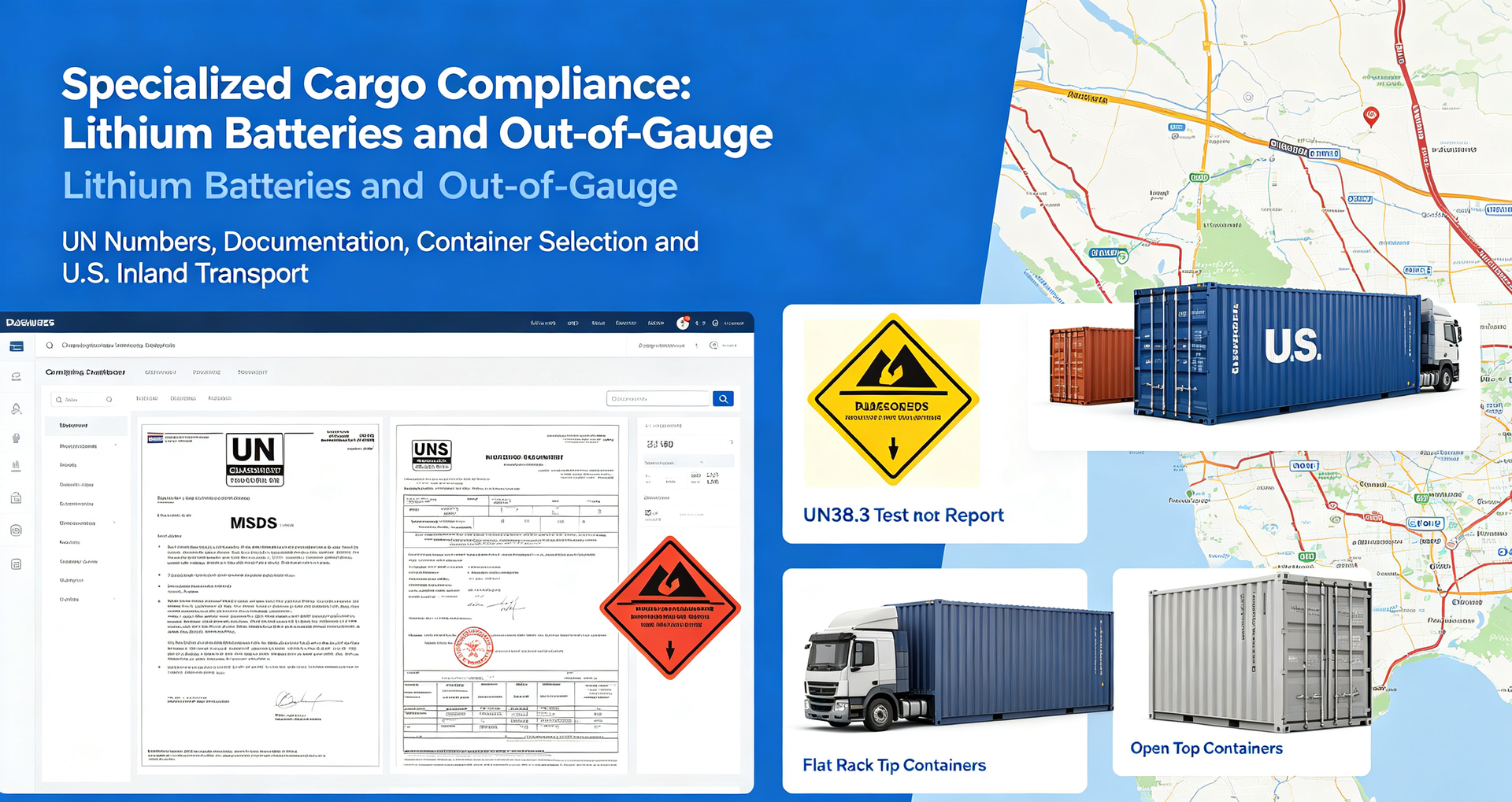
Lithium battery UN classification: Lithium-ion batteries (UN3480), lithium metal (UN3090), device-contained (UN3481/3091), and EV/new energy vehicles (UN3171) – with new IMDG 42-24 UN3556/3557/3558 for NEVs taking effect in 2026.
Three critical documents: UN38.3 test report (mandatory for all lithium batteries), MSDS (must comply with GHS Rev.11 and IMDG 42-24), and Dangerous Goods Transport Packaging Use Appraisal Certificate.
OOG definition: Cargo exceeding standard container dimensions – single side over 1200mm, any two sides over 800mm, or weight over 500kg. Requires flat rack (FR) or open top (OT) containers.
Weight compliance: The U.S. federal truck weight limit is 80,000 lbs GVW; overweight shipments require special permits and may incur $100–300 per trip for tri-axle chassis rentals.
Specialist forwarder required: Both lithium batteries and OOG cargo demand experienced handlers with DG certifications and OOG equipment access – not all freight forwarders can manage these shipments.
Not all cargo fits neatly into a standard 40ft container. Lithium batteries require strict compliance with international dangerous goods regulations, specialized packaging, and meticulous documentation. Out-of-gauge (OOG) shipments – oversized machinery, industrial equipment, or large furniture – demand specialized containers, route planning, and heavy-lift coordination.
This guide addresses both specialized cargo types for North American importers. Whether you are shipping EV batteries to California or a production line to Texas, understanding the compliance and logistics requirements is essential to avoid costly delays, penalties, or cargo destruction.
Lithium batteries are classified as Class 9 dangerous goods under the UN Model Regulations and the International Maritime Dangerous Goods (IMDG) Code. Correct UN number assignment is the first – and most critical – compliance step :
| Battery Type | UN Number | Description |
| Lithium-ion batteries | UN3480 | Standalone batteries |
| Lithium-ion batteries in/with equipment | UN3481 | Device-contained or packaged with device |
| Lithium metal batteries | UN3090 | Standalone batteries |
| Lithium metal batteries in/with equipment | UN3091 | Device-contained or packaged with device |
| Battery-powered vehicles (e-bikes, scooters, EVs) | UN3171 | Self-propelled devices |
Critical 2026 Update: The IMDG Code 42-24 revision introduces new UN numbers for new energy vehicles (NEVs): UN3556 (lithium-ion battery-powered vehicles), UN3557 (lithium metal battery-powered vehicles), and UN3558 (hybrid vehicles). These are already in effect and enforced from 2026. Shippers of electric vehicles and e-bikes must ensure they are using the correct UN number.
Every lithium battery shipment requires three essential documents before it can be accepted by any carrier or cleared by customs.
This is the mandatory safety certification for all lithium batteries – the “global passport” for lithium battery transport. It confirms the battery has passed the UN Manual of Tests and Criteria Section 38.3 test series: altitude simulation, thermal test, vibration, shock, external short circuit, impact/overcharge, and forced discharge.
Key requirements:
Must be issued by a qualified laboratory.
The battery model, specifications, and test report must match the actual shipment exactly.
The report remains valid as long as the battery design does not change.
For shipments containing multiple battery types, each requires its own UN38.3 report.
The MSDS provides detailed safety and handling information for the battery.
Critical 2026 compliance updates:
Must comply with GB/T 16483-2023 (China national standard) and align with GHS 11th Revision and IMDG Code 42-24
Must specify UN38.3 Rev.8 information, thermal runaway temperature, and test temperature range.
Must include precise electrolyte solvent ratio and silicon-based anode material composition – vague descriptions are no longer acceptable
Must include EUH hazard statements for nano-material-containing batteries and clearly classify the Class 9 dangerous goods category.
Must specify the State of Charge (SOC) limit – ≤30% for air transport and 30–50% for sea transport.
Key warning: MSDS reports that are not updated to the 2026 standards are being rejected by carriers and customs. Do not assume an old MSDS is still valid.d
This is the certification from Chinese customs (formerly CIQ) confirming that the packaging used is compliant with dangerous goods transport requirements.
Two-step process:
Step 1 – Packaging Performance Test: The packaging manufacturer applies for a packaging performance test with local customs and obtains a "Performance Test Report for Export Dangerous Goods Packaging." This is typically valid for up to 12 months from the packaging production date.
Step 2 – Packaging Use Appraisal: The battery manufacturer (the shipper) applies for the use appraisal after the battery has been properly packaged. Customs inspects the packaging and confirms compliance. A "Use Appraisal Certificate" is then issued, valid for 12 months (sea freight) or 3 months (air freight) from the date of filing. This certificate cannot exceed the packaging performance validity.
Without the “Use Appraisal Certificate”, the shipment cannot be legally exported from China.
Lithium batteries must be packaged according to the UN packaging instruction P903 :
Packaging must meet Packing Group II performance standards.
Internal cushioning and fixing must prevent battery movement and damage during transport.
For batteries weighing 12kg or more, a strong outer box, wooden frame, or pallet is required. The battery electrodes cannot bear the weight of other cargo.
Each package must display the lithium battery mark (rectangle with red border, battery and flame icon) and the Class 9 dangerous goods label (9A label).
The Wh rating must be clearly displayed on the outside of each package, and the mark must be weather-resistant.
For containerized shipments, each side of the container must display the Class 9 dangerous goods placard.
Exemption under Special Provision 188 (TDG): If the lithium battery meets the criteria under UN TDG Special Provision 188 – including cells ≤20Wh or batteries ≤100Wh, meeting certain test and packaging conditions – it may be exempt from full dangerous goods packaging requirements. However, the lithium battery mark must still be applied.
Lithium battery SOC is strictly regulated to prevent thermal runaway during transport :
Air transport: SOC must be ≤30% – mandatory for all lithium batteries shipped by air.
Sea transport: SOC is typically controlled at 30–50%. For UN3536 battery energy storage systems (BESS), the container must be stowed on deck – not inside the hold – with fire access maintained
Cargo must be segregated from oxidizers, foodstuffs, and heat sources.
Step 1: Pre-Shipment Preparation (10–15 days before shipment)
Complete UN38.3 testing at a CNAS-accredited laboratory for each battery model
Prepare an MSDS compliant with GB/T 16483-2023 and GHS Rev. 11.
Obtain transport certification for the year of shipment.
Begin any required destination-country certification (UL for U.S., CE for EU).
Step 2: Packaging Compliance
Source UN-certified packaging from a packaging manufacturer with a valid customs code
Have the packaging manufacturer apply for the Performance Test Report with local customs.
After packaging the batteries (insulation separation, cushioning, fixing), apply for the Use Appraisal Certificate with customs.
Step 3: Book with a Dangerous Goods-Capable Forwarder
Select a freight forwarder with dangerous goods handling experience and carrier relationships.
Submit UN38.3, MSDS, transport certification, and the Use Appraisal Certificate for pre-approval before booking a hazardous cargo slot.
Step 4: Container Packing and Dangerous Goods Declaration
Pack in a certified hazardous cargo warehouse with photographic documentation of the packing process (mandatory for maritime declarations).
File the Dangerous Goods Declaration with the maritime authorities or airline.
Submit the completed dangerous goods paperwork before the shipping cutoff.
Step 5: Customs Clearance and Export
Submit standard customs documentation (commercial invoice, packing list, bill of lading) along with the Use Appraisal Certificate, UN38.3 report, and MSD.S.
If randomly inspected, ensure customs can access the packaging and documentation quickly.
OOG cargo is defined by the following characteristics :
Any single dimension exceeding 1200mm (approximately 47 inches)
Any two dimensions exceeding 800mm (approximately 31 inches) each
Weight exceeding 500kg
Cargo that does not fit within a standard ISO container’s internal dimensions of approximately 300cm × 200cm × 160cm
Common OOG cargo types:
Industrial equipment: Production lines, machinery, turbines
Large furniture: Dining tables, sofas, cabinets
Medical equipment: MRI scanners, CT machines
Construction materials: Prefabricated structures, steel beams
Energy equipment: Wind turbine components, large batteries
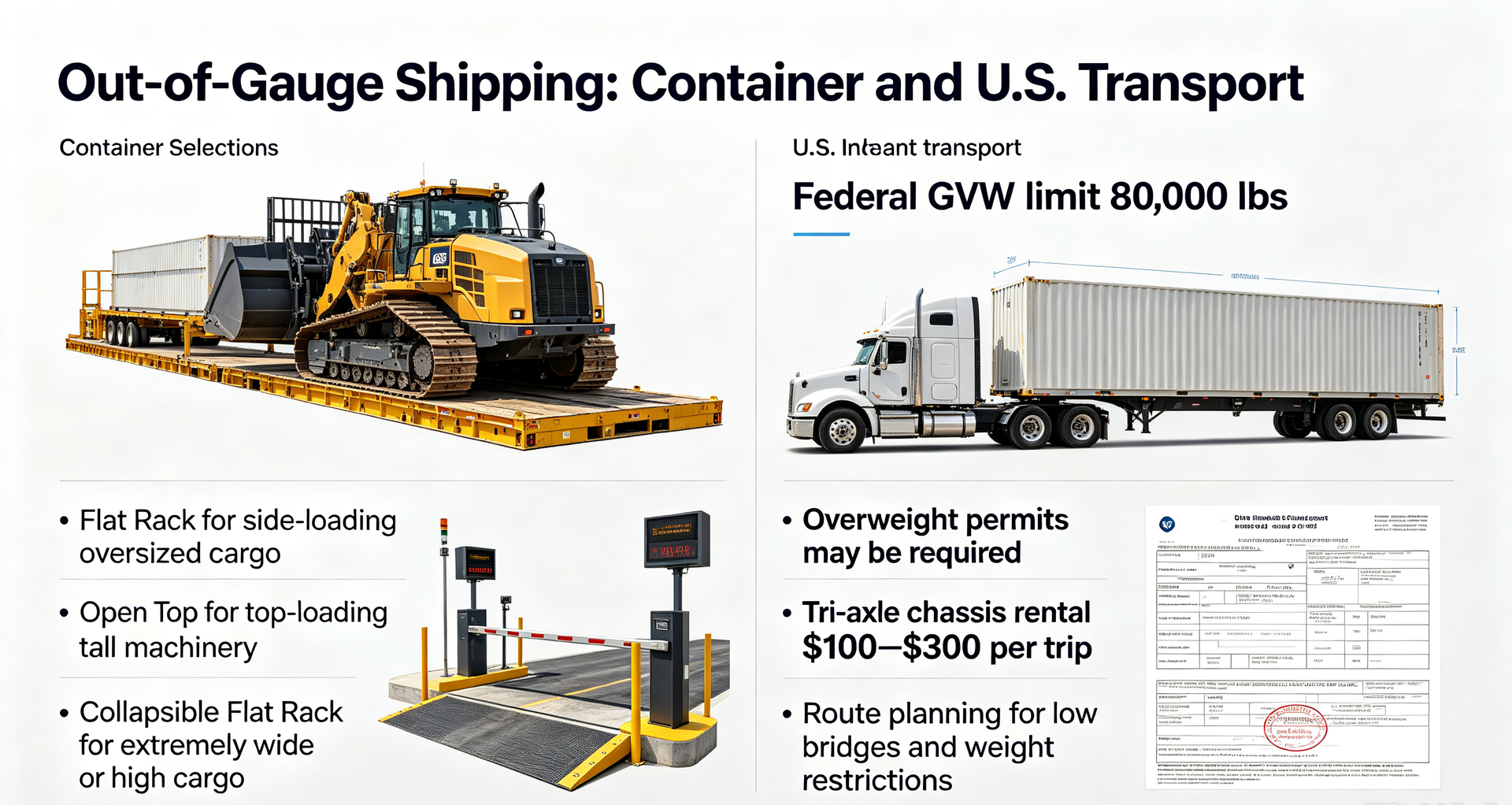
| Container Type | Best For | Key Specifications |
| Flat Rack (FR) | Cargo that can be loaded from the side, with or without end walls | 20ft FR: payload ~31,000kg; 40ft FR: payload ~39,600kg |
| Open Top (OT) | Cargo that requires top loading (e.g., tall machinery) | 20ft OT: payload ~28,220kg |
| Collapsible Flat Rack (FQ) | Extremely wide or high cargo | 40ft FQ: payload ~47,300kg |
Step 1: Cargo Assessment and Compliance
Obtain precise measurements (length × width × height) with ≤2% error tolerance – critical for container selection and booking accuracy.
Verify if the cargo has any dangerous goods components (e.g., hydraulic fluid, batteries).
Confirm any destination-country certifications (FDA for medical, FCC for electronics, DOT for vehicle parts).
Ensure ISPM 15-compliant wooden packaging (heat-treated and stamped) is used for any wood components to avoid U.S. customs rejection.o
Step 2: Specialized Container Booking
Book the appropriate container type (FR or OT) at least 7–10 days in advance, as these are not standard stock items and require carrier-specific availability.
Provide the carrier with accurate cargo dimensions, weight, and loading method (side-loading for FR, top-loading for OT).
For extremely large cargo, consider breakbulk shipping (not containerized) .
Step 3: Packaging and Loading
Custom reinforcement: For heavy machinery, ensure cargo is securely lashed with steel strapping, chains, and lashing gear. Use cushioning materials and wooden dunnage to prevent shifting.
Weight distribution: Place heavier items lower and balance the load so the center of gravity is within 10cm of the pallet/container center
Document the loading process with photos and video – this is essential for claims and customs.
Step 4: Customs Documentation
Commercial invoice: Must include the correct value for the goods and packaging. The U.S. de minimis threshold (now eliminated) means all shipments are formal entries. Ensure the value is properly declared for duty calculation.
Packing list: Provide a detailed list with the dimensions, weight, and packaging type for each item.
Certificates of Origin: If applicable, provide to claim tariff advantages.
Step 5: Ocean Freight and Routing
Select a direct route to your destination port. OOG cargo is more difficult to transship.
OOG cargo can be expensive on the spot market. For cost optimization, consider a long-term agreement with a carrier.
Consider both West and East Coast routing: For cargo destined for Eastern U.S. markets, East Coast routing may offer better total-landed-cost despite the higher ocean freight.
Step 6: U.S. Inland Transportation – Weight Compliance
This is the most common point of failure for OOG shipments.
U.S. federal truck weight limit on interstate highways is 80,000 lbs (36,287 kg) GVW (gross vehicle weight – the combined weight of the truck, chassis, and container)
Axle limits: Single axle – 20,000 lbs; tandem axle – 34,000 lbs
Typical weight thresholds: A 20ft container usually has no issue staying under 80,000 lbs. A 40ft container with heavy cargo, however, often exceeds this limit.
Overweight shipments require:
Special permits ($20–100 per state)
Tri-axle chassis rental ($100–300 per trip).
Route limitations – avoid low bridges and weight-restricted roads.
Plan: Work with your forwarder to ensure chassis availability and permit applications are completed before the shipment arrives.
A: UN3480 is for standalone lithium-ion batteries (not contained in equipment). UN3481 is for lithium-ion batteries that are contained in equipment or packed with equipment. The classification determines packaging, labeling, and regulatory requirements. For shipping e-bikes or laptops, you will typically use UN3481 or UN3171.
A: The Use Appraisal Certificate is the “Dangerous Goods Transport Packaging Use Appraisal Certificate” issued by Chinese customs. It confirms that your battery packaging has passed customs inspection and is compliant with dangerous goods transport standards. Without this certificate, the shipment cannot be legally exported from China. It is required for all lithium battery exports, regardless of the destination country.
A: The federal weight limit for trucking on interstate highways is 80,000 lbs GVW (gross vehicle weight). Heavy OOG cargo in a 40ft container will often exceed this. Solutions include using a tri-axle chassis (which requires a permit) or arranging special overweight permits. Route limitations also apply – not all roads can handle heavy loads.
A: For machinery that is too tall for a standard container, use an Open Top (OT) container. For cargo that is too wide for a standard container, use a Flat Rack (FR) container. Both require specialized booking and loading. For extremely large cargo, breakbulk shipping may be required
A: Generally, no. Lithium batteries require specific dangerous goods packaging and segregation from other cargo, including heavy machinery. They must be shipped in dedicated containers that are declared and stowed according to IMDG Code requirements. Mixing DG and non-DG cargo, particularly when the OOG cargo could damage the battery packaging, is not permitted.
Shipping lithium batteries and OOG cargo to North America is not a task for a generalist freight forwarder. It requires:
Precise compliance knowledge: UN numbers, IMDG Code, MSDS updates, and package certifications are non-negotiable for lithium batteries.
Specialized equipment: OOG containers (FR, OT) and low-boy trailers are not standard stock – they require advanced booking.
Weight and route planning: U.S. truck weight limits and route restrictions can derail an OOG shipment if not planned i
Experienced handling: From crane coordination to packing inspection, mistakes are costly and can lead to cargo holds or seizure.
TransWorld’s team has the expertise to manage both lithium battery compliance and OOG project cargo from China to North America. With local offices in Shenzhen, Shanghai, and Qingdao, we provide end-to-end oversight – from origin packing and documentation to U.S. inland delivery.






 Email: