

WORLDWIDE FREIGHT SERVICES
Email: jack@transworldcn.com
TL;DR – Key Takeaways for Importers
The Middle East market is booming: With the UAE's e-commerce penetration exceeding 90% and Saudi Arabia's "Vision 2030" driving a construction and infrastructure boom, demand for Chinese goods continues to surge.
2026 has brought major disruptions: The Strait of Hormuz conflict has forced shipping lines to divert to alternate ports like Khor Fakkan and Fujairah, adding 7–15 days and driving container rates from $3,000–4,000 to over $11,000 – a nearly 3x increase.
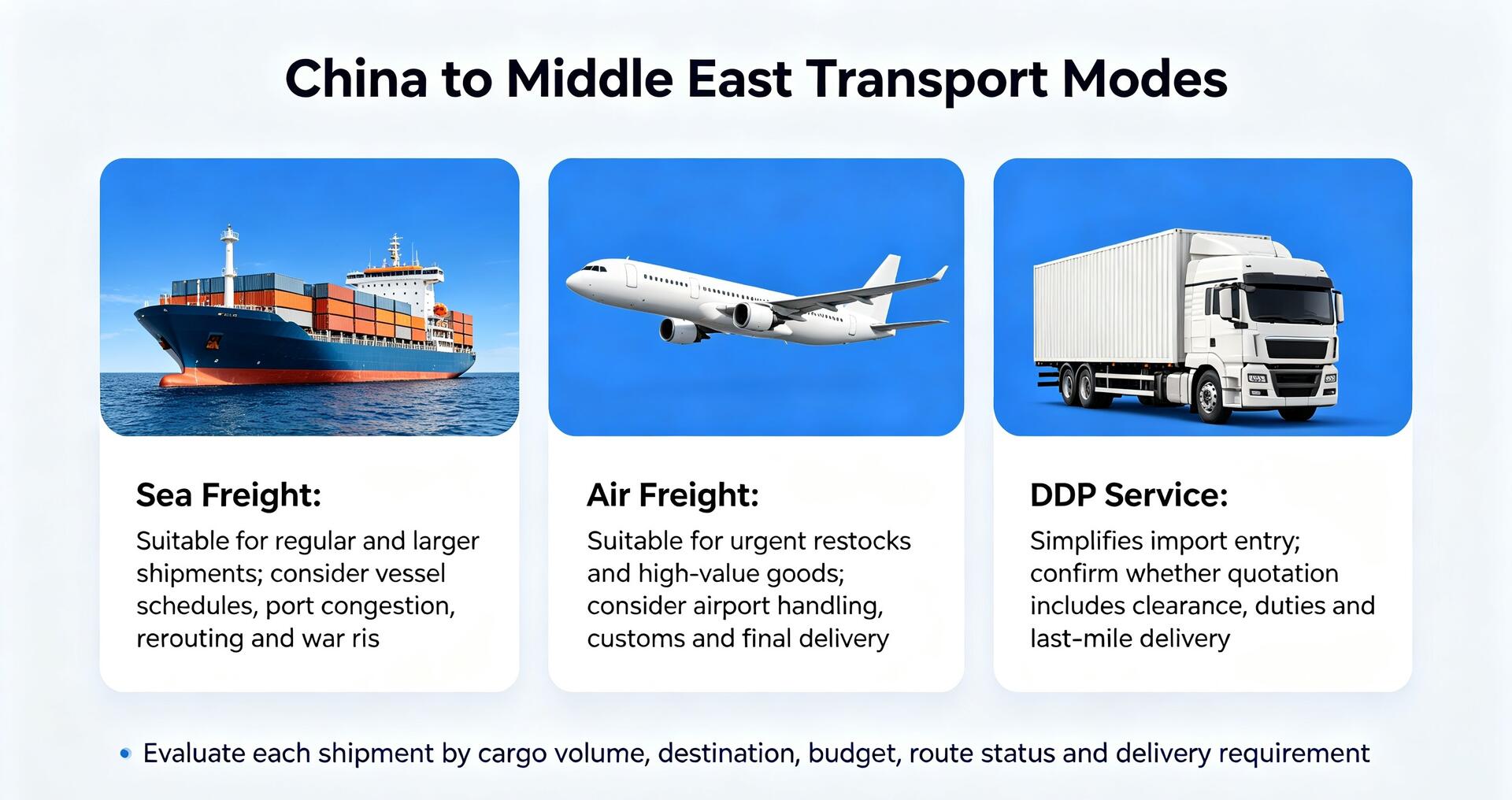
Sea freight remains the most economical choice: FCL rates to Jebel Ali range from $2,350–3,950 per 40ft, with direct sailing transit times of 14–22 days from South China ports.
Compliance is non-negotiable: Saudi Arabia requires SABER certification; the UAE requires ESMA compliance – incomplete documentation causes 70% of customs delays.
DDP simplifies entry: Door-to-door DDP service includes customs clearance and duties, eliminating surprise destination charges.
The Middle East has become one of the fastest-growing export destinations for Chinese goods. With bilateral trade volumes soaring and infrastructure projects like Saudi Arabia's "Vision 2030" driving demand, shipping from China to the Middle East represents a significant opportunity.
However, 2026 has brought unprecedented challenges. The Strait of Hormuz conflict has disrupted traditional shipping lanes, forcing carriers to reroute through alternate ports and driving container freight rates to $11,000 – nearly three times normal levels.
This guide covers shipping costs, transit times, documentation, customs clearance, and compliance requirements for Saudi Arabia, UAE, Qatar, and the broader Gulf region.
Sea freight is the backbone of China–Middle East trade, handling the vast majority of containerized cargo. In 2026, shipping from China to the Middle East remains cost-effective despite disruptions.
Direct FCL Transit Times (Port-to-Port) :
| Origin Port | Jebel Ali (UAE) | Dammam (Saudi) | Jeddah (Saudi) | Hamad (Qatar) |
| Shenzhen/Yantian | 14–18 days | 18–24 days | 20–26 days | 16–20 days |
| Shanghai/Ningbo | 18–22 days | 22–28 days | 22–28 days | 20–24 days |
| Qingdao/Tianjin | 20–24 days | 20–25 days | 24–30 days | 22–26 days |
Source: SinoShipment route data
FCL vs. LCL Breakeven: FCL (Full Container Load) becomes more cost-effective than LCL when cargo exceeds 13–15 cubic meters (CBM).LCL shipments add 5–10 days for consolidation at origin and deconsolidation at destination.
For urgent shipments, high-value goods, or time-sensitive products, air freight delivers in days rather than weeks.
| Service Type | Transit Time | Cost (USD/kg) | Best For |
| Air Freight | 5–8 days | $4–7 | 100–500kg, high-value goods |
| Express Courier | 2–6 days | $10–15 | Parcels <150< 150 kgmples, documents |
Source: FreightAmigo
For importers who want simplicity, DDP service bundles all costs – freight, customs clearance, duties, and final delivery – into a single invoice.
DDP vs CIF/FOB Comparison :
| Feature | CIF | FOB | DDP |
| Customs Clearance | Buyer's Responsibility | Buyer's Responsibility | Agent's Responsibility |
| Import Duties/VAT | Buyer Pays on Arrival | Buyer Pays on Arrival | Included in Quote |
| Hidden Port Fees | High Risk | Moderate Risk | Zero Risk |
| Convenience | Low | Medium | High |
Source: Efanda Logistics
In April 2026, escalating conflict in the Strait of Hormuz caused a major disruption to shipping from China to the Middle East. Major carriers, including Mediterranean Shipping Co., Maersk, and CMA CGM, suspended or adjusted their Middle East services.
The Impact :
Container freight rates tripled: From $3,000–4,000 per container to $11,000 (75,000 RMB)
Transit times extended by 7–15 days: Carriers rerouted to Khor Fakkan and Fujairah ports, which quickly became congested.
"Sea-land intermodal" became the alternative: Cargo offloaded at Fujairah or Khor Fakkan and trucked to destination, but this route faces capacity limits and border crossing complexities.
With Jebel Ali and Dammam becoming risky, carriers rerouted cargo to:
Khor Fakkan and Fujairah (UAE): Natural deep-water ports on the Indian Ocean. Both have reached anchorage saturation – vessels are waiting offshore for days
Sohar (Oman): Used for cargo destined for Kuwait, but transshipment adds time and cost.
Real-World Example: A Chinese steel exporter's 5,000-ton shipment to Kuwait was offloaded at Sohar, Oman, creating cross-border trucking challenges across multiple countries.
Sea Freight (FCL) – April 2026 :
| Container | Route | Cost Range (USD) |
| 20ft FCL | China → Jebel Ali | $2,350–3,250 |
| 40ft FCL | China → Jebel Ali | $2,800–3,950 |
| 20ft FCL | China → Dammam/Jeddah | $1,700–4,200 |
| LCL (per CBM) | China → UAE | $120–180 |
Source: FreightAmigo
Surcharges to Budget For :
Bunker Adjustment Factor (BAF): Fluctuates with oil prices
Peak Season Surcharge (PSS): Applies before Ramadan and Chinese New Year
War Risk Surcharge (WRS): Standard for Middle East routes; can add $3,000–5,000 per container
Low Sulphur Surcharge (LSS)
| Cost Component | USD |
| Base Ocean Freight | $3,000–4,000 |
| War Risk Surcharge | $3,000–5,000 |
| Other Surcharges | $500–1,000 |
| Total | $6,500–10,000 |
Source: Jwview reporting
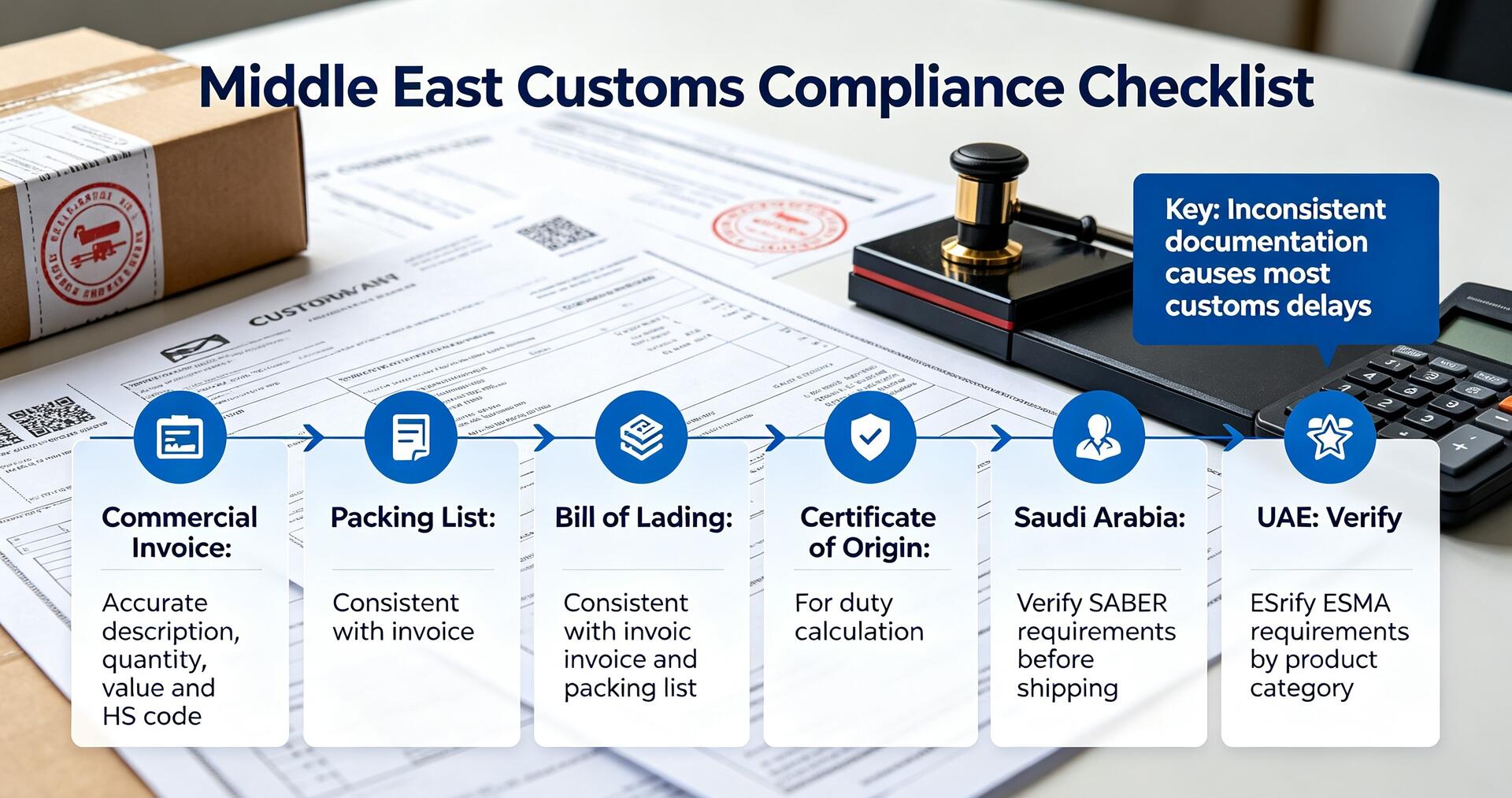
The most common cause of customs delays is inconsistent documentation. Complete, accurate paperwork is essential.
Core Documents :
Commercial Invoice: Must include product description, quantity, value, and HS code. Vague terms trigger holds.
Packing List: Must match the invoice exactly.
Bill of Lading: Must match both.
Certificate of Origin: Required for duty calculation.
Pre-Shipment Inspection (PSI): Mandatory for some countries like Iran; ensures cargo quantity and value match documents
Saudi Arabia:
SABER electronic certification: Mandatory for all shipments. Failure leads to immediate cargo rejection.
VAT rate: 15% – higher than UAE; significantly impacts landed costs.
Compliance: Verify with ZATCA (Zakat, Tax and Customs Authority) before shipping.
United Arab Emirates:
Key ports: Jebel Ali (handles 90%+ of UAE container imports), Khalifa Port (Abu Dhabi)
VAT: 5% standard.
Import duty: 5% on most general cargo; verify with the UAE Federal Tax Authority .
ESMA certification: Required for certain product categories.
Iran (special considerations) :
Gateway: Bandar Abbas handles steel, machinery, chemicals, and consumer goods.
Pre-Shipment Inspection (PSI): Mandatory. If the PSI certificate doesn't match the Commercial Invoice upon arrival, customs will reject or impose heavy fines.
Payment: Transactions often settle in RMB, AED, or EUR to avoid USD exposure.
Customs broker: A licensed "Tarkhis Kar" is almost mandatory for smooth clearance.e
Peak periods significantly affect shipping from China to the Middle East.
| Peak Period | Impact | Timing |
| Ramadan | Reduced working hours, port congestion | Islamic calendar (approx. March–April) |
| Chinese New Year | Factory closures, capacity tight | January–February |
| Golden Week | Port congestion | Early October |
| Hajj | Increased Saudi border scrutiny | Varies annually |
Recommendation: Book 2–3 weeks ahead during peak seasons. Avoid shipping 2 weeks before Ramadan when possible.
A: Sea FCL direct: 14–28 days port-to-port; LCL: +5–10 days for consolidation; air freight: 5–8 days door-to-door. Current disruptions add 7–15 days to ocean transit.
A: FCL 40ft: $2,800–3,950 (base) plus war-risk surcharges ($3,000–5,000); LCL: $120–180/CBM; air: $4–7/kg. Total costs can reach $11,000 per container
A: SABER is Saudi Arabia's mandatory electronic certification system. Without it, cargo is rejected at the port. Verify with ZATCA before shipping.
A: CIF leaves customs clearance and duties to the buyer; DDP includes everything in one all-in quote. DDP is simpler but costs more.
A: Commercial Invoice, Packing List, Bill of Lading, Certificate of Origin, and SABER certification. Ensure HS codes are accurate and descriptions are specific
A: Yes. Sanctions affect banking and vessel selection. Use RMB, AED, or EUR for payments. Confirm your carrier's P&I club covers the Iran route and work with a local "Tarkhis Kar" customs broker.
Shipping from China to the Middle East in 2026 presents opportunities – but also new challenges. The Strait of Hormuz conflict has disrupted traditional routes and tripled costs. Importers who succeed will:
Book early: Secure capacity 2–3 weeks in advance.
Verify compliance: SABER (Saudi), ESMA (UAE), and PSI (Iran) requirements are non-negotiable.
Budget for surcharges: War risk premiums and surcharges can double the base freight.
Consider DDP: Simplifies clearance and eliminates surprise destination charges.






 Email: