

WORLDWIDE FREIGHT SERVICES
Email: jack@transworldcn.com

TL;DR: How Long Does Shipping from China to Europe Take?
The shipping time from China to Europe depends mainly on the transportation method, origin and destination, customs procedures, port conditions, and whether you need port-to-port or door-to-door delivery.
For planning purposes, express shipping is usually the fastest option, while air freight offers a practical solution for commercial shipments that need speed without using premium parcel services. Ocean freight is generally the main option for larger and less time-sensitive cargo, but its transit time can vary considerably depending on the route and current vessel schedules. Rail and multimodal services can provide another option for certain cargo flows.
As a current example, FedEx states that selected international priority services from China can reach destinations in 1–2 business days, although exact transit times depend on the origin, destination, and service selected.
For ocean freight, there is no single China-Europe transit time that applies to every shipment. In 2026, carrier networks continue to change as shipping companies adjust routes between Asia and Europe. Maersk, for example, currently operates different Asia-Europe network configurations, including services around the Cape of Good Hope and a service that has returned to the Suez route.
The practical takeaway: do not plan your European delivery date using a generic "China to Europe" number. Use the exact origin, destination, shipping mode, service, customs requirements, and delivery terms to calculate the realistic lead time.
There is no universal transit time for shipments between China and Europe. A shipment from Shenzhen to Rotterdam can follow a very different logistics process from one moving from Guangzhou to Madrid.
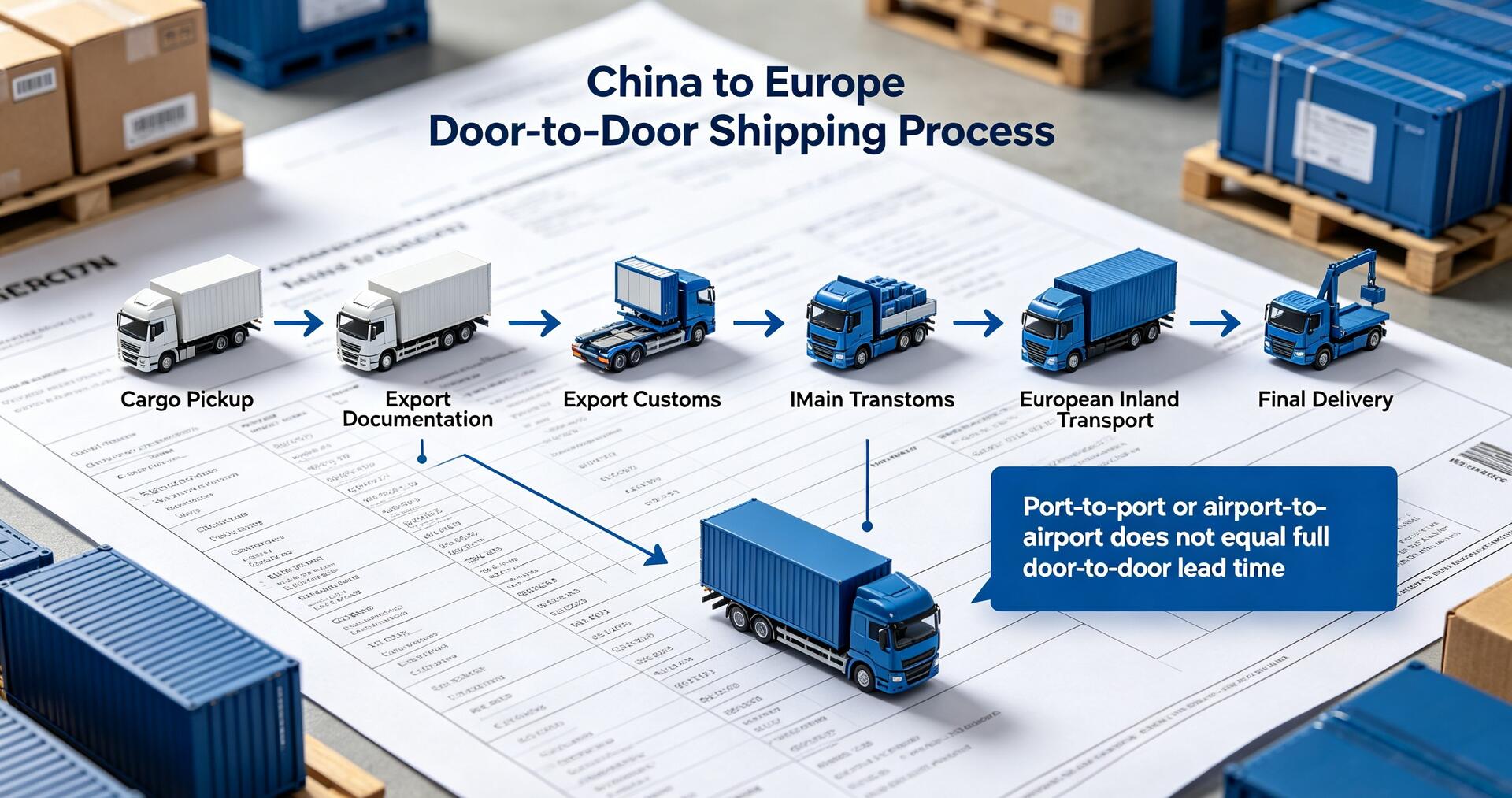
The total lead time normally consists of several stages:
This distinction is important because transport transit time is not the same as total door-to-door lead time.
For example, a carrier may quote a specific number of days for the international transportation segment, but that figure does not necessarily include supplier production, warehouse handling, export clearance, destination customs, port handling, or final-mile delivery.
European customs procedures can also affect the final delivery schedule. The European Commission explains that an import customs declaration is the legal act used to place imported goods under an EU customs procedure.
Therefore, importers should calculate logistics lead time as a complete supply-chain process rather than simply asking, "How many days is the flight or voyage?"
Different transportation methods serve different logistics requirements.
| Shipping Method | General Speed Profile | Best For | Main Consideration |
| Express | Fastest | Samples, urgent parcels, small shipments | Higher transportation cost |
| Air Freight | Fast | Commercial cargo requiring shorter lead times | Higher cost than sea freight |
| Ocean Freight | Slowest major option | Large-volume and heavy cargo | Longer and more variable transit |
| Rail / Multimodal | Middle ground | Certain commercial cargo flows | Route availability varies |
These are planning categories rather than guaranteed delivery times. The actual transit time should always be confirmed against the selected carrier's current schedule.
Express shipping is generally the most straightforward choice when speed is the primary consideration.
Major express carriers provide door-to-door services and customs-related support. For example, FedEx currently states that its International Priority service typically takes 1–2 business days worldwide, subject to destination and service conditions. FedEx also notes that exact transit time depends on the shipment's origin, destination, and selected service.
FedEx International Priority Express is also advertised at approximately 1–2 business days to selected destinations.
Express can make sense when you are:
However, express should not automatically be considered the cheapest option.
For larger commercial shipments, the price difference between parcel express and consolidated air or ocean freight can become significant.
A carrier's published transit time should not be interpreted as a guarantee that every shipment will arrive within that exact period.
Cut-off times, pickup schedules, customs clearance, weekends, holidays, restricted commodities, and destination-specific conditions can affect delivery.
FedEx specifically advises customers to obtain exact transit times based on the shipment's origin and destination.
Air freight is often selected when an importer needs faster transportation than ocean freight but is shipping commercial cargo that does not necessarily require premium express delivery.
Compared with ocean transportation, air freight significantly reduces the main transportation portion of the journey. However, the final door-to-door lead time still depends on:
DHL Global Forwarding, for example, describes air freight as part of multimodal solutions connecting China and Europe and reported a typical 4–7 day transit time from China to Türkiye by air for a particular service comparison in 2026. This is an example of a specific logistics flow, not a universal China-Europe delivery promise.
That distinction matters when publishing shipping information. A responsible logistics guide should not present one carrier's route-specific transit time as the standard for every European destination.
Air freight is particularly useful for:
For many importers, the decision is not simply "air versus sea." Instead, it is a question of how much inventory carrying cost and potential stockout risk can be avoided by paying for faster transportation.
Ocean freight remains an important option for larger shipments because containers provide substantial cargo capacity.
However, shipping time from China to Europe by sea is more difficult to summarize with one fixed number.
The route selected by the carrier can change the total transit time. Port congestion, vessel schedules, transshipment, weather, security conditions, and operational disruptions can also affect the journey.
In 2026, this issue is especially important because Asia-Europe networks continue to evolve.
Maersk currently describes separate Asia-Europe network structures covering Northern Europe and the Mediterranean. Its network information also notes different routing configurations and connections through major European gateways such as Rotterdam, Hamburg, and Bremerhaven.
Maersk also announced in August 2026 that its AE19 service would return to a Suez Canal routing, demonstrating how geopolitical and operational conditions can directly change shipping routes and transit expectations.
A China-Europe ocean shipment can be affected by:
This is why a logistics provider should ideally provide an estimated transit window rather than promise a fixed delivery date before checking the actual sailing schedule.
Rail and multimodal transportation can be useful when an importer needs an alternative to traditional ocean or air freight.
The appropriate solution depends heavily on the exact origin and destination.
Multimodal services combine different modes of transport, such as truck, rail, air, or ocean. DHL, for example, introduced its TRUCKAIR service in 2026 as a China-Europe-oriented multimodal option combining road and air transportation. DHL reported approximately 9–11 days from China to Türkiye for this specific service, compared with approximately 4–7 days for the air-only option.
This illustrates an important principle:
The fastest transportation method is not always the most cost-effective method for a commercial shipment.
For some businesses, a multimodal solution may provide a better balance between cost, speed, and capacity.
One of the most common mistakes made by first-time importers is comparing different shipping quotes without checking what the quoted transit time actually includes.
Consider two quotations:
Quote A: 25 days port-to-port
Quote B: 28 days door-to-door
It would be incorrect to conclude that Quote A is automatically faster.
The first quote may exclude:
The second quote may include these stages.
For procurement and inventory planning, door-to-door lead time is normally more useful than port-to-port transit time.
When requesting a freight quotation, ask the provider to specify:
This makes different freight quotations easier to compare.
Transportation is only one part of the international shipping process.
Customs clearance can affect delivery when documentation, product classification, customs value, origin information, or regulatory requirements need clarification.
The European Commission states that customs declarations contain information about goods being imported into or exported from EU customs territory and are part of the formal customs process.
For EU commercial imports, an EORI number is also an important compliance requirement. The European Commission states that an EORI number is mandatory for customs clearance operations in the EU customs territory, including import, export and transit.
Depending on the shipment, documentation may include:
The exact requirements depend on the product and destination country.
For this reason, importers should identify customs requirements before cargo leaves China, rather than waiting until the shipment arrives in Europe.
There is no way to eliminate every possible logistics delay, but importers can reduce avoidable problems.
Product classification can affect customs duties, regulatory requirements,s and documentation.
Do not rely only on a supplier's informal product description.
For commercial imports, confirm the appropriate classification and review the requirements applicable to the destination market.
The European Commission's Access2Markets platform provides product-specific information covering tariffs, taxes, and import requirements.
The commercial invoice should accurately describe:
Avoid vague descriptions such as "parts," "accessories,,ories" or "samples" when a more precise product description is available.
Clear documentation helps customs authorities understand what is being imported.
Importers should not intentionally undervalue goods to reduce customs charges.
EU customs valuation rules require the customs value to be determined according to applicable customs valuation procedures. The European Commission explains that customs duties and VAT calculations can depend on the value of imported goods and related costs.
Incorrect valuation can create additional questions, delays, penalties, or unexpected costs.
Do not automatically select air freight because it is faster.
Instead, consider:
Cargo value + weight + volume + urgency + inventory cost + customer deadline.
For example:
The optimal method is the one that delivers the required service level at an acceptable total landed cost.
Before placing a shipment, an importer can use the following checklist.
Record:
Specify:
China origin → European destination
For example:
Shenzhen → Rotterdam → Germany warehouse
This is more useful than simply saying "China to Europe."
Compare:
Confirm:
Ask for:
Ask:
"Is this transit time port-to-port or door-to-door?"
This single question can prevent many misunderstandings.
There is no single best option for every importer.
Express is appropriate for small, urgent shipments where delivery speed is more important than transportation cost.
Air freight can provide a practical balance between speed and capacity for commercial cargo.
Ocean freight is generally more suitable when shipment volume is high, and the business can accommodate a longer lead time.
Rail and multimodal transportation may provide another option where the route, cargo characteristics, and service availability make them commercially viable.
The decision should be based on total logistics performance, not transportation speed alone.
Consider a hypothetical importer purchasing finished products from a supplier in South China and selling them through a European distribution warehouse.
The importer initially asks:
"How many days does shipping from China to Europe take?"
That question is too broad to generate a reliable delivery plan.
Instead, the importer provides:
The logistics provider can then compare several options.
Best for urgent samples or small shipments.
The carrier's service schedule provides the baseline transit estimate, but customs and operational conditions still need to be considered.
Suitable when inventory needs to arrive quickly but the shipment is commercial and larger than a typical parcel.
More appropriate when the importer is moving substantial cargo and can plan inventory further in advance.
Potentially useful when the importer wants to balance transportation cost and lead time on a specific route.
The key lesson is not that one mode is always better.
The key lesson is that accurate route information produces a more useful transit-time estimate.
International transportation networks are not static.
Shipping companies regularly change:






 Email: