

WORLDWIDE FREIGHT SERVICES
Email: jack@transworldcn.com
TL;DR – Key Takeaways for Importers and E-Commerce Sellers
Sea freight is the most cost-effective option: 20ft FCL ranges from $1,200–$2,800, 40ft FCL from $1,800–$4,500, and LCL from $100–$180 per CBM to North European ports like Rotterdam and Hamburg.
Air freight is 4–15x more expensive: Rates run $3.50–$9.00 per kg on China–Europe lanes, with transit times of 5–10 days.
China-Europe rail offers a cost-speed middle ground: Transit times of 14–22 days at $0.09–$0.18 per kg, often 20–35% of air freight cost and about twice the sea freight cost, but significantly faster.
EU ETS carbon surcharges and CBAM add new costs in 2026: Maritime carbon tax now requires 100% emissions coverage for EU voyages, adding an estimated 12–15% to total shipping costs for carbon-intensive goods.
ICS2 Release 3 is mandatory: All shipments require full Entry Summary Declaration (ENS) data 24 hours before loading – incomplete filings trigger "Do Not Load" orders and additional fees
The China–Europe trade corridor is one of the busiest in the world, linking major manufacturing hubs in Asia with consumer and industrial markets across Europe. Bilateral trade in goods exceeds €700 billion annually.
However, 2026 has brought significant regulatory and operational changes that directly impact shipping costs:
EU ETS maritime carbon tax – now at 100% coverage for emissions within EU waters
CBAM (Carbon Border Adjustment Mechanism) – requiring certificate purchases for carbon-intensive imports
ICS2 Release 3 – mandatory Entry Summary Declaration (ENS) filing 24 hours before loading
Ongoing Red Sea disruption – many carriers still rerouting around the Cape of Good Hope, adding 10–15 days to transit times.
These factors make understanding shipping costs more complex – and more critical – than ever before.
Sea freight dominates China–Europe trade, handling approximately 90% of volume for bulk commodities. It remains the lowest-cost option for large shipments.
| Container Type | North Europe (Rotterdam/Hamburg) | UK (Felixstowe/Southampton) | Mediterranean (Genoa/Barcelona) |
| 20ft FCL | $2,800 – $4,200 | $3,000 – $4,500 | $3,100 – $4,600 |
| 40ft / 40HQ FCL | $4,500 – $6,800 | $4,800 – $7,200 | $4,900 – $7,400 |
| LCL (per CBM) | $110 – $160 | $120 – $180 | $130 – $190 |
Port-to-port ocean freight only. Rates exclude origin local charges, destination fees, and inland trucking.
Alternative benchmark (Q1 2026): FCL rates to Europe base ports averaged $1,547/TEU** for spot bookings, with Shanghai–Rotterdam rates as low as **$1,150 per container, though contract rates varied widely.
| Container Type | Best For | Approx. Capacity |
| 20ft GP | Smaller loads, heavy/dense cargo | ~28–33 CBM |
| 40ft GP | Standard medium-to-large shipments | ~58–67 CBM |
| 40ft HC | Bulky but light cargo | ~76 CBM |
| LCL | Shipments under 13–15 CBM | Pay-per-CBM |
| Route | Port-to-Port | Door-to-Door |
| China → Rotterdam (Netherlands) | ~30–35 days | 35–45 days |
| China → Hamburg (Germany) | ~35–40 days | 40–50 days |
| China → Le Havre (France) | ~38–42 days | 45–52 days |
| China → UK (Felixstowe) | ~33–38 days | 38–48 days |
| China → Italy | ~40–45 days | 45–55 days |
LCL shipments add 5–10 days for consolidation and deconsolidation.
For shipments exceeding 13–15 CBM, FCL is generally more cost-effective than LCL
LCL hidden costs to consider:
Destination CFS deconsolidation fees
Higher per-CBM handling charges
Extended transit times due to consolidation
Potentially higher damage risk
Air freight delivers goods to Europe in days rather than weeks. It is best for high-value products, urgent restocks, and time-sensitive goods.
Air freight is priced by chargeable weight – the greater of actual weight and volumetric weight (L × W × H in cm ÷ 6,000)
| Weight Bracket | Cost Range (USD/kg) | Notes |
| <100 kg | $7.00 – $9.00 | Higher per-kg rates |
| 100–300 kg | $4.50 – $7.00 | Volume discounts apply |
| >300 kg | $3.50 – $6.00 | Best rates |
Key benchmark: Q1 2026 average air freight from China to Europe was approximately $3.60/kg for larger shipments.
Air freight typically delivers in 5–10 days door-to-door, with direct flights from Shanghai/Ningbo/Shenzhen to major European hubs like Frankfurt, Amsterdam, and Paris.
Stockout prevention – when inventory is critically low
New product launches – time-sensitive market entry
High-value goods – electronics, pharmaceuticals, luxury items
Seasonal or promotional inventory – fixed delivery deadlines
Rail freight offers a compelling alternative for many importers. It delivers significantly faster transit than sea while remaining substantially cheaper than air.
| Billing Unit | Cost Range | Transit Time |
| Per kg | $0.09 – $0.18 | 14–22 days |
| Per CBM (approx.) | $200–$400 | 14–22 days |
Based on Q1 2026 operations from major Chinese hubs to Europe.
Transit: 14–22 days – much faster than sea (30–45+ days)
Cost: ~20–35% of air freight cost
Reliability: More predictable than sea, less affected by weather and port congestion
Sustainability: Lower carbon emissions than air
| Origin (China) | Destination (Europe) |
| Xi'an | Duisburg (Germany) |
| Chongqing | Warsaw (Poland) |
| Chengdu | Malaszewicze (Poland) |
Time-sensitive but not urgent – where sea is too slow but air is too expensive
Medium cargo volumes – 5–15 CBM
E-commerce and mid-range goods – balancing speed and cost
IOSS-compliant shipments – often clear faster via rail
DHL, UPS, and FedEx provide door-to-door express services with customs clearance included – the fastest option for small parcels.
| Weight Bracket | Cost Range (USD/kg) | Transit Time |
| 0.5–20 kg | $15–$25 | 3–7 days |
| 21–99 kg | $12–$18 | 3–7 days |
Volume weight cis alculated using a divisor of 5,000 for express courier.
Small parcels and samples – under 150 kg
Commercial samples – for product testing or trade shows
Urgent orders – when speed is the top priority
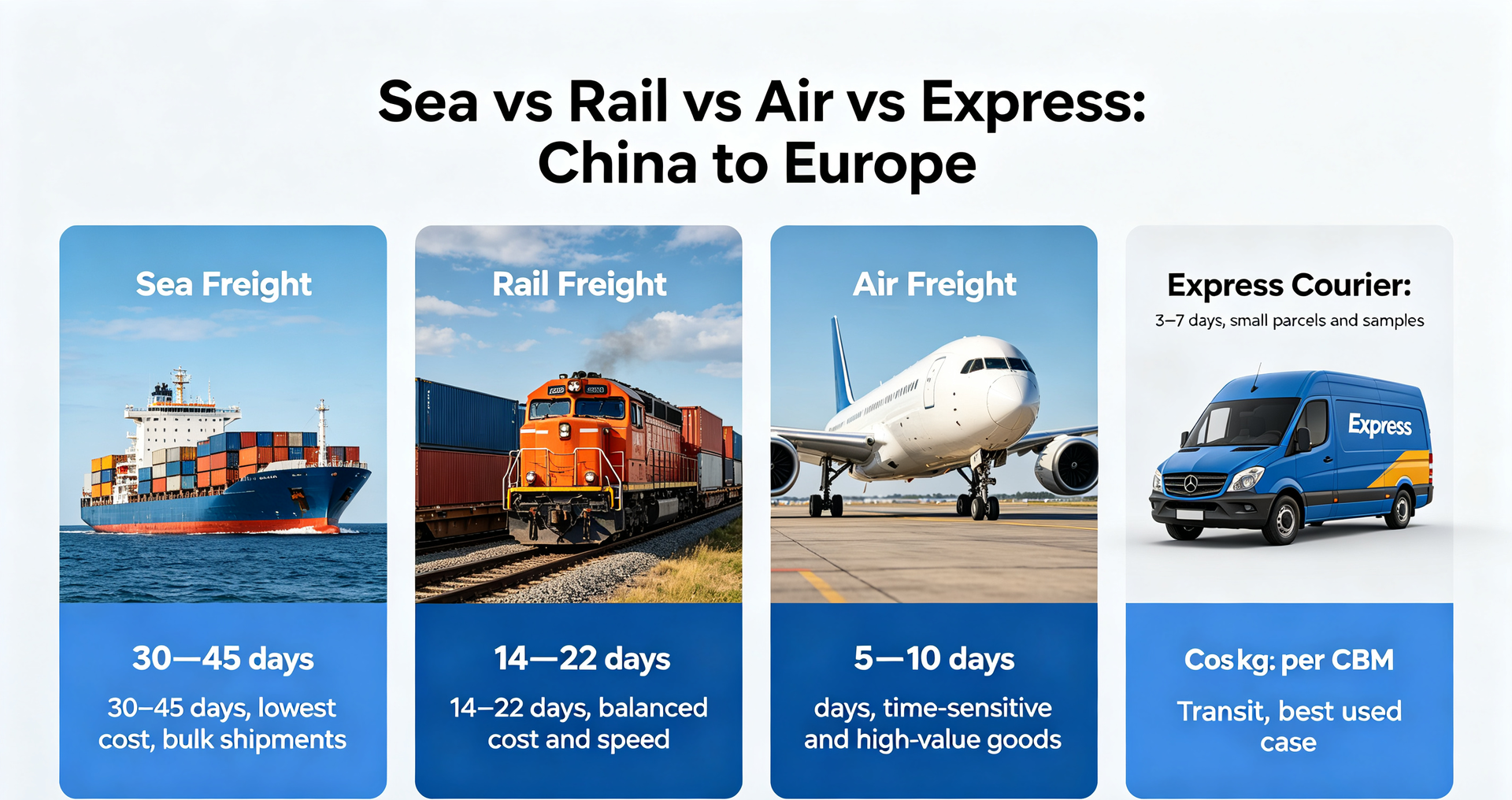
| Dimension | Sea Freight | Rail Freight | Air Freight | Express Courier |
| Cost (per kg) | Lowest (~$0.08–0.12) | Medium (~$0.09–0.18) | Medium-High ($3.50–9.00) | Highest ($15–25) |
| Cost (per CBM) | $100–$190 | $200–$400 | ~$1,500–$5,000+ | Varies |
| Transit Time | 30–45 days | 14–22 days | 5–10 days | 3–7 days |
| Best For | Bulk, non-urgent | Balanced cost/speed | Time-sensitive, high-value | Small parcels, samples |
| Stability | Low (weather, port congestion) | Medium | High | Highest |
Starting in 2026, shipping costs include 100% emissions coverage for voyages within EU waters. For a 40ft container, carbon surcharges typically add $150–$400 per container.
For carbon-intensive goods (steel, aluminum, cement, etc.), importers must purchase CBAM certificates. This can add an estimated 12–15% to total shipping costs for affected products
The Entry Summary Declaration (ENS) must be submitted 24 hours before vessel loading. Incomplete filings trigger "Do Not Load" orders and can result in:
Terminal storage fees
Missed vessel sailings
Customs penalties
| Surcharge | Typical Range | Notes |
| Bunker Adjustment Factor (BAF) | $150–$400 | Fuel cost adjustment |
| Peak Season Surcharge (PSS) | $300–$800 | Q3–Q4 periods |
| Terminal Handling Charge (THC) | $250–$550 | Both origin and destination |
| Documentation Fee | $80–$180 | Per set of documents |
| Fee | Typical Range | Notes |
| Import Customs Clearance | $150–$350 | Varies by shipment type |
| Port-to-Door Trucking (Europe) | €350–€1,200 | Depending on distance within the EU |
All rates approximate and subject to market conditions.
Step 1: Calculate Your Cargo Volume and Weight
Measure actual weight and dimensions for all packages.
For air/express, calculate volumetric weight using the applicable divisor.
For LCL, remember 1 CBM is compared against 1,000 kg – the greater value is charged.
Step 2: Determine Your Timeline and Budget
Urgent (3–7 days): Express courier – highest cost, lowest risk of delays.
Moderate (5–10 days): Air freight – balanced speed and cost.
Moderate (14–22 days): Rail freight – excellent balance of speed and cost.
Flexible (30–45 days): Sea freight – lowest cost, best for large volumes.
Step 3: Evaluate FCL vs LCL Based on Volume
Under 13 CBM: LCL is typically more cost-effective.
13–15 CBM: The "grey zone" – compare total all-in costs.
Over 15 CBM: FCL delivers lower unit cost and faster transit.
Step 4: Verify Regulatory Compliance
ICS2 ENS: Ensure full dataset is filed 24 hours before loading.
EU ETS: Factor carbon surcharge into total cost.
CBAM: For steel, aluminum, cement – budget for certificate purchases.
IOSS: For e-commerce under €150 – register for green lane processing
Step 5: Get Multiple Quotes and Compare Total Landed Cost
Compare identical scope (door-to-door, same Incoterms).
Watch for hidden fees: fuel surcharges, peak surcharges, customs duties, VAT.
A: Sea freight (LCL or FCL) is the cheapest option. LCL costs $100–$190 per CBM, while FCL provides the lowest per-unit cost for shipments over 13–15 CBM. Sea freight is approximately 40–60% of rail cost and 20–35% of air freight cost
A: Sea freight: roughly $0.08–0.12/kg (based on 1 CBM ≈ 1,000 kg); rail: $0.09–0.18/kg; air freight: $3.50–9.00/kg; express courier: $15–25/kg.
A: 30–45 days to Northern Europe (Rotterdam/Hamburg), 35–45 days to the UK, and 40–45 days to the Mediterranean. LCL shipments add 5–10 days for consolidation.
A: Rail freight takes 14–22 days (about half the time of sea) but costs approximately double sea freight. Rail is an excellent middle-ground option for medium shipments where sea is too slow, but air is too expensive.
A: As of 2026, shipping lines must pay for 100% of emissions on EU voyages. This is passed on as a carbon surcharge, typically $150–$400 per container, adding to total shipping costs
A: The Carbon Border Adjustment Mechanism requires importers of carbon-intensive goods (steel, aluminum, cement, etc.) to purchase carbon certificates. This can add an estimated 12–15% to total shipping costs for affected products .
A: ICS2 (Import Control System 2) Release 3 requires full Entry Summary Declaration (ENS) data to be filed 24 hours before vessel loading. Incomplete filings trigger "Do Not Load" orders and can result in terminal storage fees and missed sailings.
A: Yes. Rail remains a reliable middle-ground option with transit times of 14–22 days. The price gap between rail and sea has narrowed, making multimodal transport a vital hedge against shipping cost volatility
There is no single "best" shipping method from China to Europe – the right choice depends on your product, urgency, budget, and inventory strategy.
For cost-efficiency: Sea freight (FCL for >15 CBM, LCL for smaller volumes)
For speed and flexibility: Air freight
For the best balance: Rail freight (14–22 days, moderate cost)
For small parcels and samples: Express courier
The most successful importers use a hybrid strategy: sea freight for steady replenishment, rail for medium-speed, predictable inventory, air for emergency restocks and launches, and express for samples and urgent small orders.






 Email: