
WORLDWIDE FREIGHT SERVICES
Email: jack@transworldcn.com
TL;DR – Key Takeaways for Importers and E-Commerce Sellers
Sea freight is the most cost-effective option: FCL 20ft ranges $1,800–$4,550, 40ft $2,500–$5,550, LCL $80–$220 per CBM to Santos or Paranaguá, with transit of 30–50 days.
Air freight is 5–10x more expensive: Rates run $6.00–$10.50 per kg on China–Brazil lanes, with transit of 5–12 days.
Express courier is fastest but pricey: DHL/UPS/FedEx deliver in 3–7 days at $12–$20 per kg for parcels under 150kg.
Brazilian import taxes can exceed freight costs: Total tax burden (II + IPI + PIS/COFINS + ICMS + AFRMM) often ranges from 40–70% of CIF value – sometimes exceeding ocean freight.
FCL vs LCL breakeven is ~15–18 CBM: Below this, LCL makes sense; above it, FCL offers lower per-unit cost.
New 2026 policy change: 50 USD de minimis federal import tax eliminated for e-commerce parcels, effective May 13, 2026 – direct benefit for small package sellers.
Brazil is one of South America's largest economies and a top destination for Chinese exports, with bilateral goods trade exceeding $100 billion annually. But shipping to Brazil comes with a uniquely complex set of challenges:
Distance: The long-haul ocean route from China to Brazil takes 30–50 days, with no direct air connections – most air cargo transits via Europe or the Middle East.
Brazil's import tax burden: The "Custo Brasil" (Brazil Cost) can add 40–70% to landed cost – often exceeding freight charges.
Regulatory complexity: NCM (8-digit Mercosur HS code) classification, Siscomex system, AFRMM tax, and state ICMS vary by product and destination.
Red Sea rerouting impact: Ongoing disruptions have added 10–14 days to some routes and pushed rates up 20–30% in 2025–2026.
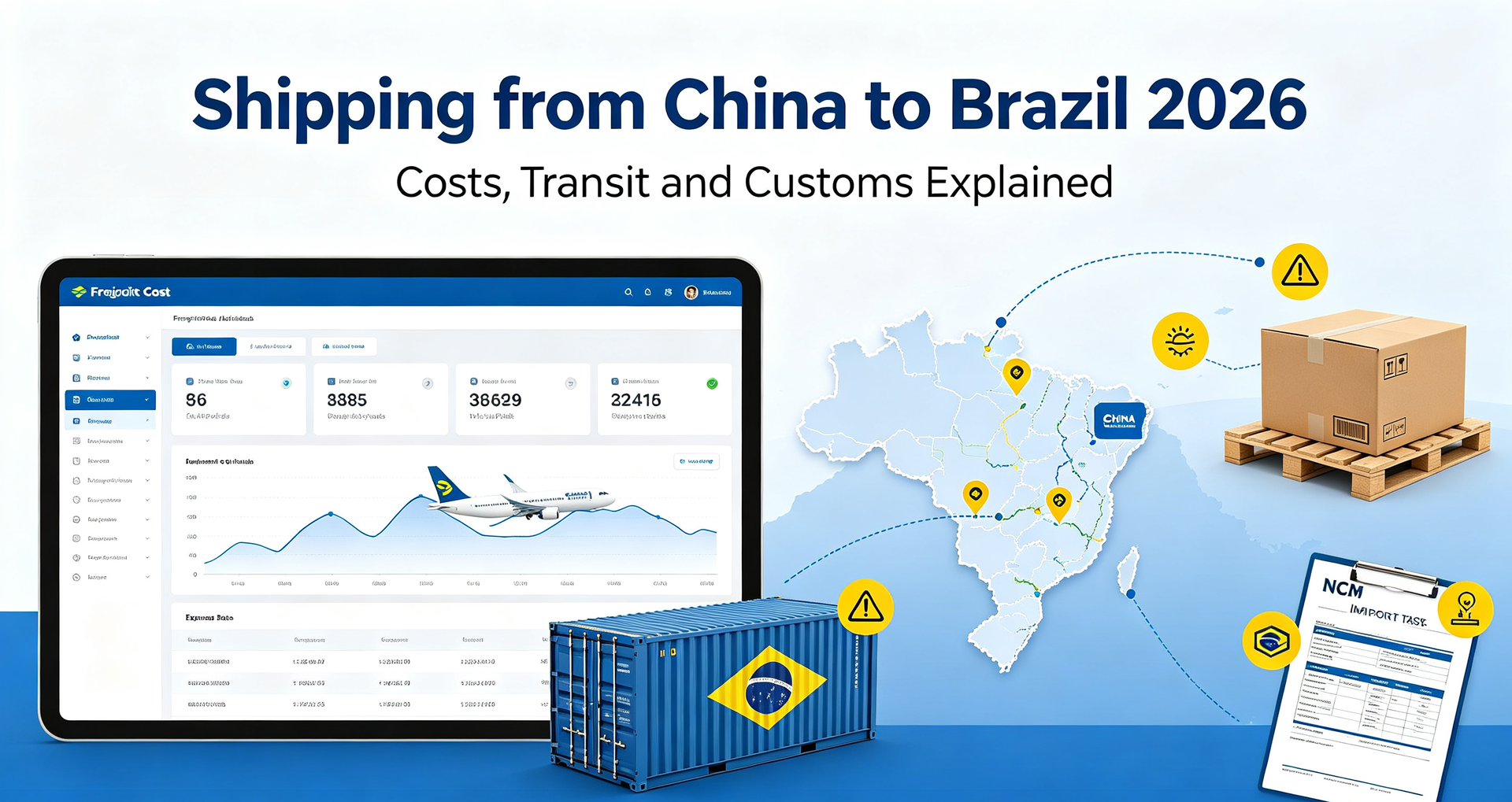
This guide compares sea, air, and express shipping costs from China to Brazil, with actionable strategies to navigate tariffs and customs.
Sea freight handles most China–Brazil trade volume. It is the lowest-cost option for large shipments, with FCL and LCL options to match cargo volume.
| Container Type | Cost Range (USD) | Best For |
| LCL | $80–$220 per CBM | Shipments under 12–15 CBM |
| 20ft FCL | $1,800–$4,550 | Medium cargo volumes |
| 40ft / 40HQ FCL | $2,500–$5,550 | Large shipments, best per-unit cost |
Rates fluctuate by season, fuel, and carrier capacity. Destination: Santos, Paranaguá, Rio de Janeiro, or Vitória.
Additional costs to factor in:
| Fee | Typical Range | Notes |
| THC (Terminal Handling) | $210–$260 (20ft) | Origin port charge |
| Port Storage | $8–$15/day | After free period (3–7 days) |
| Demurrage | $25–$60/day | After 7 days of detention |
| AFRMM (Maritime Tax) | 25% of ocean freight | Federal tax on sea imports |
| Documentation Fee | $80–$150 | Per bill of lading |
| Route | Port-to-Port | Door-to-Door |
| China → Santos | 30–40 days | 35–50 days |
| China → Paranaguá | 32–42 days | 40–55 days |
| China → Manaus (via transshipment) | 45–55 days | 50–60 days |
The breakeven point – where FCL becomes more cost-effective than LCL – is approximately 15–18 CBM. Below this, LCL offers lower upfront cost; above it, FCL delivers lower per-unit cost and more predictable transit.
Considerations for LCL:
Origin consolidation + destination deconsolidation add 5–10 days to transit
Higher handling frequency increases damage risk
Destination CFS fees can be significant ($30–50 per CBM)
Air freight delivers goods to Brazil in days rather than weeks, but carries a significant cost premium. Direct flights are limited – most cargo transits via Europe or the Middle East (e.g., Qatar Airways or Emirates).
Air freight is priced by chargeable weight – the greater of actual weight and volumetric weight (L × W × H in cm ÷ 6,000). Direct cargo flights from China to Brazil are virtually non-existent.
| Weight Bracket | Cost Range (USD/kg) | Notes |
| <100 kg | $8.00–$12.00 | Higher per-kg rates |
| 100–300 kg | $6.50–$10.00 | Volume discounts apply |
| >300 kg | $6.00–$9.00 | Best rates |
Air freight typically delivers in 5–12 days door-to-door, with express courier options reaching 3–7 days.
Hidden cost warning: Brazilian airport storage fees (Armazenagem) are calculated by Infraero as a percentage of CIF value and compound daily. If documentation is not pre-validated before wheels-up, cargo can be stuck in the Red Channel (Canal Vermelho) for extended inspection, incurring storage fees that can wipe out profit margins.
Stockout prevention – urgent replenishment
New product launches – time-sensitive market entry
High-value goods – electronics, medical supplies, fashion
Commercial samples – pre-sale validation
DHL, UPS, and FedEx provide door-to-door express services with customs clearance included – the fastest option for small parcels, samples, and documents.
| Weight Bracket | Cost Range (USD/kg) | Transit Time |
| 0.5–20 kg | $12–$20 | 3–7 days |
| 21–99 kg | $10–$16 | 3–7 days |
Volume weight is calculated using a divisor of 5,000 for express courier.
2026 Policy Update: Brazil eliminated the 20% federal import tax on parcels under $50, effective May 13, 2026. This applies to e-commerce shipments under the "Remessa Conforme" program. State ICMS (17–20%) still applies.
Small parcels and samples – under 150kg
Commercial samples – product testing or trade shows
Urgent e-commerce orders – direct-to-consumer shipments
Documents and contracts – fastest option
| Dimension | Sea Freight (FCL/LCL) | Air Freight | Express Courier |
| Cost (per kg) | Lowest (~$0.08–0.15) | Medium-High ($6.00–10.50) | Highest ($12–20) |
| Cost (per CBM) | $80–$220 | ~$2,000–$5,000+ | Varies |
| Transit Time | 30–50 days | 5–12 days | 3–7 days |
| Best For | Bulk, non-urgent | Time-sensitive, high-value | Small parcels, samples |
| Customs | Separate broker entry | Broker included | Door-to-door clearance |
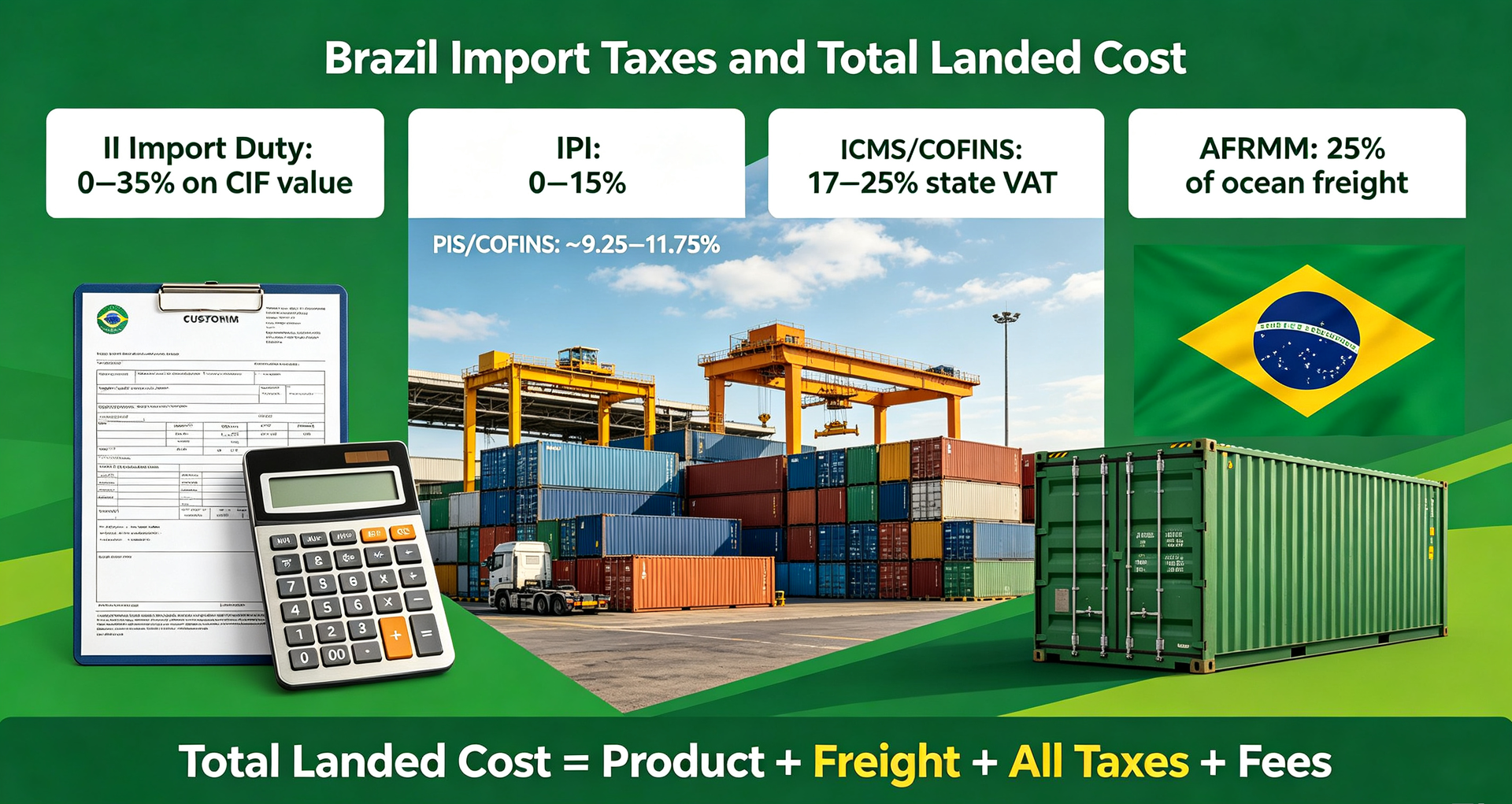
Brazil applies one of the most complex cumulative tax structures in the world – commonly referred to as the "Custo Brasil" (Brazil Cost). The total tax burden often ranges from 40–70% of CIF value and can exceed ocean freight costs.
| Tax | Typical Rate | Calculation Base |
| II – Import Duty | 0–35% (commonly 10–18%) | CIF value |
| IPI – Industrialized Products Tax | 0–15% | CIF + II |
| PIS/COFINS | ~9.25–11.75% combined | CIF + taxes |
| ICMS – State VAT | 17–25% (18% in São Paulo) | CIF + federal taxes |
| AFRMM – Maritime Freight Tax | 25% of ocean freight | Ocean freight cost |
| Siscomex Fee | ~$38 per shipment | Per import declaration |
Example: A shipment with a CIF value of $10,000 could incur $5,000–$8,000 in duties and taxes – often exceeding the freight cost.
Brazil uses the NCM (Nomenclatura Comum do Mercosul) – an 8-digit extension of the HS code that determines the exact duty rate. Duty rates are tied to the NCM, not the HS code, so accuracy at the 8-digit level is essential. Misclassification can lead to customs holds (5–15 days), storage fees, and fines.
50 USD De Minimis Eliminated: Effective May 13, 2026, Brazil eliminated the 20% federal import tax on parcels under 50 USD under the "Remessa Conforme" program. However, state ICMS (17–20%) still applies. For a 45 USD product, total tax dropped from ~$20 to ~$9.
Temporary 120-day measure: The policy is currently temporary for 120 days, pending congressional approval.
Sector-specific tariff changes: Brazil has reduced import duties to 0% on certain products including polyester fiber, titanium dioxide, and pharmaceutical ingredients.
Step 1: Calculate Your Cargo Volume and Weight
Measure actual weight and dimensions (L × W × H) for all packages.
For LCL, remember 1 CBM is compared against 1,000 kg – the greater value is charged.
Step 2: Determine Your Timeline and Budget
Urgent (3–7 days): Express courier – highest cost, lowest risk.
Moderate (5–12 days): Air freight – balanced speed and cost.
Flexible (30–50 days): Sea freight – lowest cost, best for large volumes.
Step 3: Evaluate FCL vs LCL Based on Volume
Under 12 CBM: LCL is typically more cost-effective.
12–18 CBM: The "grey zone" – compare total all-in costs.
Over 18 CBM: FCL delivers far lower unit cost.
Step 4: Verify NCM Code and Duty Rate
Use Siscomex or consult a customs broker to verify the 8-digit NCM.
Confirm II, IPI, and ICMS rates for your product category.
Factor total taxes into landed cost – often exceeding freight.
Step 5: Select Incoterms
FOB: Balanced control – most common for China-Brazil.
DAP/DDU: Buyer pays duties on arrival.
DDP: Seller pays duties (requires careful customs planning).
Step 6: Get Multiple Quotes and Compare Total Landed Cost
Compare identical scope (door-to-door, same Incoterms).
Watch for hidden fees: AFRMM (25% of ocean freight), port storage, demurrage.
Three suppliers each shipping 5 CBM via LCL: $110/CBM × 15 = $1,650. Consolidated into one 20ft FCL (~$2,500) – slightly higher cost but 7–10 days faster transit and lower damage risk.
Wrong NCM codes are the #1 customs hold cause in Brazil. Pre-validation prevents 5–15-day inspection holds and storage fees.
AFRMM is 25% of ocean freight. ICMS varies by state (17–25%). Many importers miss these until the bill arrives.
Brazil peaks: Chinese New Year, Carnival, June–August. Add 1–2 weeks of buffer. Rates can spike 30–50% during these periods.
Under 10 CBM, a door-to-door LCL quote often beats FOB + destination charges, because the forwarder absorbs consolidation costs into the per-CBM rate.
Direct Nansha-to-Vitória service cuts transit by over 5 days compared to Singapore or European transshipments. New weekly routes from Ningbo to Manaus and Salvador offer alternatives.
The China-Brazil route is long-haul with handling risks. Coverage typically costs 0.2–0.5% of cargo value.
A: Sea freight (LCL or FCL) is the cheapest option. LCL costs $80–$220 per CBM, while FCL provides the lowest per-unit cost for shipments over 15–18 CBM.
A: Express courier: $12–20/kg; air freight: $6.00–10.50/kg; sea freight: significantly less per kg (LCL $80–220/CBM, or roughly $0.08–0.22/kg).
A: 30–40 days to Santos (port-to-port) and 35–50 days door-to-door. LCL adds 5–10 days for consolidation/deconsolidation.
A: Approximately 15–18 CBM. Below this, LCL is usually cheaper. Above it, FCL delivers lower per-unit cost and faster transit.
A: AFRMM is the Merchant Marine Renewal Tax – 25% of ocean freight cost. It applies to all sea freight imports into Brazil and must be factored into total landed cost.
A: NCM is Brazil's 8-digit Mercosul HS code extension that determines exact duty rates. Accuracy at the 8-digit level is critical – misclassification leads to customs holds, storage fees, and penalties.
A: Brazil eliminated the 20% federal import tax on e-commerce parcels under 50 USD, effective May 13, 2026. This applies to "Remessa Conforme" shipments. State ICMS (17–20%) still applies. The policy is temporary for 120 days.
There is no single "best" shipping method from China to Brazil – the right choice depends on your product, urgency, budget, and ability to navigate Brazil's tax system.
For cost-efficiency: Sea freight (FCL for >18 CBM, LCL for smaller volumes)
For speed and flexibility: Air freight
For small parcels and samples: Express courier
The most successful importers use a hybrid strategy: sea freight for steady replenishment, air freight for emergency restocks and launches, and express for samples and urgent small orders. And above all – verify your NCM code, factor in all taxes, and work with an experienced forwarder on the China-Brazil lane.






 Email: