

WORLDWIDE FREIGHT SERVICES
Email: jack@transworldcn.com
TL;DR – Key Takeaways for First-Time Importers
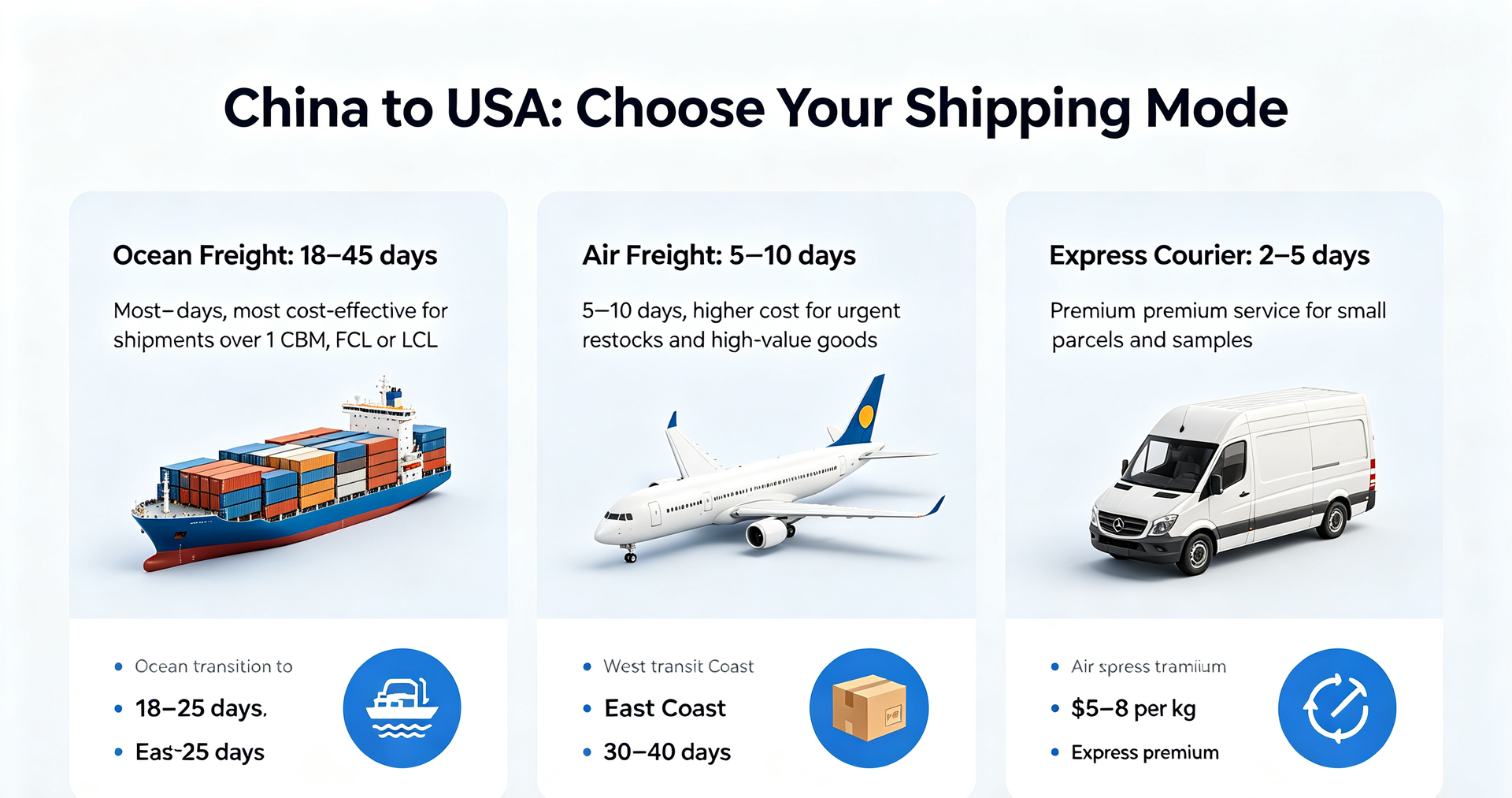
Choose your shipping mode wisely: Ocean freight is most cost-effective for shipments over 1 CBM (18–45 days transit); air freight delivers in 5–10 days but costs 4–8x more; express couriers offer 2–5 day delivery for small parcels.
Complete documentation is non-negotiable: You'll need a Commercial Invoice, Packing List, Bill of Lading or Air Waybill, ISF filing (for ocean), and likely a Customs Bond.
Factor in all costs, not just freight: Total landed cost includes freight + duties (Section 301: 7.5–25%, plus base tariffs) + customs broker fees ($125–300/entry) + inland trucking.
The $800 de minimis exemption is gone (August 29, 2025): Every commercial shipment from China now requires formal customs entry, regardless of value.
Work with a freight forwarder: They handle carrier booking, customs filings, and coordination with local trucking – critical for first-timers.
You've found a supplier in China, negotiated a price, and placed your first order. Then comes the part nobody warned you about: actually getting the goods to your door.
Shipping from China to the USA involves more moving parts than most first-time importers expect. There are multiple transport modes to choose from, a customs process with real financial consequences if handled poorly, and in 2026, a tariff environment that has changed significantly.
This step-by-step guide covers everything you need to know: choosing the right shipping method, understanding costs, preparing documentation, navigating U.S. customs clearance, and managing the tariff landscape. Whether you're sourcing for an e-commerce store, Amazon FBA, or industrial equipment, this guide provides a practical roadmap.
The first decision is how your goods will travel. It has the biggest impact on both cost and timing.g
Ocean freight is the most cost-effective option for shipments over 1 CBM. It divides into two options :
| Mode | Best For | Transit Time | Cost |
| FCL (Full Container Load) | Shipments >15 CBM; lower damage risk | 18–25 days to West Coast; 30–40 days to East Coast | $2,500–3,500 (20ft); $3,500–6,000 (40ft) |
| FCL (Full Container Load) | Shipments 1–15 CBM; shares container space | FCL time + 3–7 days for consolidation | $50–80 per CBM |
Ocean freight from China to the U.S. West Coast typically takes 18–25 days port-to-port, with East Coast destinations running 30–40 days.LCL shipments add time at both ends for consolidation at origin and deconsolidation at destination.
Air freight cuts transit time down to 5–10 days door-to-door for standard services, or 3–7 days for express couriers like DHL, FedEx, and UPS
| ode | Transit Time | Cost per kg | Best For |
| Standard Air Freight | 5–10 days | $5–8 | High-value goods, urgent restocks |
| Express Courier | 2–5 days | Premium | Small parcels, samples, urgent orders |
Air freight rates per kilogram run several times higher than ocean freight. It makes sense for high-value goods, time-sensitive restocks, or product samples, but not as a routine shipping method for heavy or bulky cargo.
Under 150 kg and time-sensitive: Price express courier or air freight.
Over 500 kg: Ocean freight is almost always the right choice unless there's a genuine deadline.
Between 150–500 kg: The middle range requires a judgment call based on your goods and business situation.
| Cost Component | Typical Range | Notes |
| Base Freight | Varies by mode | Ocean: per CBM or per container; Air: per kg or volumetric weight |
| Origin Charges | $200–500 | THC, documentation, export clearance |
| Destination Charges | $300–800 | THC, customs clearance, delivery fees |
| Customs Bond | $100–500 (single) / $500–1,000+ (continuous) | Required for most formal entries |
| Import Duties | 7.5–25%+ (Section 301) + base tariff | Varies by HTS code and country of origin |
| Customs Broker Fee | $125–300 | Per entry filing |
| Fuel Surcharge | 10–25% of base freight | Fluctuates monthly |
For air freight and express, airlines charge based on the greater of actual weight or volumetric weight: Length × Width × Height (cm) ÷ 6,000. For bulky but lightweight cargo, you may pay significantly more than the actual weight.
The tariff landscape for Chinese imports has changed substantially :
Section 301 tariffs remain in force: 7.5–25% on most Chinese goods across electronics, furniture, machinery, and textiles.
New 12.5% Section 301 forced-labor tariff (effective July 24, 2026): Brings aggregate Section 301 rate to approximately 37.5% on typical consumer goods.
IEEP reciprocal tariffs (10–145% during 2025) were struck down by the U.S. Supreme Court on February 20, 2026, and are no longer collected.
$800de minimis eliminated (August 29, 2025): Every commercial shipment now requires formal entry, regardless of value
The practical result: For most SMBs importing Chinese goods, Section 301 duties still apply, plus the new 12.5% tariff stacks on top. Use a duty calculator or consult a customs broker before you book.
Documentation is where many first-time importers stumble. The core documents required include :
| Document | Purpose | Timing |
| Commercial Invoice | Goods details, value, buyer/seller info | Pre-shipment |
| Packing List | Itemized list of packages, weights, dimensions | Pre-shipment |
| Bill of Lading (B/L) or Air Waybill (AWB) | Contract of carriage; proof of ownership | At booking |
| ISF 10+2 (Importer Security Filing) | Required for ocean freight; filed 24+ hours before vessel loading | Pre-loading |
| Customs Entry (CBP Form 3461 or 7501) | Filed by customs broker to clear goods | At arrival |
| Customs Bond | Single-entry or continuous; required for formal entries | At arrival |
| Product Type | Required Certification |
| Electronics | FCC certification |
| Batteries | MSDS + UN38.3 test report |
| Food/Cosmetics | FDA registration |
| Toys/Children's Products | CPC (Children's Product Certificate) |
| Wood Packaging | ISPM 15-compliant IPPC marks |
Expert Insight: "Many first-time importers assume that customs clearance only starts at the destination port. In reality, for U.S. shipments, ISF filing must be completed before the vessel even departs China. Missing this deadline can trigger $5,000 fines. The professional approach is to implement a 'three-document consistency check'—ensuring the Bill of Lading, Commercial Invoice, and Packing List all match exactly—before the booking stage" .
Key tip: Work with a freight forwarder who can explain documentation requirements in plain terms and pre-validate your documents before cargo is loaded. This is one of the most effective ways to avoid delays.
U.S. Customs clearance is mandatory for all commercial imports. Here's what happens :
1. ISF Filing (Ocean Only)
File ISF 10+2 at least 24 hours before vessel loading. Late or missing filings risk penalties up to $5,000.
2. Shipment Arrives at U.S. Port/Airport
Carrier notifies CBP and your broker of arrival.
CBP logs the shipment into the ACE system.
3. CBP Document Review & Risk Assessment
Automated review scans documents for discrepancies (mismatched quantities, vague descriptions, invalid HTS codes)
High-risk shipments are flagged for manual review. In 2026, the "5H" inspection code has become increasingly common – a digital hold that locks cargo within the ACE system until document discrepancies are resolved.
4. Duty Calculation & Payment
Duties are based on HTS code, Section 301 tariffs, and port fees (MPF: 0.3464%; HMF: 0.125%).
Payment via Customs Bond (preferred for speed) or direct payment.
5. Release or Inspection
If approved: Shipment is released (ACE status: 5I).
If selected for inspection: VACIS X-ray (1–2 days), manual check (2–5 days), or PGA inspection (3–7 days).
6. Pickup & Last-Mile Delivery
Pay port/airport fees, arrange trucking to your warehouse.
For FBA shipments: Coordinate with Amazon's warehouse appointment system.
| Hold Type | Cause | Resolution |
| 5H Document Review | Document discrepancies, invalid HTS codes | Provide corrected docs within 30 days |
| Physical Inspection | AI flags, random checks, undervaluation | Usually a 25–day delay |
| PGA Inspection | Missing FDA, FCC, EPA certifications | Provide certificates, 3–7 day delay |
| Service | What's Included | Best For |
| DDP (Delivered Duty Paid) | All duties, taxes, and fees prepaid; one invoice for door-to-door | First-time importers; Amazon FBA sellers; simpler budgeting |
| DDU (Delivered Duty Unpaid) | Freight only; buyer pays duties on arrival | Experienced importers with their own customs broker and bond |
DDP is typically the better fit if:
You are an Amazon FBA seller who needs goods delivered without managing the customs process.
You are importing for the first time and do not have a U.S. EIN, IOR registration, or Customs Bond in place.
You want a single invoice covering everything from the Chinese warehouse to the U.S. delivery point.
For importers just getting started, working with a freight forwarder who can explain mode selection in plain terms reduces a significant amount of guesswork.
Arranges pickup from your supplier
Books vessel or aircraft space
Prepares export documents
Files ISF on your behalf
Coordinates with U.S. customs brokers for clearance
Arranges delivery to your warehouse or fulfillment center
Confirm they have experience with your product category
Ask about their process for handling customs holds
Request references from similar importers
Verify they offer door-to-door service if you prefer DDP
| Red Flag | Why It Matters |
| Only quotes port-to-port | May not have U.S. operations or customs relationships |
| No U.S.-based operations team | Can't manage customs clearance issues during U.S. business hours |
| ISF filing not included | Legal requirement for every ocean shipment – if it's not in the quote, they may not routinely handle it |
| No documented FBA experience | Shipping to Amazon requires specific knowledge (FNSKU labels, pallet specs, appointment scheduling) |
| "Actual charges may vary" without cap | Potential for surprise charges upon delivery |
A: Door-to-door: air freight 5–10 days; sea FCL to West Coast 25–35 days, East Coast 30–45 days; LCL adds 3–7 days for consolidation/deconsolidation
A: Ocean FCL: $2,500–3,500 (20ft), $3,500–6,000 (40ft); LCL: $50–80 per CBM; air freight: $5–8/kg. Total landed cost must include duties, customs broker fees, and inland trucking.
A: ISF (Importer Security Filing) must be filed at least 24 hours before vessel loading. Late or missing filings can result in penalties up to $5,000 and cargo holds
A: Yes, for most formal entries. You can choose between a single-entry bond (for one shipment) or a continuous bond (for frequent shipments).
A: No. The $800 de minimis exemption was eliminated on August 29, 2025. Every commercial shipment now requires formal entry, regardless of value.
A: FCL means you rent an entire container. LCL means your cargo shares space with other shippers. FCL is cheaper per unit and faster for shipments over 15 CBM; LCL works for smaller volumes
A: Yes, but Amazon has specific requirements: FNSKU labels on every unit, FBA box ID labels on each carton, and appointment scheduling through Amazon's system. Your forwarder should manage these requirements
Shipping from China to the USA doesn't have to be complicated – but it does require planning. The importers who succeed are those who:
Choose the right shipping mode based on cargo volume and timeline
Understand total landed cost – not just the freight quote
Prepare documentation before cargo is loaded
Work with an experienced freight forwarder
Factor tariffs and duties into their margins






 Email: