

WORLDWIDE FREIGHT SERVICES
Email: jack@transworldcn.com

TL;DR – Key Takeaways for Importers and E-Commerce Sellers
Air freight rates in August 2026 remain elevated: The global Baltic Air Freight Index (BAI00) is 19.2% higher year-over-year, driven by rising jet fuel costs (+76.5% YoY) and ongoing geopolitical tensions in the Persian Gulf.
Rates vary significantly by destination: North America ($7.04–$7.77/kg), South America ($8.50–$9.24/kg), Europe ($5.86–$6.60/kg), and Oceania ($3.67–$4.40/kg) as of April 2026
China–Europe rates saw sharp volatility in mid-2026: The EU's July 1 removal of the €150 de minimis exemption triggered a 29% drop in spot rates from China to Europe between late June and early August.
Chargeable weight is the key to cost control: Airlines charge based on the greater of actual gross weight or volumetric weight (Length × Width × Height ÷ 6,000). Optimizing packaging can reduce chargeable weight by 15–30%
Air freight is 4–15x more expensive than ocean freight: For a 1,000 kg shipment from Shanghai to Los Angeles, air totals $3,800–$5,800 versus sea LCL at $450–$900.
For businesses sourcing products from China, air freight offers the fastest shipping option—but also the most expensive. In 2026, global air freight rates have been shaped by a volatile mix of geopolitical tensions, fuel price fluctuations, and regulatory changes.
As of August 2026, the global Baltic Air Freight Index (BAI00) sits 19.2% higher than a year ago, with jet fuel prices up 76.5% year-over-year and ongoing Persian Gulf tensions adding further pressure. The end of the EU's de minimis exemption on July 1, 2026, has also reshaped e-commerce volumes and pricing dynamics on China–Europe lanes.
This guide provides a comprehensive breakdown of air freight costs from China to major global destinations, explains the critical concept of chargeable weight, and offers actionable strategies to optimize your shipping costs.
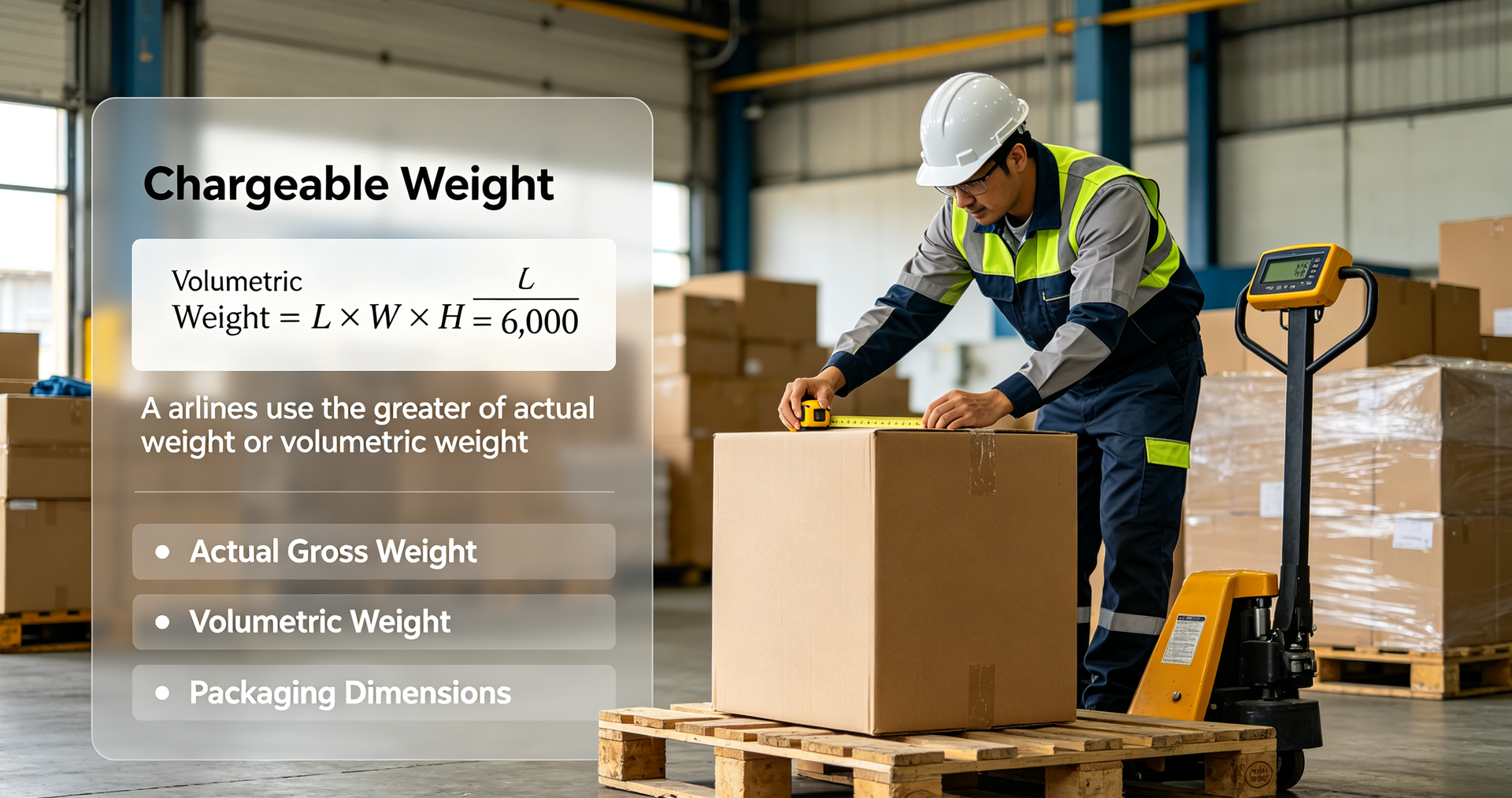
Airlines do not simply charge by the kilogram of your product. They calculate the chargeable weight—the greater of your shipment's actual gross weight or its volumetric (dimensional) weight.
Volumetric Weight Formula :
text
Volumetric Weight (kg) = Length × Width × Height (cm) ÷ 6,000
Example: A pillow shipment weighing 2 kg in a 50×40×30 cm carton:
Actual weight: 2 kg
Volumetric weight: 50×40×30 ÷ 6,000 = 10 kg
Chargeable weight: 10 kg
Critical insight: Even small changes in package dimensions can significantly reduce shipping costs. Many shippers are surprised to find they are paying for space rather than weight.
Air freight rates decrease as shipment weight increases. Typical weight brackets:
| Weight Bracket | Rate Impact |
| <100 kg | Highest per-kg rates |
| 100–300 kg | Volume discounts apply |
| >300 kg | Best rates |
For dense cargo, the break-even point where air freight becomes comparable to ocean freight typically occurs at 150–300 kg on major lanes like China–US.
The following rates are indicative averages and exclude destination delivery, customs clearance, and surcharges :
| Destination Region | Rate Range (USD/kg) | Transit Time (Days) | Trend |
| North America (USA/Canada) | $7.04 – $7.77 | 3–5 | ↑ Rising |
| Europe (UK, Germany, France) | $5.86 – $6.60 | 1–3 | ↑ Rising |
| South America (Brazil, etc.) | $8.50 – $9.24 | 5–7 | ↑ Rising |
| Middle East | $5.57 – $6.30 | 1–3 | ↑ Rising |
| Africa | $8.06 – $8.80 | 5–7 | ↑ Rising |
| Oceania (Australia, NZ) | $3.67 – $4.40 | 1–3 | → Stable |
| Asia (Southeast Asia) | $1.76 – $4.10 | 1–3 | → Stable |
Source: BSI Freight, April 2026 Week 4 data.
Rate range: $7.04–$7.77/kg (airport-to-airport)
Q1 2026 benchmark: Shanghai–Los Angeles average $7.40/kg
Transit time: 3–5 days
In August 2026, rates from China to the US increased week-over-week as the market adjusted to the new EU customs regime, with some freighter capacity shifting from Europe to the transpacific sector. Rates from Hong Kong to the US remained firm throughout July, with Hong Kong to US West Coast dropping only slightly from $49.43/kg to $46.34/kg.
Rate range: $5.86–$6.60/kg (airport-to-airport)
Q1 2026 benchmark: $3.60/kg average
Transit time: 1–3 days
Major volatility in mid-2026: Spot tariffs from mainland China to Europe tumbled 29% between late June and early August, settling at $3.86/kg, while Hong Kong–Europe prices dropped 15% to $4.96/kg. This was driven by the EU's July 1 termination of duty-free entry for goods under €150, which hit the e-commerce-centric Hong Kong corridor especially hard.
Despite this correction, rates remain above year-ago levels, and outbound China-to-Europe pricing increased +6% week-over-week in mid-August as the market adjusted to the new customs regime.
Rate range: $8.50–$9.24/kg
Transit time: 5–7 days
Best for: Urgent commercial goods, electronics, medical supplies, high-value cargo
South America remains the most expensive lane from China due to longer flight distances and limited direct routing.
Rate range: $3.67–$4.40/kg
Transit time: 1–3 days
Best for: Urgent fashion, apparel, high-end electronics
| Surcharge Type | Typical Range | Notes |
| Fuel Surcharge | Variable | Based on jet fuel price; up 76.5% YoY |
| War Risk Surcharge | Per kg basis | Applied on chargeable weight |
| Security Surcharge | Varies by route | Determined by origin/destination |
| Documentation Fee | $50–$150 | Per Air Waybill |
| Customs Clearance | $80–$200 | Varies by destination |
| Destination Trucking | $100–$500+ | Airport to final warehouse |
For a 100 kg shipment from China to Germany :
Base rate: $7.30/kg × 100 = $730
Surcharges (fuel, security, etc.): $200–$300
Total: $930–$1,030
As a rule of thumb, surcharges add 30–60% to the base freight cost
Even small reductions in carton size can lower chargeable weight by 15–30%. Use right-sized cartons, vacuum-compress soft goods, and eliminate unnecessary packaging.
Air freight cost per kg decreases as shipment weight increases. If possible, combine multiple smaller shipments into one larger shipment to access better per-kg rates.
Peak periods (Chinese New Year, March–April fashion cycle, Q4 holiday surge) can push rates 20–40% higher. Booking 3–4 weeks ahead locks in capacity and avoids premium pricing.
Selecting the gateway closest to your final destination reduces trucking costs and transit time. For Germany, routing through Leipzig instead of Frankfurt for Berlin deliveries can save €100–€200 in trucking costs.
The most common causes of customs delays are incorrect HS codes, undervalued invoices, missing compliance certificates, and invalid EORI numbers. Pre-screen all documentation to avoid storage fees and delays.
An experienced team can compare different airlines and routes to find the most cost-effective option for your shipment. Even small changes in weight, packaging size, or timing can significantly affect your air freight cost from China
Air freight is recommended for:
Time-sensitive shipments – When sea freight would miss delivery deadlines
High-value goods – Electronics, medical supplies, pharmaceuticals
Inventory replenishment – Emergency restocks to avoid stockouts
Commercial samples – Pre-sale validation and trade shows
Product launches – Time-sensitive market entry
A: Rates range from $2.50 to $9.24/kg depending on destination, with North America ($7.04–7.77/kg), Europe ($5.86–6.60/kg), and South America ($8.50–9.24/kg) being the most expensive lanes as of April 2026.
A: Volumetric weight is the space your cargo occupies, calculated as Length × Width × Height ÷ 6,000. Airlines charge based on the greater of actual weight or volumetric weight. For light-but-bulky cargo, you may pay significantly more than the actual weight.
A: Optimize packaging to reduce volumetric weight (saving 15–30%), consolidate shipments for better per-kg rates, book 3–4 weeks ahead during peak seasons, and choose the gateway closest to your final destination
A: Yes. For a 1,000 kg shipment from Shanghai to Los Angeles, air totals $3,800–$5,800 versus sea LCL at $450–$900—a 4–15x premium.
A: Transit times range from 1–7 days depending on destination: Asia (1–3 days), Europe (1–3 days), North America (3–5 days), South America (5–7 days), and Africa (5–7 days).
A: The EU's July 1 termination of duty-free entry for goods under €150 significantly reduced e-commerce volumes from China, with mainland China-to-Europe tonnage dropping 10% year-over-year and Hong Kong shipments plunging 29%. Spot tariffs fell 29% in response.
A: Strongly recommended for shipments valued over $10,000. Premiums typically cost 0.3–1.0% of declared value and cover loss, damage, and theft during transit.
Air freight from China remains the fastest shipping option but comes at a significant premium—typically 4–15x more expensive than sea freight. Rates vary by destination, with North America and South America commanding the highest per-kg prices.
The 2026 market has been marked by volatility: geopolitical tensions and fuel costs have driven rates higher year-over-year, while the EU's de minimis removal caused a sharp correction on China–Europe lanes in mid-202. For shippers, the key to cost control lies in understanding chargeable weight, optimizing packaging, and booking early during peak seasons.






 Email: