

WORLDWIDE FREIGHT SERVICES
Email: jack@transworldcn.com
TL;DR – Case Study at a Glance
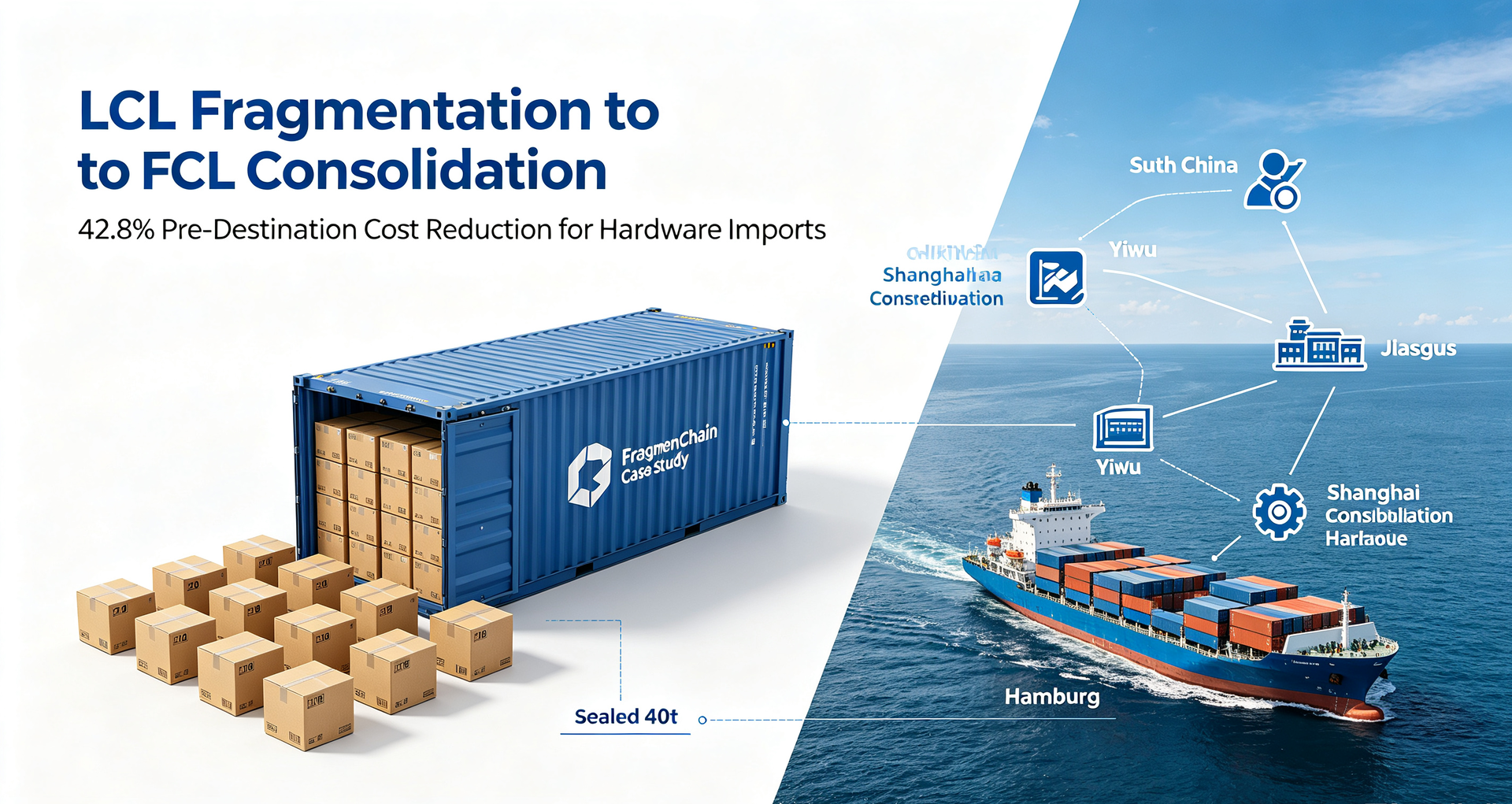
The Problem: A mid-sized hardware distributor shipped 20+ separate LCL consignments per month from multiple suppliers across South China, Yiwu, Ningbo, and Jiangsu to Hamburg, Germany.
The Hidden Costs: Each LCL shipment incurred separate inland trucking fees, export declaration charges, bill of lading fees, and documentation processing—costs that don't scale down with small shipment size.
The Solution: Consolidated all monthly volume (35–50 CBM) into a single 40ft FCL shipment from Shanghai Yangshan port.
The Result: 42.8% reduction in pre-destination logistics costs—from $7,820 to $4,470 per month. Administrative labor tracking 20 separate shipments was reduced by approximately 70%.
Key Lesson: The volume threshold where FCL becomes more cost-effective is not just about base freight—it's about total cost including fragmentation overhead. For hardware, fasteners, and dense goods, the breakeven can be as low as 15–18 CBM per month.
Most mid-sized hardware distributors serving European or North American markets fall into a predictable pattern: they source SKUs from 12 to 25 separate suppliers across multiple Chinese manufacturing hubs—South China, Yiwu, Ningbo, and Jiangsu—and ship each small production run as a separate 1–3 CBM LCL consignment.
Over a month, this adds up to 20+ individual shipments, usually totaling 35 to 50 CBM of dense hardware, fasteners, and plastic injection parts. On paper, each LCL shipment looks cost-effective. In practice, the fragmentation creates a stack of hidden fees that procurement teams rarely track.
This case study examines a real-world hardware distributor that made the switch from fragmented LCL to consolidated FCL—and the measurable cost savings that followed.
| Parameter | Detail |
| Client | Mid-sized hardware distributor sourcing from China to Germany |
| Product Type | Mixed hand tools, fasteners, plastic injection parts |
| Monthly Volume | 35–50 CBM total |
| Supplier Network | 12–25 suppliers across South China, Yiwu, Ningbo, Jiangsu |
| Before Approach | 20 separate LCL shipments, each 1–3 CBM |
| After Approach | 1 consolidated 40ft FCL shipment from Shanghai Yangshan |
| Cost Reduction | 42.8% in direct pre-destination logistics costs |
LCL shipping is designed for small-volume importers. It allows businesses to pay only for the space they use—usually 1–3 CBM per consignment—rather than committing to an entire container.
For a growing hardware distributor, LCL made sense during the early stages. Each purchase order from a supplier was small, and the immediate freight spend was manageable. The challenge is that as the business grows, the LCL model does not scale efficiently.
Most procurement teams do not track the full stack of hidden fees that come with fragmented LCL shipments. Per individual LCL consignment, the importer pays:
Separate inland trucking fees from each supplier to their local port
Separate export declaration charges
Separate bill of lading fees
Separate certificate processing (CO, CE, ISF documentation)
Separate THC (Terminal Handling Charges) accessorials
None of these costs scale down proportionally with small shipment size. A $40 export declaration fee on a 2 CBM shipment is the same $40 fee that would cover a full container. When multiplied across 20 shipments per month, fragmentation becomes expensive.
Beyond direct costs, there is the hidden overhead of management:
8–12 hours per week spent tracking 20 separate LCL shipments
Resolving individual customs queries for each consignment
Chasing suppliers for missing documentation
Coordinating with multiple freight forwarders
LCL shipments generate separate documentation for each consignment. Bills of lading, commercial invoices, packing lists, and ISF filings must be prepared individually. When one document has an error—an incorrect HS code, a missing supplier address—the entire shipment can be delayed.
LCL shipments are also subject to consolidation delays. Cargo must wait at origin CFS (Container Freight Station) for other shippers' goods before the container is sealed. At destination, the container is deconsolidated, adding further time. LCL typically involves more handling and less control over timing, as your cargo is tied to the schedules of other shipments.
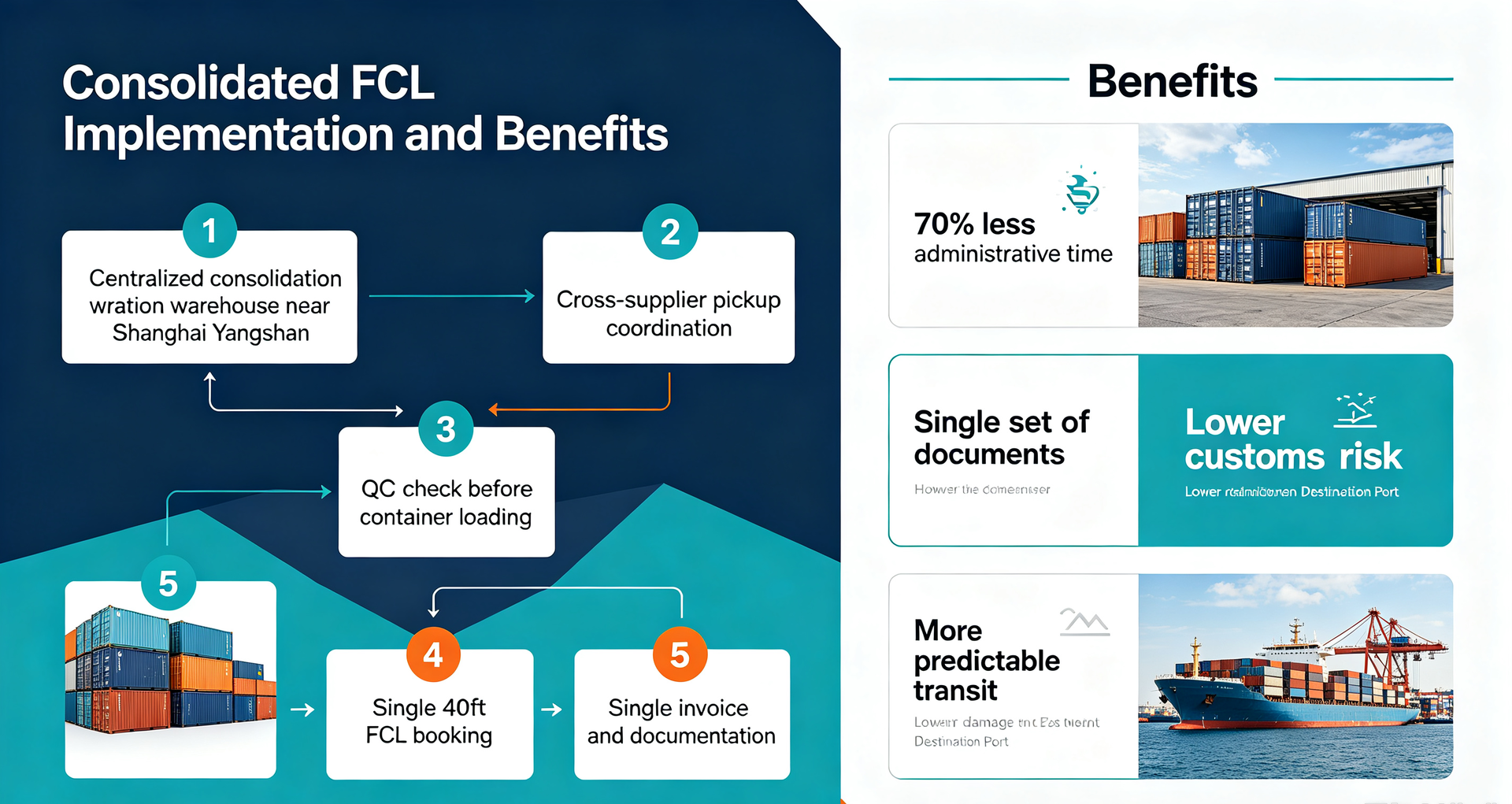
Step 1: Establish a Centralized Consolidation Warehouse
The distributor continued placing individual POs with all existing suppliers.
Each supplier delivered goods to the Shanghai consolidation warehouse, located 12 km from Yangshan port.
The logistics provider tracked every incoming pallet and logged individual SKU counts.
Step 2: Implement Cross-Supplier Pickup Coordination
For suppliers located in Yiwu, Ningbo, and Jiangsu, staggered pickup routes were scheduled.
This cut total inland trucking costs by more than 50% compared to individual supplier trips to local ports.
Step 3: Execute Quality Control at Consolidation Point
A two-gate QC process was implemented:
Pre-Shipment Inspection (PSI) at each factory
Incoming QC check on the warehouse dock, verifying quantities and spot-checking for shipping damage
Non-conforming parts were rejected before they ever entered the container.
Step 4: Book a Single 40ft FCL
Once all goods were received, a single 40ft FCL was booked from Shanghai Yangshan to Hamburg.
A single EOR (Exporter of Record) declaration covered all goods—one set of documentation instead of 20.
Step 5: Simplify Billing and Documentation
The distributor received a single USD invoice for the consolidated shipment.
The logistics provider handled all downstream RMB settlements to individual factories.
The table below compares the true cost of 20 separate LCL shipments versus one consolidated FCL for a shipment of 40 CBM to Hamburg, Germany:
| Cost Category (40 CBM, Hamburg) | Traditional 20 x 2 CBM LCL | Consolidated 1 x 40ft FCL |
| Base ocean freight | $5,000 (avg $125/CBM) | $2,100 |
| Inland trucking (supplier to port) | $1,400 ($70 per supplier) | $650 (consolidated pickups) |
| China export declaration fees | $800 ($40 per shipment) | $150 (single declaration) |
| Document processing (CO, CE, ISF) | $420 ($21 per shipment) | $120 (single set) |
| Port handling & THC | $200 ($10 per shipment) | $1,450 (one-time 40ft) |
| Total Pre-Destination Cost | $7,820 | $4,470 |
Savings: $3,350 per month (42.8% reduction)
| Benefit | Impact |
| Administrative time | Reduced by ~70% (8–12 hours/week to ~3 hours/week) |
| Documentation complexity | 20 sets of documents → 1 set |
| Customs risk | Reduced (single filing instead of 20) |
| Transit time predictability | Consolidated FCL has a fixed schedule and direct routing |
| Damage risk | Lower (FCL cargo is sealed and handled as a single unit) |
Based on this case and industry research, here is a decision framework:
Step 1: Calculate Your True LCL Cost Per CBM
Include: base freight + origin CFS fee + destination CFS fee + documentation charges.
For a shipment of 2 CBM, per-CBM costs are often 2–3x higher than the headline rate.
Step 2: Track Administrative Overhead
How many hours per week are spent tracking LCL shipments?
How many separate export declarations, bills of lading, and customs filings are processed monthly?
These costs are not visible on a freight invoice but are real costs to the business.
Step 3: Assess Transit Time and Damage Risk
Transit time: LCL takes 3–15 days longer than FCL due to consolidation/deconsolidation.
Damage risk: LCL cargo is handled multiple times; FCL cargo is sealed and handled as a single unit.
Step 4: Consider Product Characteristics
Hardware, furniture, electronics: Dense, high-value, or fragile—FCL is often better.
Samples, trial orders, new product tests: LCL offers flexibility to ship small quantities.
Step 5: Test the Consolidation Model
Run one consolidated FCL shipment while maintaining LCL for other orders.
Compare total landed cost (including administrative time).
Scale the consolidation program based on the results.
For hardware, fasteners, and dense goods, the breakeven point where FCL becomes more cost-effective than LCL can be as low as 15–18 CBM per month.
The key insight from this case is that the breakeven is not just about base freight. It is about total cost including fragmentation overhead. When you factor in:
Separate inland trucking fees
Separate export declarations
Separate documentation
Separate customs filings
Administrative labor
the cost advantage of LCL disappears at much lower volumes than a simple per-CBM comparison suggests.
According to 2026 market data, the decision zone breaks down as follows:
| Volume Range | Recommendation |
| Under 12 CBM | LCL almost always saves money |
| 12–18 CBM | Grey comparison zone – compare all-in costs including destination CFS fees |
| Over 18 CBM | FCL delivers far lower unit cost |
The hardware distributor in this case was shipping 35–50 CBM per month—well above the 18 CBM threshold.
Many importers assume they cannot consolidate because their suppliers are spread across multiple cities. This case demonstrates that with a competent logistics partner, cross-supplier pickup coordination and centralized warehousing can work at scale.
A: For most China–North America routes, the breakeven point is approximately 12–18 CBM. Below 12 CBM, LCL is usually cheaper. Above 18 CBM, FCL is more cost-effective. The hardware distributor in this case was shipping 35–50 CBM, well above the break-even point.
A: LCL has multiple hidden fees that do not scale down with small volume: origin CFS handling, destination CFS deconsolidations, separate export declarations, separate documentation, and per-shipment THC charges.
A: Yes. The hardware distributor used a Shanghai consolidation warehouse and coordinated cross-supplier pickups from suppliers across South China, Yiwu, Ningbo, and Jiangsu.
A: In the hardware case study, the client achieved a 42.8% reduction in pre-destination logistics costs—from $7,820 to $4,470 per month. Other industry sources report savings of 28% to 42% for similar consolidation programs.
A: Yes. LCL cargo is handled multiple times at origin and destination, increasing damage risk. FCL cargo is sealed in the container at origin and not opened until destination—reducing handling and risk.
A: The grey zone is the volume range (approximately 12–18 CBM) where the cost comparison is not obvious. In this range, importers should calculate total all-in costs—including destination CFS fees, transit time differences, and damage risk—rather than just comparing base freight rates.
The hardware distributor's transition from 20 separate LCL shipments to one consolidated FCL demonstrates a principle that applies across industries:
LCL is not always cheaper—and fragmentation has real costs that are not visible on a freight quote.
By consolidating volume, this importer achieved:
42.8% lower direct logistics costs
70% reduction in administrative time
Simplified documentation and customs filing
More predictable transit times
Reduced damage risk
For any importer shipping 15+ CBM per month from multiple Chinese suppliers, the consolidation model is worth evaluating.






 Email: