

WORLDWIDE FREIGHT SERVICES
Email: jack@transworldcn.com

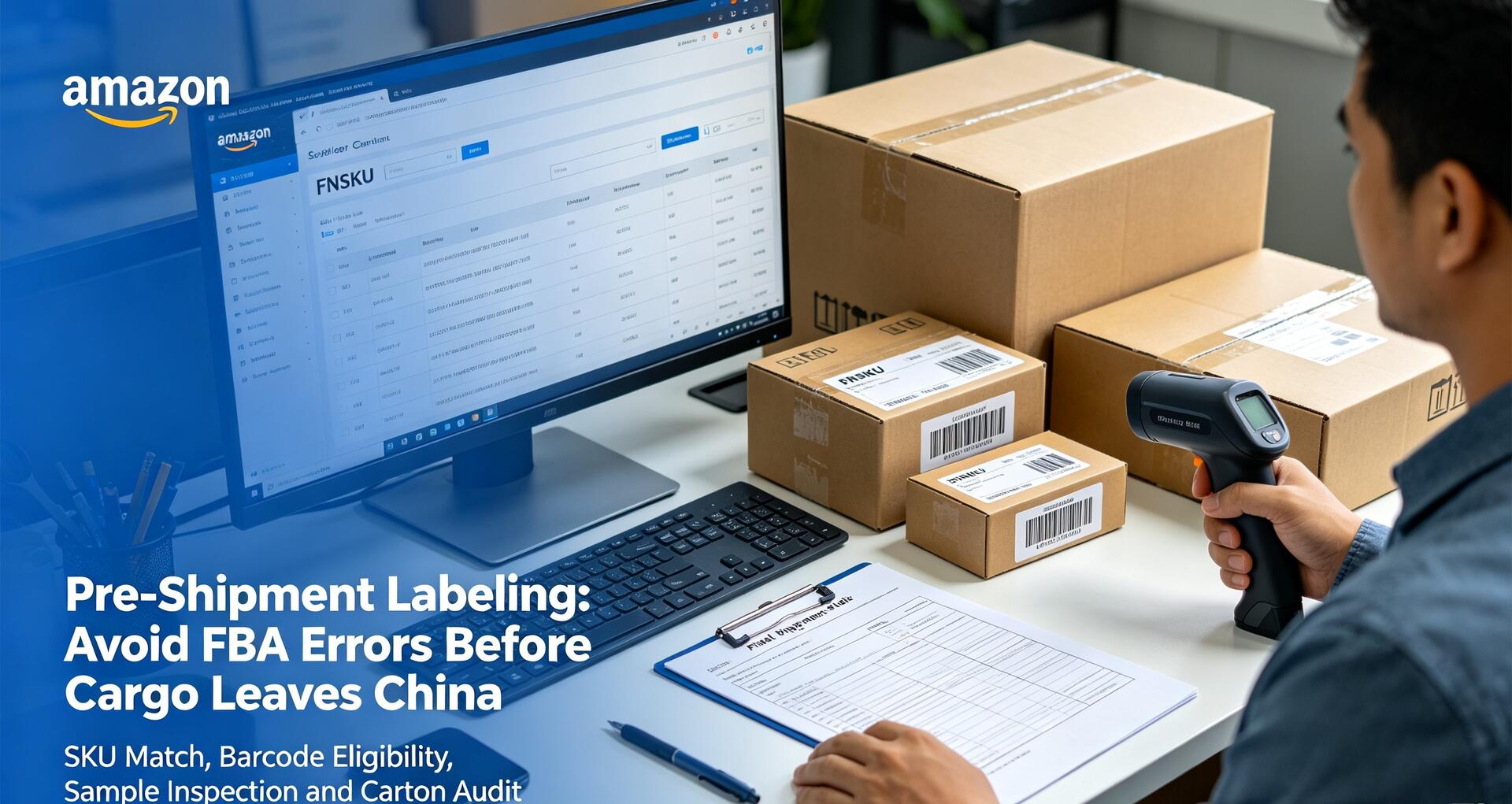
A private-label Amazon seller sourcing products from China was preparing inventory for shipment to a US Amazon FBA fulfillment center. The supplier had already printed a manufacturer barcode on the product packaging, but the seller needed to confirm whether that barcode was appropriate for the current FBA inventory configuration.
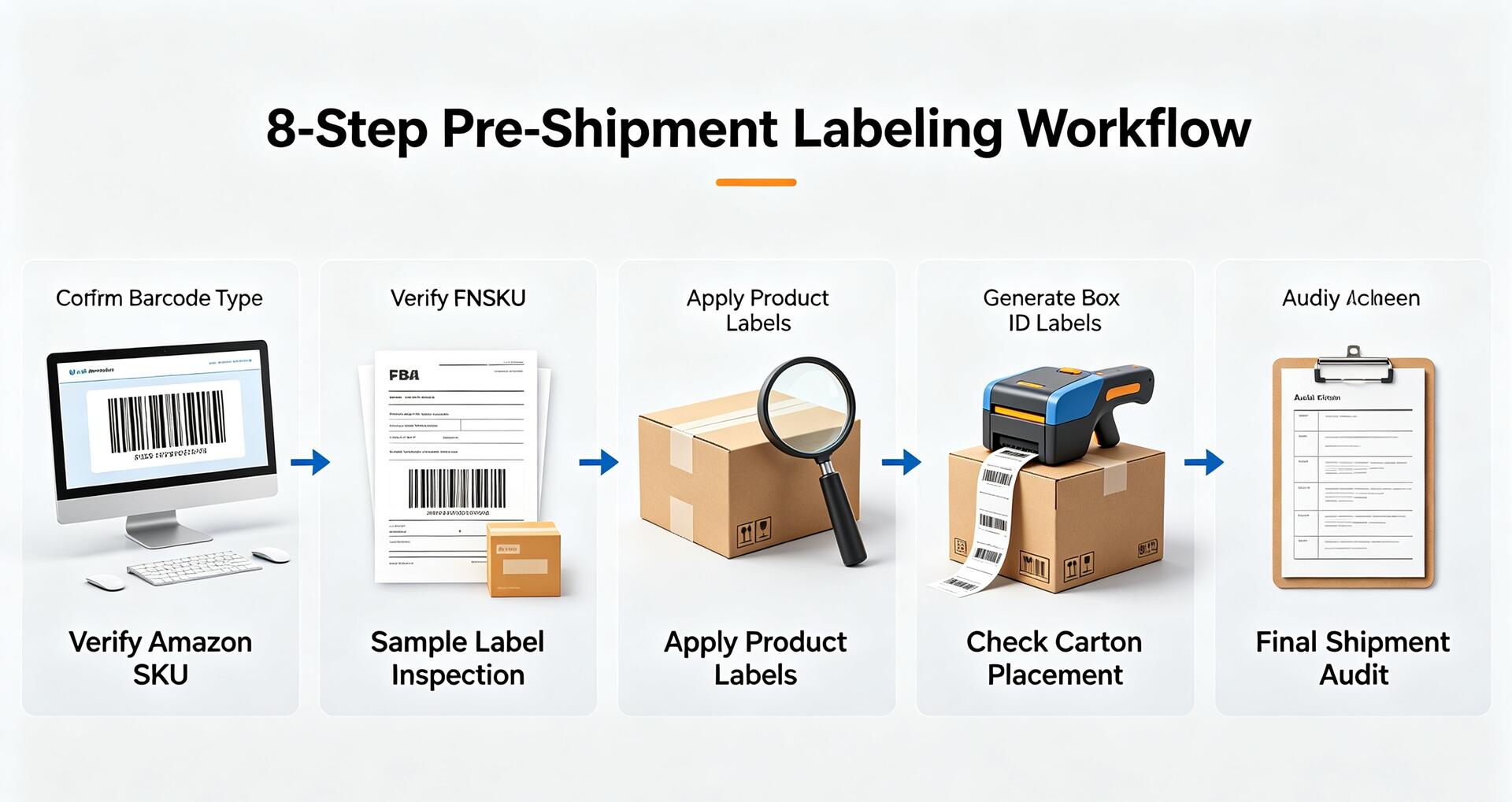
The logistics team introduced a pre-shipment labeling workflow covering barcode verification, product labeling, carton labeling, and final shipment inspection.
The key lesson was straightforward:
Amazon FBA labeling should be checked before cargo leaves China, not after the shipment reaches the United States.
Amazon requires FBA inventory to have an applicable product barcode, while each shipment carton also requires its own FBA box ID label. Amazon also changed its manufacturer-barcode and commingling requirements for inventory shipped on or after March 31, 2026.
The seller was a private-label e-commerce business sourcing products from a Chinese manufacturer.
The planned logistics route was:
Chinese Supplier → FBA Preparation → Export → International Freight → Amazon Fulfillment Center
The manufacturer handled production and retail packaging. The seller planned to use the logistics provider for shipment preparation and international transportation.
At first, the seller believed the labeling process was straightforward because the retail packaging already contained a manufacturer barcode.
However, the existence of a UPC or other manufacturer barcode does not automatically determine whether that barcode can be used for every FBA inventory configuration.
Amazon identifies three main barcode categories for FBA inventory:
Amazon also states that some products are not eligible for manufacturer-barcode tracking and therefore require an Amazon barcode.
That made barcode verification the first step in the shipment process.
The seller's original workflow focused mainly on the product barcode.
The logistics review identified that an FBA shipment actually contains several identification layers.
The individual product needs the applicable barcode.
The outer shipping carton needs the appropriate FBA box ID label.
Applicable palletized shipments require pallet labels.
The carrier also needs its transportation label.
Amazon's shipping guidance states that each box in an FBA shipment must have its own FBA box ID label, and each pallet requires four pallet labels. Amazon also requires labels to remain readable and scannable.
Therefore, the preparation process was redesigned around the complete shipment rather than the product barcode alone.
The first control point was the Amazon inventory record.
Before the supplier applied any labels, the logistics team requested the current shipment and inventory information.
The verification included:
| Item | What Was Checked |
| ASIN | Correct Amazon product |
| Seller SKU | Correct seller inventory |
| Product condition | Matches shipment |
| Barcode type | Manufacturer or Amazon barcode |
| FNSKU | Correct where applicable |
| Shipment information | Matches current shipment |
| Destination | Correct FBA destination |
This step is important because a barcode can be technically readable while still being associated with the wrong inventory.
Amazon recommends that sellers check their FBA barcode configuration and use the appropriate barcode type for the specific product.
The next step was determining whether the seller could use the manufacturer barcode or needed an Amazon barcode.
This became particularly important in 2026.
Amazon announced that its commingling practices would end for inventory shipped on or after March 31, 2026.
Under the updated requirements:
This means a supplier should not simply decide:
“The product has a UPC, so we can use the UPC.”
The seller's Amazon configuration must be checked first.
If an Amazon barcode is required, the seller needs to provide the correct barcode information to the supplier or preparation facility.
Amazon identifies FNSKU as one type of Amazon barcode used for FBA inventory. Products that are not eligible for manufacturer-barcode tracking may require an Amazon barcode.
The logistics team therefore added an internal rule:
Never use an old FNSKU label file without checking the current SKU and shipment information.
The preparation team compared:
Amazon SKU → FNSKU → Physical Product
Only when the three matched could the labeling process continue.
Instead of immediately labeling all inventory, the team first checked sample units.
The inspection covered:
Amazon's labeling guidance emphasizes that labels need to remain readable and scannable. Its guidance also warns against placing labels where they may become difficult to scan.
This sample-first approach creates an important quality-control checkpoint.
If an error is found on a sample, the supplier can correct the labeling process before the remaining units are prepared.
Once the sample was approved, the preparation team continued with the remaining units.
The basic workflow was:
Receive Label File → Match SKU → Apply Label → Inspect → Record
The team avoided placing labels:
Amazon's FBA labeling guidance emphasizes barcode visibility and scanability.
For products that already contain another barcode, the preparation team also checked the applicable Amazon requirements before covering or replacing an existing code.
After product-level labeling was completed, attention moved to the cartons.
This was a separate step because the FBA box ID serves a different function from the product barcode.
Amazon states that:
Each box in an FBA shipment must have its own FBA box ID label.
The labels should be generated through the shipment workflow rather than copied from another carton. Amazon also warns that failure to apply the required box ID label can lead to receiving delays and may affect future shipments.
For this reason, the preparation team checked every carton individually.
The team inspected the position of the FBA box ID label and carrier label on each carton.
The main requirements were:
Amazon specifically states that both the FBA box ID label and carrier label must remain uncovered, readable, and scannable.
This is a small operational detail, but it is exactly the type of detail that can be missed when labeling is handled informally at the supplier.
Before the cargo left China, the logistics team conducted a final audit.
The inspection followed this sequence:
SKU → Barcode → Label → Quantity
Box ID → Label Position → Barcode → Quantity
Shipment ID → Destination → Carton Count → Documentation
This created a single final checkpoint before export.
The purpose was not to guarantee Amazon acceptance. Instead, it was to reduce avoidable preparation errors before the cargo entered international transportation.
A labeling problem discovered at a Chinese supplier is relatively straightforward to investigate.
The preparation team can still:
Once the shipment has entered international transportation, physical correction becomes more complicated.
This is why the logistics team treated FBA labeling as part of origin-side shipment preparation, rather than as an issue to solve after arrival in the United States.
The main change in this case was process control rather than a claimed financial saving.
| Previous Process | Improved Process |
| Supplier checked barcode informally | Barcode eligibility verified |
| Label file provided without structured review | SKU and label matched |
| No sample inspection | Sample inspection before mass labeling |
| Product labels checked separately | Product and carton labels checked together |
| Box labels handled at the final stage | Box labels included in shipment QC |
| Shipment released after packing | Final FBA audit before export |
This approach provides a clearer division of responsibility between the seller, supplier, preparation facility, and logistics provider.
The timing of this case is particularly relevant.
Amazon's March 2026 policy update changed who can use manufacturer barcodes under the updated commingling rules.
Amazon states that eligible brand owners with the Brand Representative selling role can continue using qualifying manufacturer barcodes, while resellers without that role must use Amazon barcode stickers for applicable products. Products without manufacturer barcodes also require Amazon barcode stickers.
For China-based sellers, this means the supplier's packaging decision should not be made independently of the Amazon account configuration.
The correct workflow is:
Amazon Account → Barcode Eligibility → Label File → Supplier Preparation
not:
Supplier Barcode → Shipment
Before releasing an FBA shipment from China, sellers can use the following checklist.
Amazon's official shipping guidance confirms that each shipment box requires its own FBA box ID label and that palletized shipments require four pallet labels.
Whether a manufacturer barcode can be used depends on the product's eligibility and the seller's current Amazon configuration.
The 2026 barcode policy change makes this distinction especially important.
The product barcode identifies the inventory unit.
The FBA box ID identifies the shipping carton.
They should be managed as two separate checkpoints. Amazon explicitly requires a unique FBA box ID label for each shipment box.
Instead of telling a factory:
“Please prepare the products for Amazon.”
The seller should provide:
This creates a much clearer preparation process.
For China-based sellers, the best place to identify a labeling problem is usually while the inventory is still accessible at the supplier or preparation warehouse.
This allows the logistics team to correct physical preparation issues before international transportation begins.
For sellers sourcing products from China, international freight is only one part of the FBA workflow.
Depending on the shipment requirements, a China-based logistics partner can coordinate:
The exact preparation and labeling services should be confirmed for each shipment.
For Amazon sellers, the value is not simply moving cargo from China to the US.
It is creating a controlled workflow:
Supplier → Preparation → Inspection → Export → International Freight → FBA
Does every Amazon FBA product need an FNSKU?
No.
Amazon supports several barcode types, and eligible products may use manufacturer barcodes. Products that are not eligible for manufacturer-barcode tracking may require an Amazon barcode such as an FNSKU.
Can a Chinese factory apply FNSKU labels?
Yes.
A seller can provide the appropriate Amazon-generated label information to the factory or preparation facility.
The key requirement is that the label corresponds to the correct Amazon inventory.
Can resellers use manufacturer barcodes after March 31, 2026?
Amazon states that resellers who are not enrolled in Amazon Brand Registry with the Brand Representative selling role must use Amazon barcode stickers for applicable products, even if the products have manufacturer barcodes.
Does every FBA carton need a unique box label?
Yes.
Amazon states that each box in an FBA shipment must have its own FBA box ID label generated through the shipment workflow.
Can I reuse an FBA box label?
No.
The box ID label is associated with the specific shipment carton. Amazon's guidance states that each box needs its own label.
What should I do if the supplier has already printed the wrong barcode?
Do not ship the inventory immediately.
First verify the current Amazon barcode requirement and compare the physical product with the Seller Central inventory configuration.
If an Amazon barcode is required, the appropriate Amazon barcode should be applied according to the current FBA instructions.
Why should FBA labeling be completed in China?
Completing labeling and inspection before export allows the seller and logistics provider to identify physical preparation problems while the inventory is still accessible.
This can make correction easier than trying to resolve a physical labeling issue after international transportation.
This case demonstrates that Amazon FBA labeling is a logistics-control issue, not simply a packaging task.
For sellers importing from China, a reliable process should connect:
Amazon Listing → Barcode Verification → Product Labeling → Quality Control → Carton Labeling → Final Audit → Export → International Freight → FBA
The most important principle is simple:
Verify the barcode before printing, inspect the label before shipping, and verify the carton before export.
Amazon's current requirements should always be checked in Seller Central because barcode eligibility, labeling rules, and fulfillment requirements can change.
For shipments prepared in China, integrating FBA labeling into the logistics workflow gives sellers a clearer opportunity to identify preparation issues before the cargo enters international transportation.






 Email: