
WORLDWIDE FREIGHT SERVICES
Email: jack@transworldcn.com
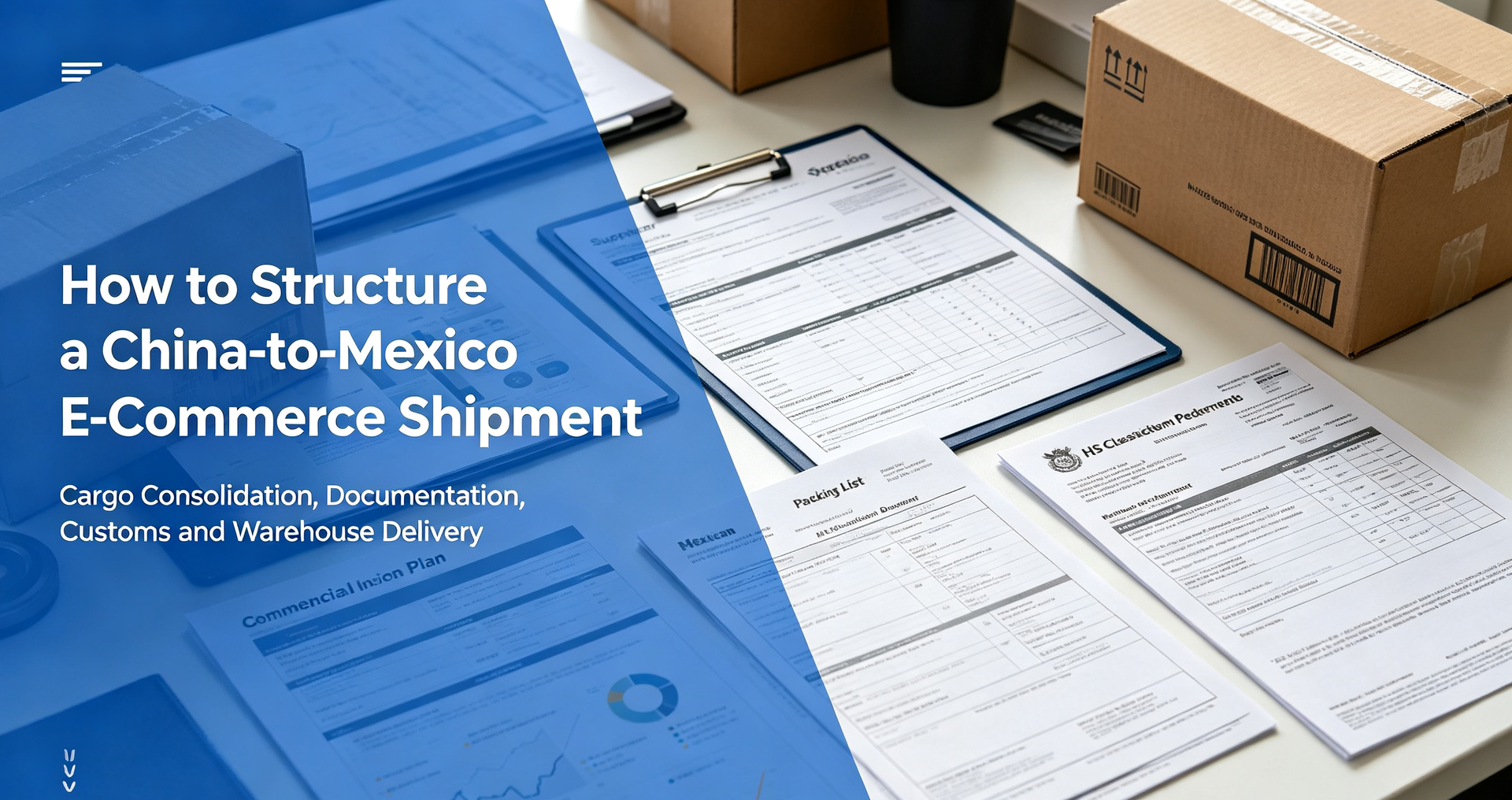
TL;DR: How This China-to-Mexico Shipment Was Structured
A growing e-commerce importer sourcing products from multiple suppliers in China needed a more predictable way to move inventory into Mexico. The main challenge was not simply finding a low freight rate. The shipment involved supplier coordination, cargo consolidation, export documentation, international transportation, Mexican customs requirements, and final delivery to a warehouse.
For this illustrative case, the shipment profile included approximately 12 CBM of commercial cargo, 1,000 kg of gross weight, and multiple Chinese suppliers. These figures are used to demonstrate the logistics planning process and are not presented as actual customer performance data.
The key lesson is that shipping from China to Mexico should be planned as an end-to-end supply-chain process. Freight cost, customs responsibilities, documentation, Incoterms, transportation mode, and final-mile delivery all need to be considered before the cargo leaves China.
| Item | Illustrative Case Details |
| Customer type | E-commerce importer |
| Origin | China |
| Destination | Mexico |
| Suppliers | Multiple Chinese suppliers |
| Cargo volume | Approx. 12 CBM |
| Gross weight | Approx. 1,000 kg |
| Main challenge | Supplier coordination and import planning |
| Logistics objective | Predictable end-to-end delivery |
| Key considerations | Freight, documentation, customs, final delivery |
Important: The shipment figures above are illustrative planning figures. They are not a claim about a specific customer's shipment or a guaranteed Transworld service result.
The customer was an e-commerce business purchasing products from several suppliers in China and selling them in the Mexican market.
At first, the logistics process appeared straightforward: collect the products from suppliers in China and deliver them to a warehouse in Mexico.
In practice, several issues needed to be coordinated simultaneously.
The suppliers were not located at the same facility, and their cargo was not necessarily ready on the same day. The customer also needed to understand how the shipment would move through export procedures, international transportation, Mexican customs, and final delivery.
The customer therefore needed more than a freight quotation.
The logistics plan had to answer five practical questions:
These questions became the foundation of the shipment planning process.
The first step was to establish a complete cargo profile.
Instead of asking suppliers to simply provide a shipping address, the logistics team needed information that could be used for transportation and customs planning.
The required information included:
This information is important because freight costs and customs requirements are influenced by the actual characteristics of the cargo.
For example, two shipments with the same number of cartons can have very different transportation costs if their dimensions and weights are substantially different.
For e-commerce businesses, supplier information is often distributed across different purchase orders.
Creating one consolidated shipment record helps reduce the possibility of:
The objective is to make the shipment information consistent before the cargo enters international transportation.
The customer was working with several suppliers rather than a single factory.
That creates a common problem for cross-border e-commerce businesses:
Production schedules do not always match shipping schedules.
One supplier may finish production while another supplier is still preparing its cargo.
Rather than immediately arranging separate international shipments, the logistics plan considered whether cargo could be coordinated and consolidated.
The basic workflow was:
Supplier A + Supplier B + Supplier C → China Consolidation → Export → International Freight → Mexico → Final Warehouse
This type of consolidation can make shipment management easier when the cargo, supplier locations, readiness dates, and transportation requirements are compatible.
However, consolidation should not be treated as automatically cheaper.
The decision should consider:
The correct objective is therefore total landed logistics cost and operational reliability, rather than simply maximizing consolidation.
Customs preparation was one of the most important parts of the shipment.
According to Mexico's tax authority, SAT, individuals and legal entities that intend to import merchandise into Mexico generally need to register in the Padrón de Importadores, subject to the applicable rules and exceptions. SAT lists requirements including an active RFC, valid e.firma, compliance with tax obligations, a properly registered fiscal address, and the involvement of an authorized customs representative for foreign-trade operations.
This means the importer should not wait until the cargo arrives in Mexico to start checking its import requirements.
Before dispatching the cargo, the importer should confirm:
Mexico's National Customs Agency (ANAM) explains that goods entering Mexico must be assigned an applicable customs regime and that a pedimento is used to declare the intended customs treatment of the goods.
For importers, this reinforces an important principle:
Customs planning should begin before the cargo leaves China.
The next stage was documentation review.
A typical commercial shipment may require information from documents such as the commercial invoice, packing information, transportation document, and customs-related documentation.
ANAM states that information transmitted with an import pedimento can include commercial details such as the detailed description of the merchandise, quantities, identification information where applicable, unit and total values, and seller and buyer information.
This is why document consistency matters.
For example:
| Information | Invoice | Packing List | Customs Information |
| Product description | ✓ | ✓ | ✓ |
| Quantity | ✓ | ✓ | ✓ |
| Weight | — | ✓ | As required |
| Package count | — | ✓ | As required |
| Product value | ✓ | — | ✓ |
| Supplier | ✓ | ✓ | ✓ |
| Buyer/importer | ✓ | ✓ | ✓ |
The exact documentation required depends on the shipment, commodity, customs regime, and current Mexican regulations.
There is no universal answer to the question of which method is best for shipping from China to Mexico.
The appropriate method depends on the shipment's:
Ocean freight can be considered for larger commercial shipments where the importer has enough inventory planning flexibility.
Its main advantage is suitability for substantial cargo volumes.
The trade-off is that the importer needs to plan inventory further in advance.
Air freight may be appropriate when inventory is more urgent or when the commercial value of faster transportation justifies the additional freight cost.
It can also be useful for replenishment shipments when waiting for a regular ocean shipment would create an inventory problem.
Express transportation can be useful for smaller shipments, samples, documents, or urgent commercial requirements.
However, the applicable customs process and charges should be confirmed for the specific shipment.
Another important part of the case was defining who was responsible for each stage of the shipment.
This is where Incoterms® become important.
For example, under DDP (Delivered Duty Paid), the seller has the maximum level of obligations among the Incoterms® 2020 rules. ICC explains that under DDP, the seller delivers the goods cleared for import at the named destination and is responsible for applicable import duties and taxes.
However, DDP should not automatically be considered the best option.
ICC also warns that practical and legal requirements in the destination country can make it difficult for a foreign seller to handle import clearance.
Therefore, before accepting a DDP quotation, the buyer should ask:
This can prevent a common problem:
A freight quote may look inexpensive while important destination costs remain outside the quoted price.
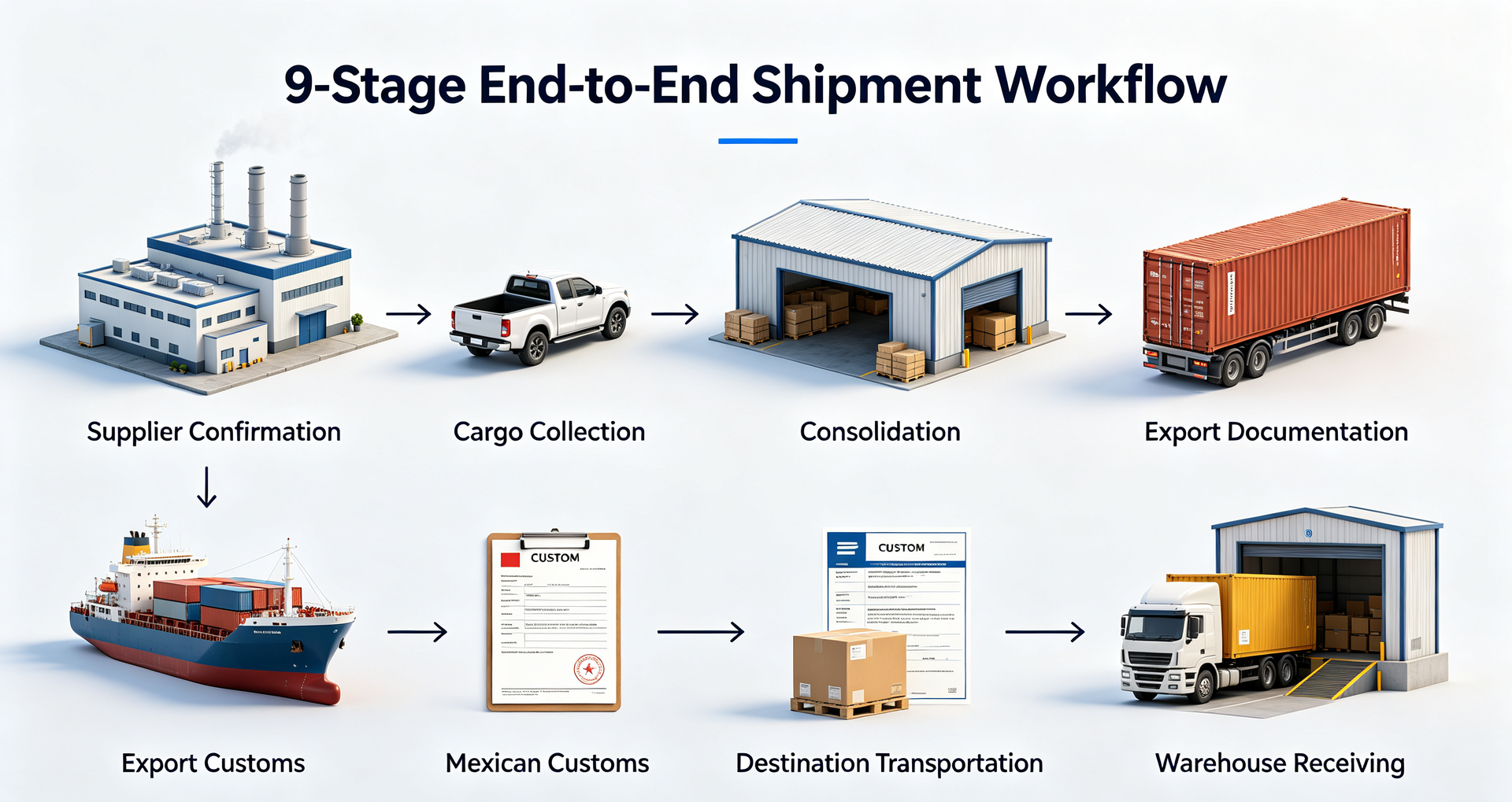
After the major responsibilities were clarified, the shipment was structured into a sequence of operational stages.
1. Supplier confirmation
Confirm suppliers, cargo readiness, product information, and packaging.
2. Cargo collection
Arrange pickup from the relevant supplier locations.
3. Consolidation
Where appropriate, move compatible cargo to a consolidation point.
4. Export documentation
Check commercial and export documentation.
5. Export customs clearance
Complete the applicable China export procedures.
6. International transportation
Move the cargo from China to Mexico using the selected transportation mode.
7. Mexican customs
Complete the applicable import procedures.
8. Destination transportation
Arrange transportation from the destination facility to the agreed delivery location.
9. Warehouse receiving
Confirm cargo receipt and reconcile the shipment against the original cargo record.
This structure provides the importer with a clear operational map.
The main lesson was not simply that a freight forwarder can arrange transportation.
The more important lesson was coordination.
For an e-commerce importer, international logistics connects several independent parties:
A delay at one stage can affect every subsequent stage.
The logistics process therefore needs to be designed around the entire supply chain.
| Area | Before Planning | Structured Approach |
| Supplier management | Separate supplier information | Centralized cargo record |
| Cargo collection | Supplier-by-supplier coordination | Planned collection schedule |
| Documentation | Prepared during shipment | Reviewed before departure |
| Customs planning | Reactive | Pre-shipment review |
| Freight selection | Rate-focused | Cost + time + cargo requirements |
| Incoterms | Not clearly reviewed | Responsibilities confirmed |
| Delivery | Transportation-focused | End-to-end warehouse delivery |
| Future shipments | Repeated manual work | Repeatable workflow |
The purpose of this comparison is not to claim a guaranteed reduction in cost or transit time.
Instead, it demonstrates how a structured process can improve visibility and shipment control.
Start with the shipment requirements.
A quotation is only meaningful when the importer understands what is included and excluded.
Mexico's customs authorities require importers to comply with applicable customs procedures, documentation, taxes, and non-tariff regulations.
Preparing this information before departure can help identify potential problems earlier.
A vague product description can make customs communication more difficult.
Use commercially meaningful descriptions and ensure that information is consistent across relevant documents.
An e-commerce seller may need regular replenishment.
Therefore, the logistics strategy should consider:
The cheapest shipment is not necessarily the best shipment if it creates an inventory shortage.
DDP can simplify responsibilities for a buyer, but the seller's ability to legally and practically handle destination import formalities must be confirmed.
ICC specifically notes the potential difficulty of foreign sellers undertaking import clearance in the buyer's country.
The basic process is to confirm the cargo and suppliers, choose a transportation method, prepare export and import documentation, arrange international transportation, complete Mexican customs procedures, and organize final delivery.
The exact process depends on the commodity, importer, transportation mode, customs regime, and Incoterm.
There is no single cheapest method for every shipment.
For larger commercial cargo, ocean freight may be considered when delivery speed is less important. For urgent or smaller shipments, air freight or express services may be more appropriate.
The correct comparison should include the complete logistics cost rather than only the international freight charge.
Businesses intending to import merchandise into Mexico generally need to comply with SAT's applicable importer-registration requirements. SAT states that the Padrón de Importadores applies to individuals and legal entities that wish to import merchandise into Mexico, subject to the applicable rules and exceptions.
Importers should verify their specific requirements before shipping.
Requirements vary according to the commodity and shipment structure.
Common commercial information includes:
ANAM provides specific information regarding electronic or digital documents transmitted as attachments to import pedimentos.
DDP can be useful when the commercial structure and destination customs arrangements support it.
However, DDP places extensive obligations on the seller. ICC notes that DDP requires the seller to handle import clearance and applicable duties and taxes, while also warning that destination-country requirements can make this difficult for foreign sellers.
The importer should therefore confirm the importer-of-record structure and exactly what the quotation includes.
This case demonstrates that successful shipping from China to Mexico is not simply a matter of booking a container or choosing the lowest freight quotation.
For e-commerce importers, the stronger approach is to build a complete process:
Supplier → Cargo Collection → Consolidation → Export → International Freight → Mexico Customs → Final Delivery → Warehouse
The most important planning points are:






 Email: