

WORLDWIDE FREIGHT SERVICES
Email: jack@transworldcn.com

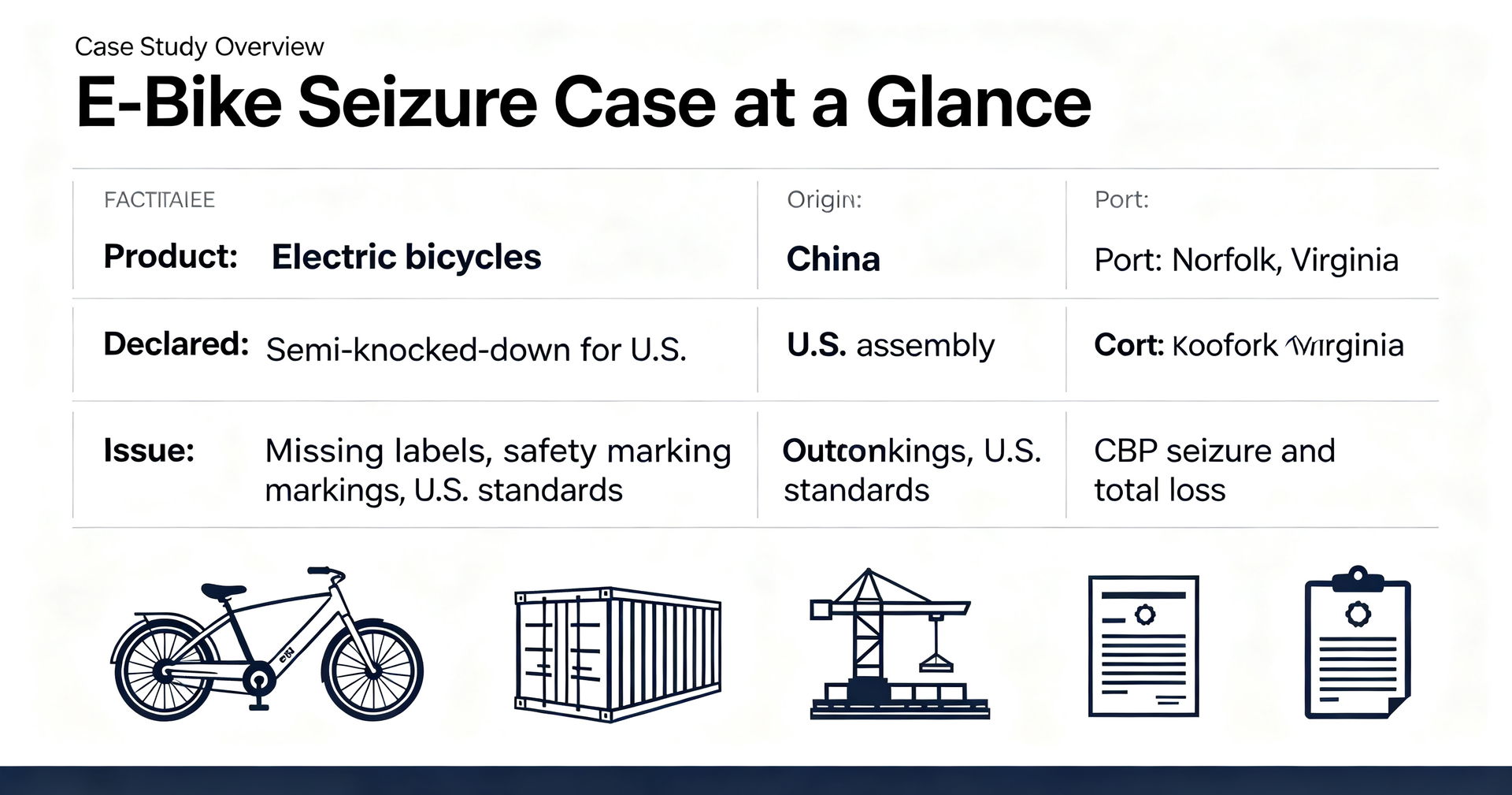
TL;DR – Case Study at a Glance
Shipment: A batch of electric bicycles (e-Bikes) from China, shipped in "semi-knocked-down" form to reduce cost and regulatory burden.
Destination: Norfolk, Virginia – U.S. East Coast.
The Problem: U.S. Customs and Border Protection (CBP) seized the shipment, citing missing product identification labels, safety markings, and failure to meet U.S. motor vehicle safety standards.
The Root Cause: The importer attempted to circumvent certification requirements by splitting the product into components for U.S. assembly—a "grey route" that regulators are now actively targeting.
The Outcome: CBP recommended the return of the goods, but the importer failed to comply, resulting in the entire shipment being seized and disposed of – a total loss.
Key Lesson: "Split shipment + overseas assembly" does not exempt compliance responsibilities. U.S. regulators are now actively scrutinizing this practice.
In early 2026, a shipment of e-Bikes from China arrived at the Port of Norfolk, Virginia, destined for U.S. consumers. The shipment was in "semi-knocked-down" form—some key components were shipped separately, intended for final assembly in the U.S.
This shipment was seized by U.S. Customs and Border Protection (CBP) and ultimately destroyed. The importer suffered a total loss.
This case is not isolated. It represents a broader shift in U.S. enforcement strategy: regulators are systematically closing down grey-route strategies that have long been used to circumvent certification and tariff obligations. For e-commerce sellers, the message is clear: the era of "ship first, fix compliance later" is over.
| Parameter | Detail |
| Product | Electric bicycles (e-Bikes) |
| Shipment Origin | China |
| Arrival Port | Norfolk, Virginia – U.S. East Coast |
| Declared Condition | "Semi-knocked-down" – partially disassembled for U.S. assembly |
| Regulatory Issue | Missing product identification labels, safety markings; failed U.S. motor vehicle safety standards |
| Outcome | CBP seizure; importer ordered to return goods but failed; shipment destroyed |
| Industry Context | Part of broader enforcement wave including 5H and 9H CBP inspections in 2026 |
Over the past two years, the e-Bike market in North America and Europe has grown rapidly, driven by green mobility trends and e-commerce growth. Many Chinese sellers leveraged supply chain advantages to achieve sales growth on platforms like Amazon.
However, e-Bikes are subject to stringent U.S. regulatory requirements. To be legally imported and sold in the U.S., e-Bikes must meet:
Federal Motor Vehicle Safety Standards (FMVSS): If classified as motor vehicles.
Consumer Product Safety Commission (CPSC) requirements: For bicycles and related products.
Product labeling and identification rules: Including manufacturer marks, model numbers, and safety warnings.
FCC certification: For electronic components.
To reduce transportation costs, avoid tariffs on fully assembled units, or circumvent time-consuming certification processes, some sellers adopted a strategy: ship the e-Bike as "parts" in semi-knocked-down form, then assemble it in the U.S.
This was viewed by some as a "grey-route optimization"—not technically illegal if done correctly, but operating in a regulatory gray area.
CBP examined the shipment and determined that the "semi-knocked-down" designation did not exempt the product from compliance requirements. Key issues identified:
Missing product identification labels: No clear manufacturer identification, model numbers, or tracking marks.
No safety markings or certifications: Required safety warnings and certification marks (CPSC, FCC, etc.) were absent.
Failure to meet U.S. motor vehicle safety standards: The product, whether in parts or assembled, did not demonstrate compliance.
When CBP recommended that the importer return the goods, the importer did not cooperate. The entire shipment was seized and disposed of—a total loss.
This e-Bike seizure is not an isolated incident. It is part of a comprehensive wave of U.S. customs enforcement in 2026 that has significantly raised the stakes for cross-border e-commerce.
In early 2026, CBP intensified its 5H inspections – a document-first, then goods-second examination process. The 5H status code indicates "Entry Processing Hold": CBP reviews documentation for consistency, truthful declarations, valid Importer of Record (IOR), and bond status. Any discrepancy triggers detention—with no opportunity to add documents later.
The scale of enforcement is staggering: In February 2026 alone, 3,826 containers of Chinese exports triggered 5H inspections, with an 82% rejection rate.
From May 2026, CBP launched 9H inspections—focused on the importer rather than the goods. This inspection targets:
Importer/receiver authenticity
Business operation status and import qualification
Bond usage compliance
Consistency of AMS/ISF filings with invoices, packing lists, and bills of lading
Triggering event: This intensified enforcement was driven by Roanoke Group, a major U.S. surety company, which announced it would strengthen importer background checks from May.
The e-Bike seizure, combined with 5H and 9H inspections, shows a clear pattern: U.S. regulators are closing multiple compliance loopholes simultaneously. The message is unmistakable: compliance from the origin is no longer optional.
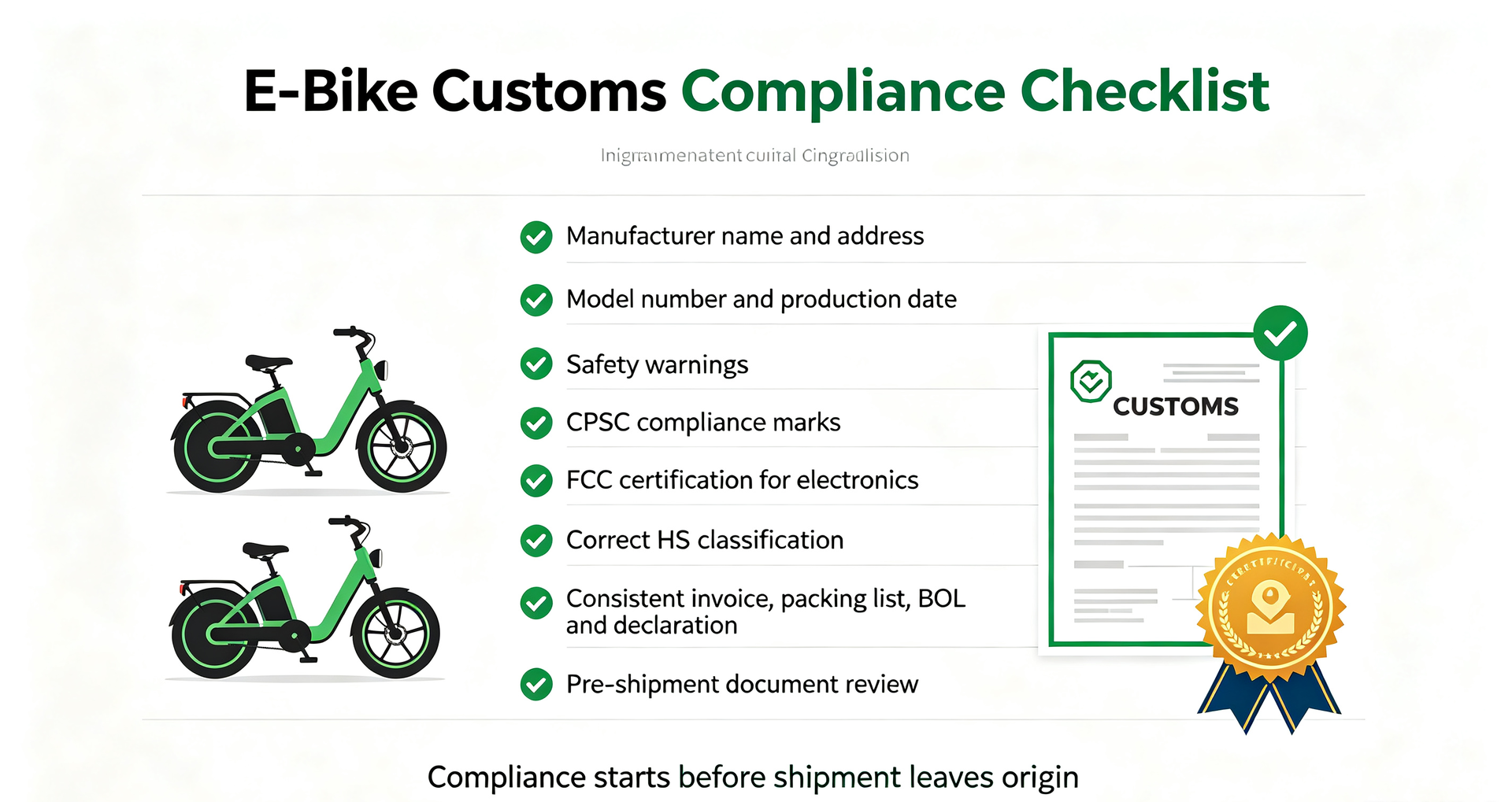
The e-Bike case demonstrates that regulators are now scrutinizing "split shipment + overseas assembly" practices. Even if goods are shipped as components or "parts," the final product must meet U.S. regulatory standards.
Best Practice: Complete all required certifications and testing before shipment. Do not assume that components shipped separately are exempt from regulatory review.
Missing product identification labels or safety markings are a primary reason for CBP holds. For e-Bikes, required marks include:
Manufacturer name and address
Model number and production date
Compliance marks (CPSC, FCC, etc.)
Safety warnings
Best Practice: Before shipment, verify that all labels and marks are present. Have a compliance checklist for each product category. Work with a forwarder that includes compliance verification in the pre-shipment process.
In 2026, cargo originating from China has faced the highest level of inspection intensity on record—5H inspections hitting an 82% rejection rate. E-Bikes from China are specifically targeted for regulatory scrutiny.
Best Practice: Be aware that Chinese-origin shipments are subject to elevated scrutiny. Compliance documentation must be impeccable.
When sellers use "double clearance" (DDP) services, in which the forwarder manages both export and import clearance, there is a temptation to "hand over the responsibility" to the forwarder. However, as the e-Bike case shows, the ultimate responsibility for regulatory compliance remains with the importer/seller.
Best Practice: Specify compliance requirements in your service contract. Request proof of certifications and review documentation before shipping. Keep full copies of all documents.
The e-Bike shipment was lost because the importer did not cooperate with CBP's return recommendation. If customs issues arise, the first step is to engage immediately with CBP and your compliance team to avoid the worst outcome—seizure and destruction.
Best Practice: Build a relationship with a logistics provider with U.S. customs expertise before issues arise.
A: Shipping products as partially disassembled components, with final assembly in the destination country, is often used to lower transportation costs, avoid tariffs, or bypass regulatory certification. However, U.S. regulators are now actively scrutinizing this practice, and it does not exempt the product from compliance requirements.
A: This depends on the product classification, but typically includes: CPSC certification (bicycle safety), FCC certification (electronic components), and possibly Federal Motor Vehicle Safety Standards (FMVSS) if classified as a motor vehicle. Labeling requirements include manufacturer identification, model numbers, and safety warnings.
A: 5H is a document-first, then goods-second inspection that verifies consistency and compliance. 9H focuses on the importer's qualifications, bond compliance, and filing accuracy. Both result in holds, delays, and, if unresolved, seizure or return of goods. In February 2026, 3,826 containers triggered 5H inspections, with an 82% rejection rate.
A: Engage your logistics provider and compliance team immediately. CBP may require additional documents or request product return. Non-cooperation can lead to full seizure and destruction, as in the e-Bike case.
A: TransWorld provides pre-shipment documentation review, compliance verification, and full DDP (Delivered Duty Paid) service to the U.S. and Canada. Our local presence in Chinese ports and partnerships with U.S.-based customs brokers ensure seamless, compliant customs clearance.
The e-Bike seizure at the Port of Norfolk is one of many cases illustrating the shift from "compliance optional" to "compliance mandatory." In 2026, high-growth categories—e-Bikes, electronics, toys—have entered a "strong compliance era". Strategies that once worked (split shipments, ambiguity in labeling) are now liabilities.
For e-commerce sellers and foreign trade businesses, the competitive advantage no longer comes from lowering costs through grey routes. It comes from building a compliance-first supply chain: clear documentation, proper certifications, and correct labeling, starting at the point of origin.






 Email: