

WORLDWIDE FREIGHT SERVICES
Email: jack@transworldcn.com

TL;DR – Case Study at a Glance
The Event: On June 11, 2026, a massive fire destroyed Medline Industries' 1 million-square-foot distribution center in Tracy, California.
The Scale: The facility represented approximately 4% of Medline's U.S. warehouse capacity and served as a local distribution hub for Northern California.
The Response: Medline activated an emergency command center within hours and executed a pre-existing network contingency plan, rerouting inventory to secondary and tertiary distribution centers.
The Result: Despite the facility being a total loss, the company maintained customer service by leveraging network redundancy and boosting regional staffing and transportation capacity.
Key Lesson: Supply chain resilience is not about avoiding disruption—it's about having the network redundancy and rapid response protocols to absorb catastrophic shocks without breaking customer service.
On June 11, 2026, at approximately 1 p.m., a fire broke out on the roof of Medline Industries' distribution center at 5701 Promontory Parkway in Tracy, California. Fueled by temperatures approaching 99 degrees Fahrenheit, low humidity, and wind gusts exceeding 25 mph, the fire spread rapidly through the approximately 1 million-square-foot facility.
Multiple fire agencies from across the region responded, with over 120 firefighters and 35 apparatus battling the blaze through the night. The City of Tracy confirmed the facility was a total loss.
This was not a minor warehouse fire. It was the destruction of one of the largest distribution centers in the U.S. medical supply network—a real-time test of supply chain resilience for one of the country's most critical healthcare logistics providers.
| Parameter | Detail |
| Company | Medline Industries – largest U.S. distributor of medical-surgical products |
| Event | Catastrophic fire, June 11, 2026 |
| Facility | 1 million-square-foot distribution center, Tracy, California |
| Function | Local distribution center serving Northern California healthcare providers |
| Conditions | 99°F, low humidity, 25+ mph wind gusts – rapid fire spread |
| Outcome | Facility declared a total loss; all employees safely evacuated |
| Response | Command center activated; network contingency plan executed within hours |
| Result | Customer service maintained through reassignment to secondary/tertiary facilities |
A 1 million-square-foot distribution center is not a small operation. For context, this is approximately the size of 17 football fields. The Tracy facility was described as a "local distribution center", but its loss represented a significant capacity reduction in Northern California—one of the most populous and economically critical regions in the U.S.
The facility also represented approximately 4% of Medline's U.S. warehouse space and 3% of its global capacity. While not the company's central hub, the loss created immediate concerns about medical supply disruptions for hospitals and healthcare providers across the western United States.
The fire response was complicated by two major system failures:
Sprinkler system failure: Fire officials reported that sprinklers were not operating. While the system had passed inspection in January, crews arriving on scene observed no water activation.
Hydrant water pressure failure: Fire hydrants within the facility lacked water pressure, "significantly impacting" firefighting efforts.
These failures highlight a sobering reality: even well-maintained facilities can experience catastrophic infrastructure failures.
Medical supply distribution operates under unique constraints:
Life-critical products: Many healthcare supplies are not optional—hospitals and clinics depend on reliable, uninterrupted delivery.
Regulatory requirements: Medical products face strict handling, storage, and traceability requirements.
Just-in-time reality: Healthcare providers have limited on-site storage capacity and rely on frequent, reliable replenishment.
The immediate risk was clear: would essential supplies continue to reach healthcare providers in Northern California?
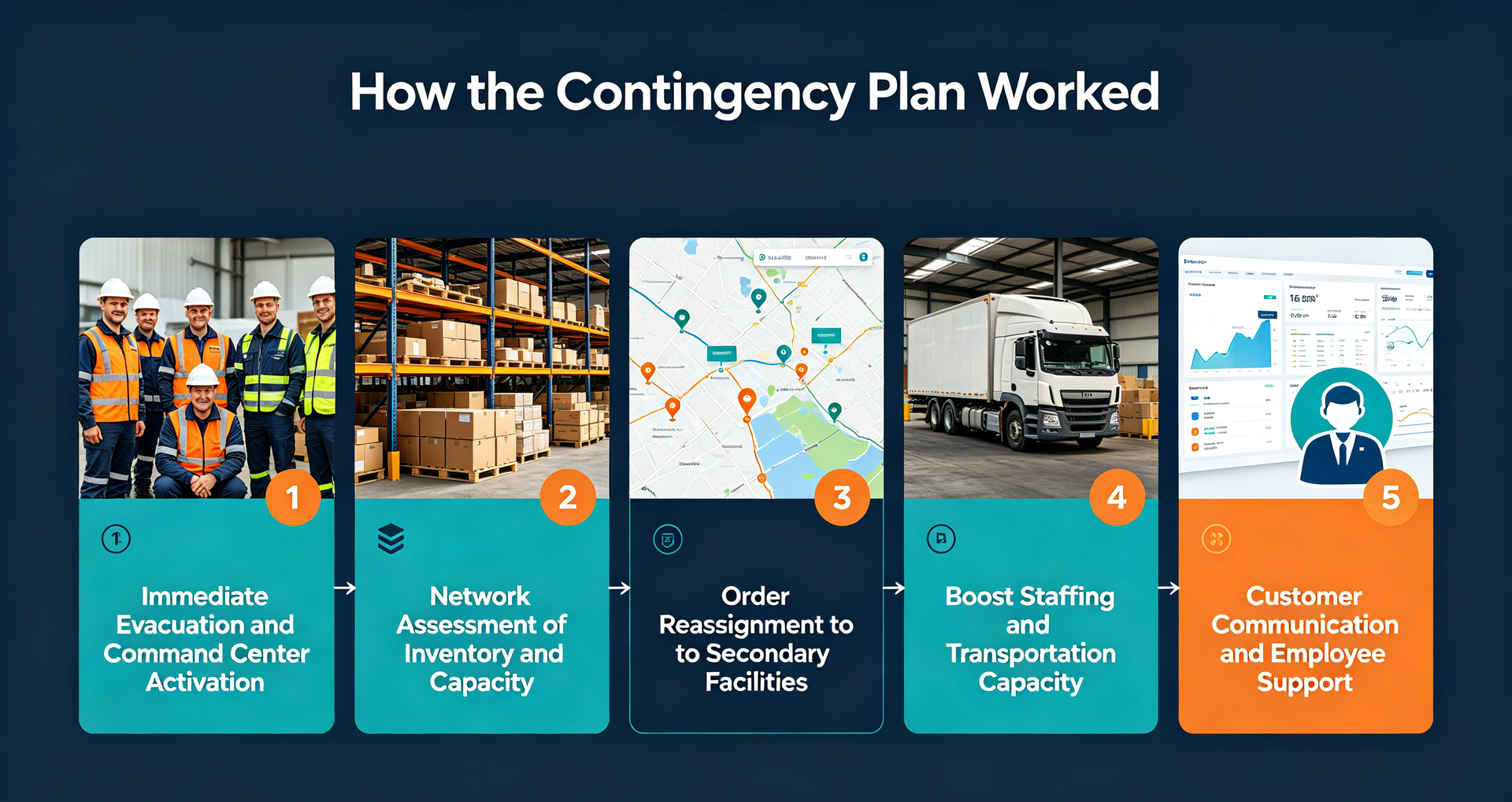
Medline's response was immediate and systematic. The company activated a command center and implemented network contingency plans designed to maintain customer service levels.
"Medline's supply chain is designed with resiliency, scale and flexibility at its core," the company stated.
This was not empty corporate language—it was the result of deliberate network design. The company operates more than 50 U.S. distribution centers, with three located within a 20-minute drive of each other in the Tracy area.
Step 1: Immediate Incident Response
All 120+ employees were safely evacuated with no injuries reported.
The command center was activated within hours of the fire breaking out.
Step 2: Network Assessment
The company identified which inventory and order fulfillment responsibilities had been managed by the Tracy facility.
Secondary and tertiary distribution centers within the regional network were assessed for available capacity.
Step 3: Order Reassignment
Product distribution previously supported by the Tracy facility was reassigned to other facilities within Medline's regional network.
The company worked 24/7 to maintain service and execute its network contingency plan.
Step 4: Capacity Expansion
Medline boosted regional staffing, regional inventory, and transportation capacity.
The company increased use of MedTrans trucks, third-party carriers, and truck relay operations to accelerate product movement throughout the impacted region.
A real-time dashboard and instruction manual were deployed to ensure transparency and supply continuity for customers.
Step 5: Employee Support
Medline connected with nearly all affected employees, offering onsite and local support, financial assistance, and counseling services.
Employee vehicles were professionally cleaned and validated before being returned.
Medline's success in managing this crisis was built on three foundational elements:
Network Redundancy: The company operates an expansive distribution network with overlapping capabilities. No single facility is irreplaceable.
Pre-Existing Contingency Plans: The company did not write its response plan after the fire—it had a plan ready to execute.
Scale and Flexibility: Medline's "expansive distribution network" provided the capacity buffer needed to absorb the shock.
The Medline fire is a powerful case study for any business managing cross-border supply chains:
1. Single Points of Failure Are a Strategic Risk
Whether it's a single factory, a single port, or a single distribution center—reliance on one node is a vulnerability. Medline's network redundancy—multiple facilities capable of serving the same region—absorbed the shock.
For China-North America importers: This means diversifying not just suppliers but logistics nodes. A single warehouse or 3PL partner is a point of failure. Consider multiple fulfillment centers across regions.
2. Contingency Plans Must Be Pre-Written
Medline did not create its response plan while the building was burning. The plan existed, was validated through regular safety drills (including an emergency evacuation drill on April 15, 2026), and was ready to execute.
For China-North America importers: Document clear contingency plans for scenarios:
Port congestion or closure
Carrier capacity shortage
Customs delays or holds
Warehousing disruption (fire, flood, labor action)
3. Resilience Costs Less Than the Alternative
While the financial impact of the fire has not been disclosed, analysts noted that Medline's scale would allow it to continue fulfilling customer orders. The cost of lost customer relationships and reputational damage from failing to deliver would have been far higher than the cost of maintaining redundant capacity.
For China-North America importers: The "efficiency-first" model that minimizes redundancy is increasingly risky. The premium paid for network redundancy and contingency planning is insurance against catastrophic loss.
4. Employee Safety is Foundational
Medline prioritized employee safety above all else—and this paid dividends in maintaining customer service. Employees who feel valued are more likely to perform effectively during crises.
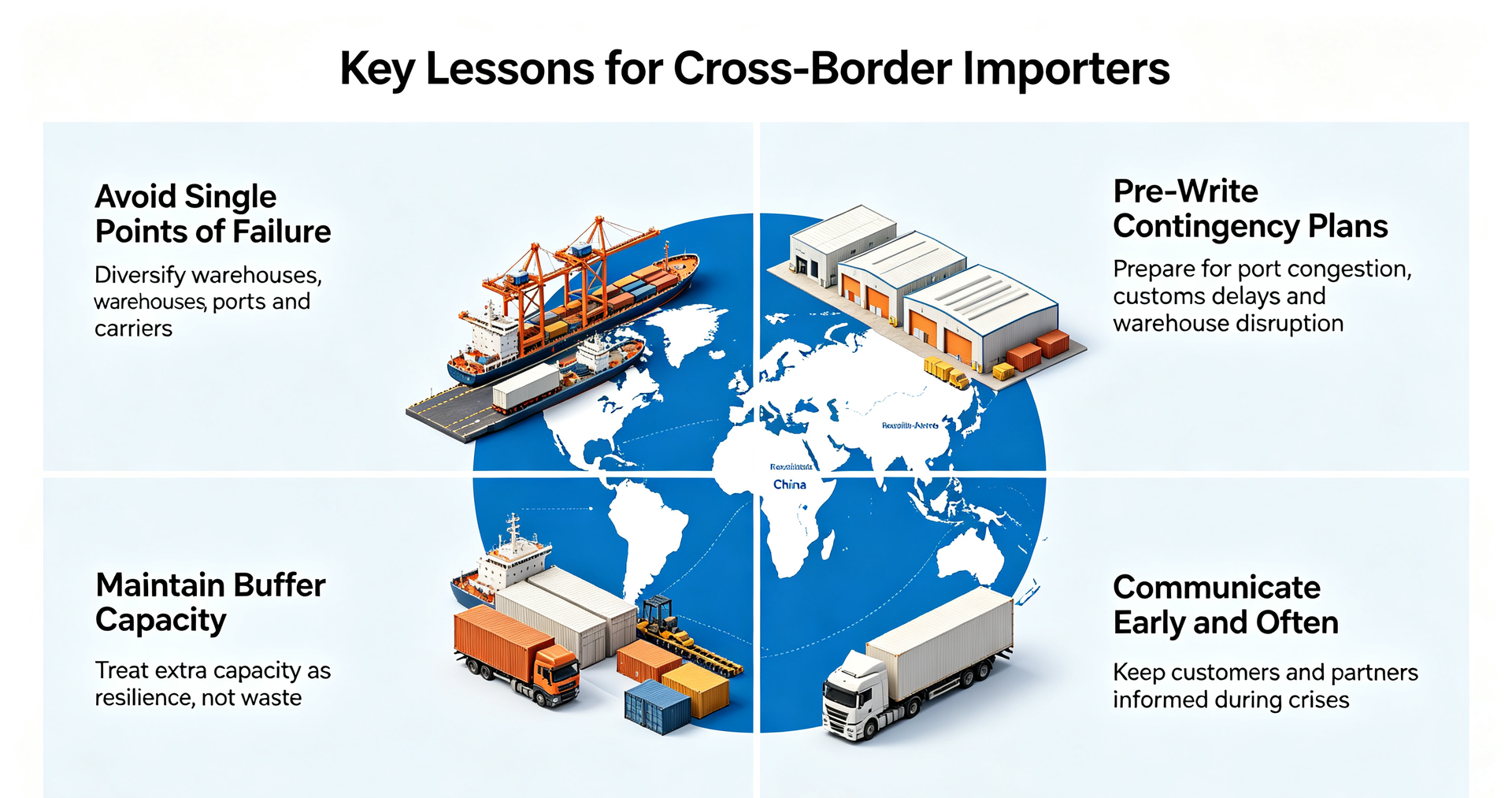
Medline's ability to maintain service after losing a 1-million-square-foot facility was the result of deliberate network design. For businesses handling critical or time-sensitive goods—medical supplies, e-commerce inventory, automotive parts—single-point dependency is a vulnerability.
Best Practice: Design your supply chain with overlapping capabilities. No single warehouse, port, or carrier should be essential.
Medline activated its command center "immediately" after the fire. This is only possible if the command structure, communication protocols, and decision rights are pre-defined.
Best Practice: Document your incident response plan. Define who makes decisions, how information flows, and what actions are triggered by specific scenarios. Conduct regular drills.
Medline's command center operated continuously, 24 hours a day, following the incident. This centralized decision-making enabled rapid coordination across the entire network.
Best Practice: Establish a clear command structure with defined roles and communication protocols before disruption occurs.
Medline's secondary and tertiary facilities had the capacity to absorb the Tracy facility's workload. This capacity did not exist by accident—it was maintained as part of the network design.
Best Practice: Maintain buffer capacity in your logistics network. It is not waste—it is resilience.
Medline provided daily updates to customers. This transparency maintained trust even during a catastrophic event.
Best Practice: Establish communication protocols with customers, suppliers, and logistics partners before disruption occurs. Transparency builds trust.
A: On June 11, 2026, a fire broke out on the roof of the 1 million-square-foot facility. Fueled by extreme heat (99°F) and 25+ mph winds, the fire spread rapidly, and the facility was declared a total loss. All 120+ employees were safely evacuated with no injuries reported.
A: Yes. Medline activated a command center and network contingency plan immediately, reassigning inventory and order fulfillment to secondary and tertiary distribution centers across its regional network. The company also boosted staffing and transportation capacity.
A: The company's supply chain was designed "with resiliency, scale and flexibility at its core". Network redundancy—multiple facilities capable of serving the same region—enabled rapid reassignment of operations. Pre-existing contingency plans and regular safety drills ensured readiness.
A: It demonstrates that reliance on a single logistics node—whether a warehouse, port, or carrier—creates a point of failure. Importers should diversify logistics nodes, maintain buffer capacity, and document contingency plans before disruption occurs.
A: Medline has not disclosed the volume of inventory lost, but the facility was considered a total loss. The company's ability to reassign operations to other facilities limited customer disruption.
A: The sprinkler system failed to activate despite passing inspection in January, and fire hydrants within the facility lacked water pressure—significantly impacting firefighting efforts.
The Medline fire is a powerful demonstration of supply chain resilience in action. When a 1-million-square-foot distribution center was destroyed, the company did not fail its customers. It executed a pre-written contingency plan, leveraged network redundancy, and maintained service.
For importers and e-commerce sellers managing China-North America supply chains, the lesson is clear:
Build redundancy into your logistics network.
Document contingency plans before disruption occurs.
Maintain buffer capacity—it's not waste, it's resilience.
Test your plans and communication protocols through regular drills.
Prioritize employee safety—it enables effective crisis response.
In a world of volatile trade routes, climate-driven disruptions, and geopolitical uncertainty, the companies that survive—and thrive—will be those that have invested in resilience before the crisis arrives.






 Email: