

WORLDWIDE FREIGHT SERVICES
Email: jack@transworldcn.com

Introduction: A Milestone for Furniture Exports
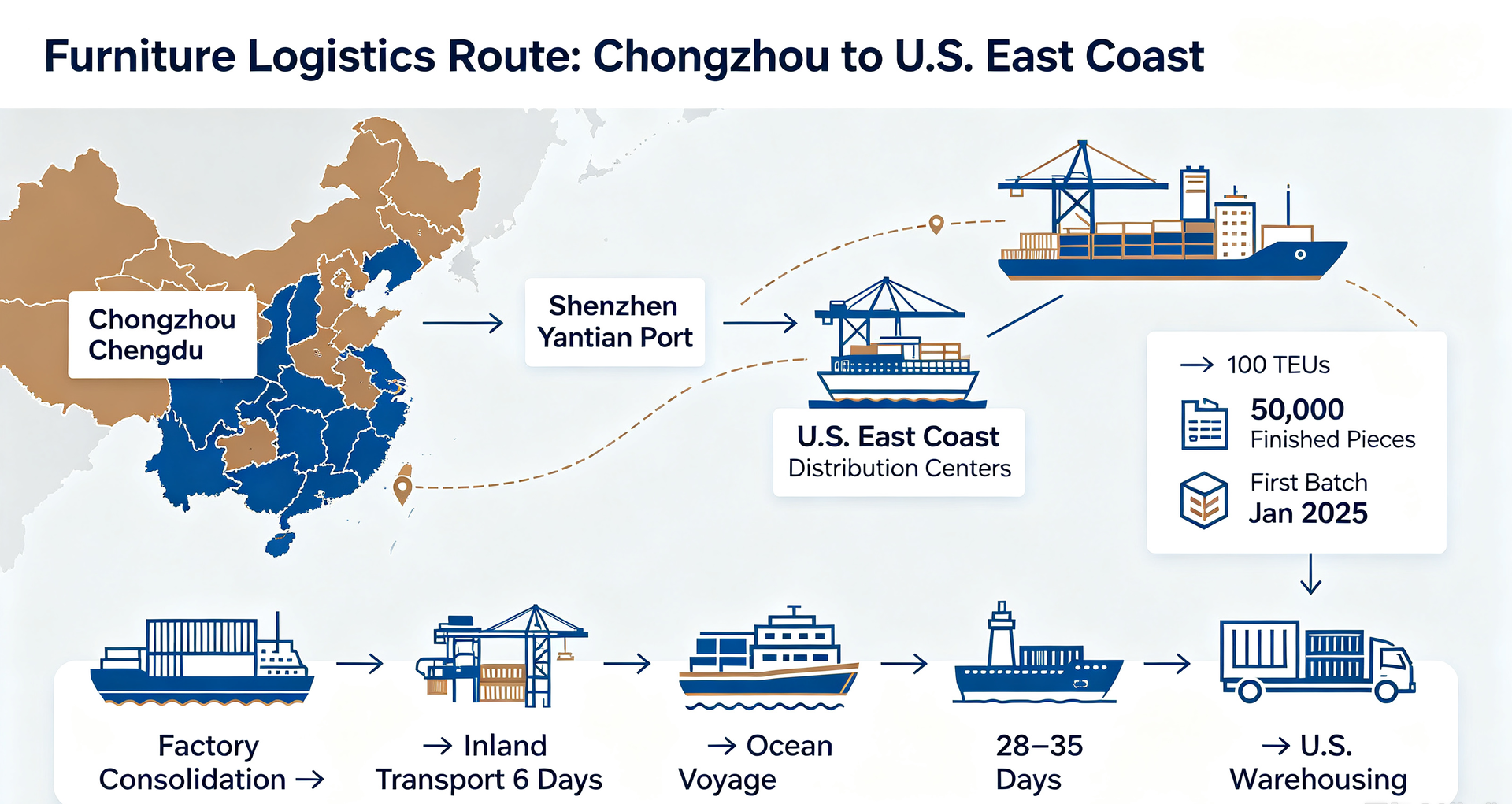
On January 18, 2025, a shipment of 50,000 finished furniture pieces – including sofas, bed frames, accent chairs, and storage cabinets – departed from Chongzhou, Chengdu, heading for Shenzhen’s Yantian port and ultimately the U.S. East Coast. This was not a typical export order. It marked the first large-scale, organized cross-border furniture export via e-commerce from China’s western interior.
This case study examines the logistics strategy behind this pioneering shipment. It addresses the challenges faced and the solutions that proved successful. For North American furniture importers and e-commerce sellers, this case provides actionable insights into cost optimization, compliance management, and scalable shipping solutions.
| Parameter | Detail |
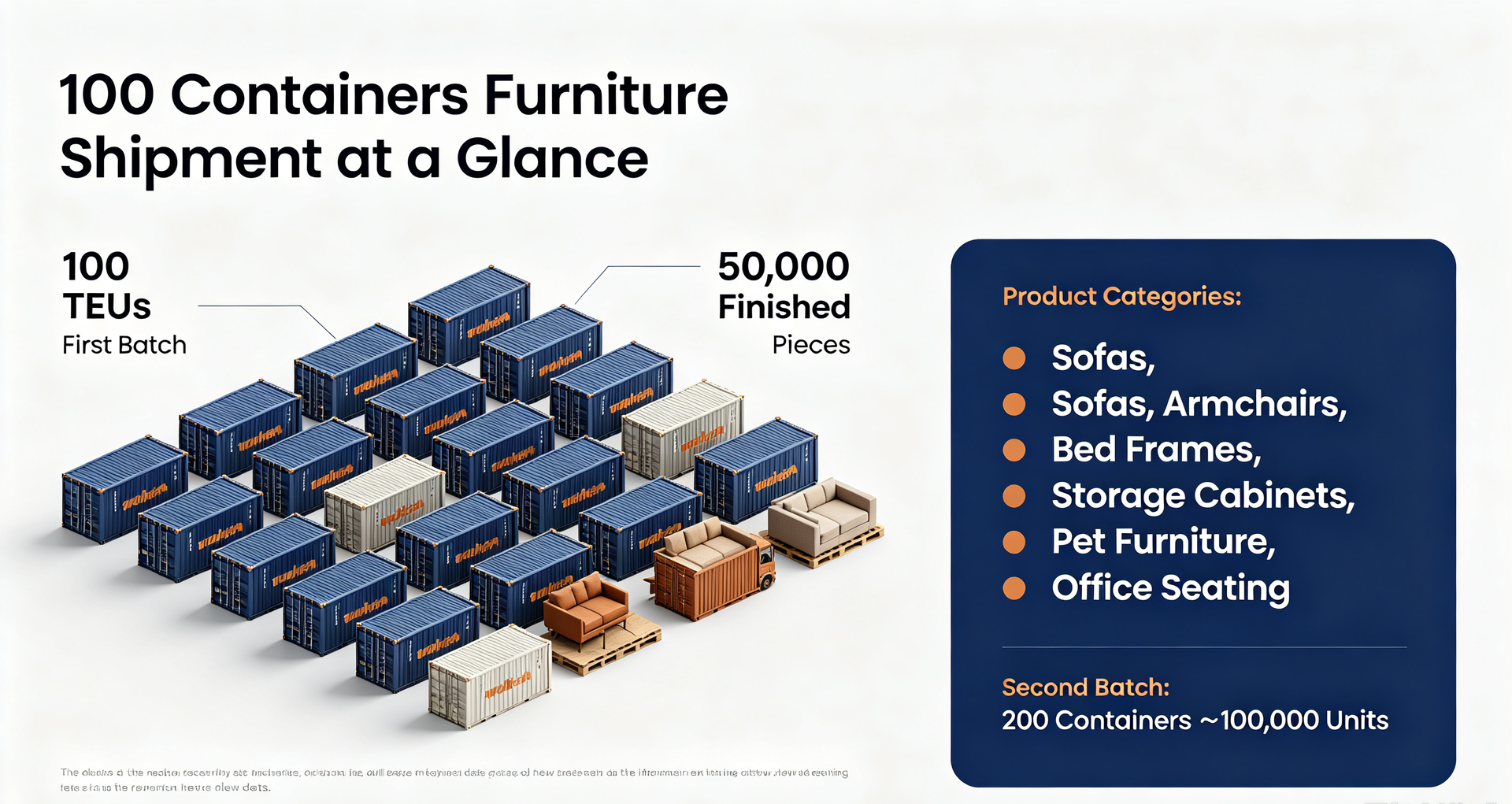
| Total Containers | 100 TEUs (first batch) |
| Total Units | 50,000 finished pieces |
| Product Categories | Sofas, armchairs, bed frames, storage cabinets, pet furniture, office seating |
| Origin | Chongzhou, Chengdu (inland China) |
| Departure Port | Yantian, Shenzhen |
| Destination | U.S. East Coast distribution centers |
| Second Batch | 200 containers, ~100,000 units (post-Lunar New Year) |
Before this shipment could proceed, the client and their logistics partners had to solve three critical problems.
Chengdu is located over 1,700 kilometers from Shenzhen’s Yantian port – a significant distance compared to coastal manufacturing hubs. This creates higher domestic transport costs, longer lead times before ocean departure, and additional risk of damage during inland transit.
Previously, Chongzhou’s furniture manufacturers relied on scattered, small-lot orders through independent foreign trade agents. They had no direct export experience and lacked the infrastructure for large-scale overseas sales. The traditional model of “each factory negotiating independently” drove up per-unit logistics costs and made reliable delivery timelines impossible.
The shipment aggregated products from multiple factories across the Chongzhou cluster, each with different production timelines, packaging standards, and documentation practices. Coordinating consolidation, quality checks, and unified customs documentation represented a significant operational challenge.
The “cross-border e-commerce + industrial cluster” model was built to address these challenges. Here is the step-by-step approach that made the shipment successful.
In 2023, the local government established Yajia International Trade as a dedicated cross-border e-commerce platform. This platform acts as a single point of contact for overseas buyers and consolidates orders from multiple factories within the industrial cluster.
How it works:
The platform connects with U.S. customers and e-commerce channels (Amazon, Walmart, etc.) to aggregate demand.
Production is distributed across factories based on their capacity and specialization.
Logistics, customs documentation, and international shipping are centrally managed.
Measured Outcome: By consolidating orders, the platform eliminated the “scattered export” problem. The 100-container volume secured economies of scale on domestic trucking and ocean freight, reducing per-container logistics costs.
Instead of each factory operating independently, the export platform provided clear production and delivery deadlines to all participating manufacturers. Factories were required to meet standardized packaging requirements and delivery timelines.
Measured Outcome: Synchronized production allowed for a single departure date, eliminating idle trucking time and reducing warehousing costs at origin.
Large furniture items are vulnerable to damage during the long ocean journey. The logistics team implemented enhanced packaging and loading protocols:
Disassembly where possible: Sofa legs, bed rails, and other detachable parts were separated and wrapped individually.
Corner protection: EPE foam corner guards were applied to all sharp edges and high-impact zones.
Moisture barrier: Waterproof plastic film was wrapped around all soft furniture to protect against condensation during temperature changes at sea.
Container loading: Furniture was loaded with heavy items on the bottom, lighter items stacked above, with airbags and strapping to prevent shifting during voyage.
Measured Outcome: Zero damage claims were recorded upon U.S. delivery.
The logistics provider handled all export and import documentation, addressing the regulatory complexity head-on:
| Document | Action Taken |
| IPPC Export Certification | All wood packaging was heat-treated and stamped with valid IPPC marks. |
| Lacey Act Wood Declarations | Genus/species declarations prepared for U.S. customs review for products containing solid wood. |
| HS Code Verification | Furniture categories were accurately classified to ensure correct tariff application. |
| Commercial Invoices & Packing Lists | Itemized with unit counts, dimensions, and materials for streamlined customs processing. |
Measured Outcome: All containers cleared U.S. Customs with no holds and no penalties.
The shipment departed from Yantian, Shenzhen, with routing optimized for the U.S. East Coast. The ocean transit time was approximately 28–35 days from port departure to arrival at an East Coast port.
Why East Coast routing? For a full 100-container shipment, direct East Coast routing provided a balanced total-landed-cost solution. West Coast routes offer shorter ocean transit, but inland rail/truck costs from West Coast ports to East Coast distribution centers would have increased significantly.
Upon arrival on the U.S. East Coast, the shipment was directed to third-party logistics (3PL) warehouses. The export platform is also exploring building a dedicated U.S. forward warehouse (pre-positioning warehouse) to further reduce final-mile delivery times.
U.S. Customs has strict requirements for wood products – ISPM 15 for packaging and Lacey Act declarations for wood content. This shipment achieved 100% customs clearance success because documentation was prepared proactively and centrally.
Best Practice: Work with a logistics provider that can manage ISF filings, Lacey Act declarations, and wood packaging certifications on your behalf.
The “cross-border e-commerce + industrial cluster” model demonstrates that aggregated shipments – even from multiple factories – reduce per-unit logistics costs.
Best Practice: If you source from multiple Chinese factories, consolidate at a single logistics hub before ocean departure to secure better rates and consistent quality.
The zero-damage result in this shipment is attributable to the enhanced packaging protocol. In furniture shipping, packaging is a primary protection against claims and lost sales.
Best Practice: Specify packaging standards that include corner protection, moisture barriers, and secure container loading. Have your forwarder or logistics provider inspect packaging at origin.
This shipment validated the model where a dedicated export platform consolidates orders, leverages centralized logistics, and sells directly to overseas customers via Amazon, Walmart, or other platforms.
For North American buyers, this model means:
Lower prices (factory-direct, without multiple intermediaries)
Consistent product quality (centralized oversight)
Reliable fulfillment (established logistics pipeline)
A: A dedicated export platform aggregates orders from multiple factories within a geographic industrial cluster (e.g., furniture factories in Chongzhou). The platform handles all logistics, customs, and international sales, allowing factories to focus on production. This model was used for the 100-container shipment to the U.S. East Coast.
A: For the January 2025 shipment, the timeline was: Chongzhou → Shenzhen (6 days, arriving Jan 24), ocean voyage to East Coast (~28–35 days), with delivery to U.S. distribution centers within March 2025.
A: Three critical requirements: (1) ISPM 15-compliant wood packaging with IPPC marks, (2) Lacey Act declarations for all wood-containing products (genus, species, country of harvest), and (3) accurate HS code classification. All were successfully met in this case study.
A: Work with logistics providers that offer consolidation services at origin, or engage with export platforms that aggregate orders from multiple factories. This approach, used in the Chongzhou case, secures better rates and simplified documentation.
A: Centralized platforms handle logistics, customs, and international sales, reducing per-unit costs and simplifying the import process. For North American buyers, this means lower landed costs and more reliable delivery schedules.






 Email: