
WORLDWIDE FREIGHT SERVICES
Email: jack@transworldcn.com
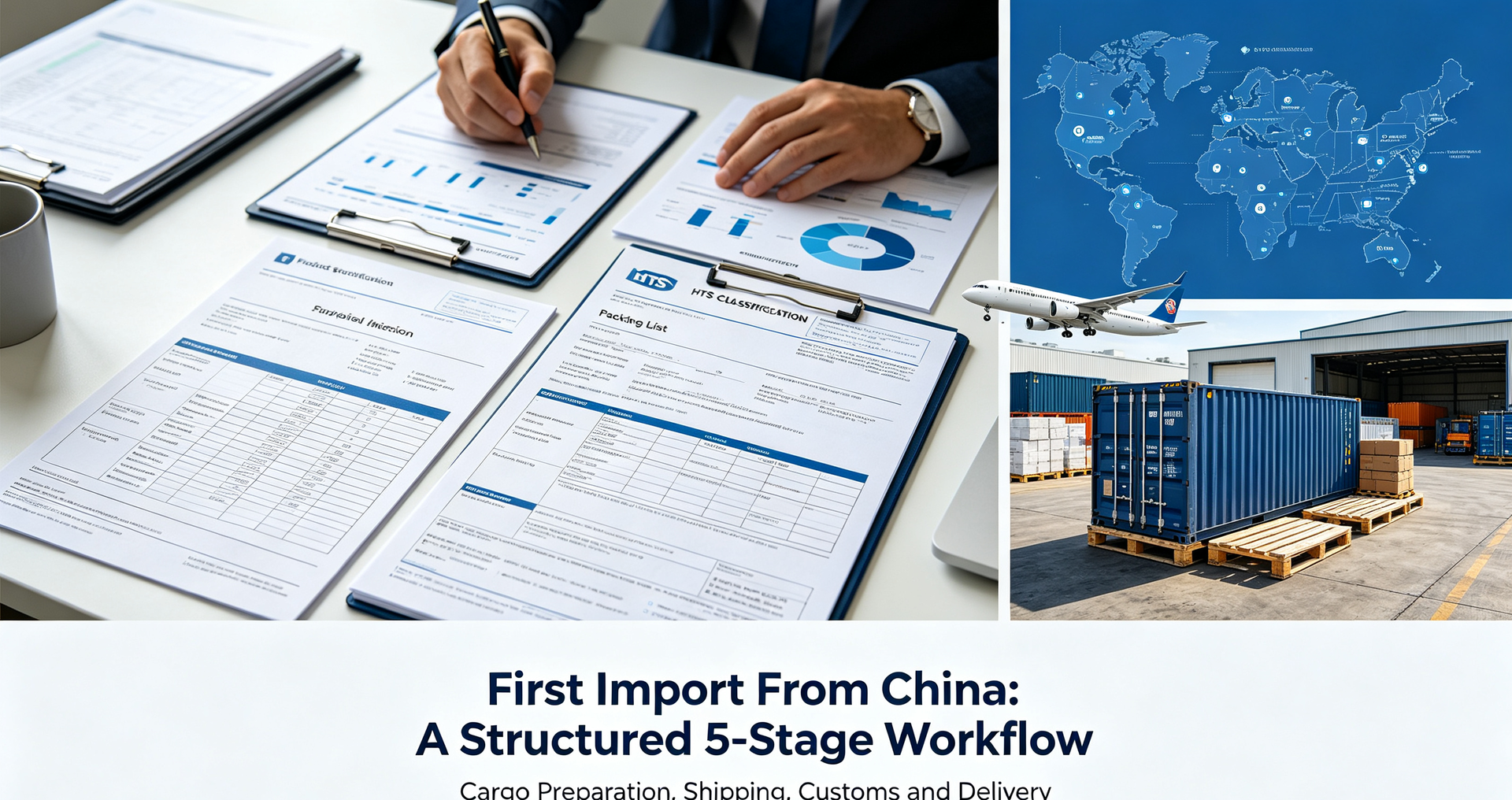
TL;DR: What Did The First-Time Importer Need?
A U.S. e-commerce seller was preparing its first commercial shipment from a Chinese supplier and needed a clear process for moving the goods from the factory to its U.S. destination.
The main challenges were not simply finding a freight rate. The importer also needed to understand cargo preparation, shipping options, documentation, customs coordination, import compliance, and final delivery.
TransWorld structured the shipment around a 5-stage logistics workflow:
The case demonstrates an important principle for first-time importers: international shipping should be planned as an end-to-end process rather than as a single freight booking.
Case-study note: The customer is presented anonymously, and no unsupported customer revenue, savings, transit-time, or performance claims are included. The workflow below is based on a representative first-import scenario and is intended to demonstrate the logistics planning process.
The customer was a U.S.-based e-commerce business preparing its first commercial order from a Chinese manufacturer.
The supplier had already been selected, and the product specifications and commercial terms were being finalized.
However, the customer had limited experience with international freight and was uncertain about how to coordinate the shipment after production.
The customer needed answers to several practical questions:
These are common questions for businesses beginning to source internationally.
The customer's greatest difficulty was not one individual transportation problem.
It was the lack of a clearly defined process connecting the shipment's different stages.
The logistics workflow was divided into 5 major stages:
| Stage | Main Task | Information Required |
| 1 | Supplier & Cargo Review | Product, quantity, dimensions, weight |
| 2 | China Origin Handling | Pickup address, cargo-ready date |
| 3 | International Freight | Mode, destination, shipment requirements |
| 4 | U.S. Import | Customs and regulatory documentation |
| 5 | Final Delivery | Warehouse, 3PL, fulfillment destination |
This structure gave the importer a single view of the shipment instead of treating every logistics activity separately.
Before arranging transportation, the logistics team needed accurate shipment information.
The customer was asked to provide:
This information is important because freight planning depends on the actual characteristics of the cargo.
CBP also advises new importers to become familiar with applicable requirements before importing and emphasizes the importance of being able to accurately describe the merchandise, including its country of origin, composition, intended use, and pricing information.
A freight quotation based only on:
“I have products in China. How much is shipping to the USA?”
is unlikely to provide enough information for a meaningful comparison.
A better inquiry includes the actual cargo details.
The customer also needed to understand that logistics and product compliance are connected but different responsibilities.
Depending on the product, additional requirements may come from agencies such as:
CBP specifically notes that certain commodities can have requirements administered by Partner Government Agencies.
For example, CPSC states that children's products subject to applicable safety rules require third-party testing and certification.
For regulated consumer products, CPSC's updated eFiling requirements took effect for most imported regulated consumer products on July 8, 2026.
This illustrates why importers should review compliance before mass production and shipment, rather than waiting until cargo reaches the United States.
Another important part of the import process is understanding the applicable tariff classification.
The U.S. Harmonized Tariff Schedule is maintained by the U.S. International Trade Commission.
Importers should not assume that a supplier-provided HS code is automatically the correct U.S. classification.
The USITC's official 2026 archive shows that the HTS was revised multiple times during the year, with Revision 16 published on August 14, 2026.
For products where classification is uncertain or has a significant impact on the import calculation, the importer should consider obtaining appropriate customs advice or a ruling where applicable.
The customer's landed-cost calculation should use current tariff information, not an old spreadsheet or an unverified supplier classification.
The customer then needed to determine which transportation method best matched the shipment.
The three primary options considered were:
| Shipping Method | Best Suited For | Key Consideration |
| Sea Freight | Larger commercial shipments | Lower transportation cost per unit is possible, but transit takes longer |
| Air Freight | Time-sensitive commercial cargo | Faster than ocean freight but generally more expensive |
| Express | Samples and smaller urgent shipments | Convenient but not normally designed for large commercial volumes |
The important point was that the customer did not select a transportation method based solely on the lowest quoted freight rate.
Instead, the decision considered:
Cargo Volume + Delivery Requirement + Inventory Plan + Total Cost
For an e-commerce business, a shipment arriving too late can affect inventory availability even if the transportation rate was inexpensive.
The customer originally focused heavily on the supplier's product price and freight quotation.
The logistics review showed why this approach can be incomplete.
A basic landed-cost framework is:
Landed Cost = Product Cost + Origin Charges + International Freight + Applicable Duties/Fees + U.S. Delivery + Other Applicable Costs
This worksheet is not a customs duty calculator. Actual costs depend on the merchandise, classification, commercial terms, destination, service scope, and applicable regulations.
Once the cargo-ready information was confirmed, the logistics process moved to the China origin stage.
The workflow became:
Supplier → Pickup → Warehouse / Consolidation → Export Handling → International Freight
For businesses purchasing from multiple Chinese suppliers, consolidation can also be considered where the shipment characteristics and schedule make it appropriate.
The key objective was to coordinate the pickup with the actual production and cargo-ready schedule.
This reduced the risk of arranging transportation before the supplier had finished preparing the goods.
Customs clearance was treated as a separate operational stage rather than something that automatically happened after the cargo arrived.
The importer needed to understand:
CBP states that there is no legal requirement to hire a customs broker, although many importers choose to use one. CBP also makes clear that the importer remains ultimately responsible for understanding applicable requirements and ensuring compliance.
This distinction is important for first-time importers.
A broker can assist with customs business, but the importer should still understand what is being imported and what responsibilities apply.
Customs clearance is not the final step.
After release, the cargo still needs to reach the customer's destination.
The destination could be:
Before shipping, the customer confirmed the final delivery information and receiving requirements.
The complete workflow therefore became:
China Supplier → Pickup → Export → International Freight → U.S. Customs → Final Delivery
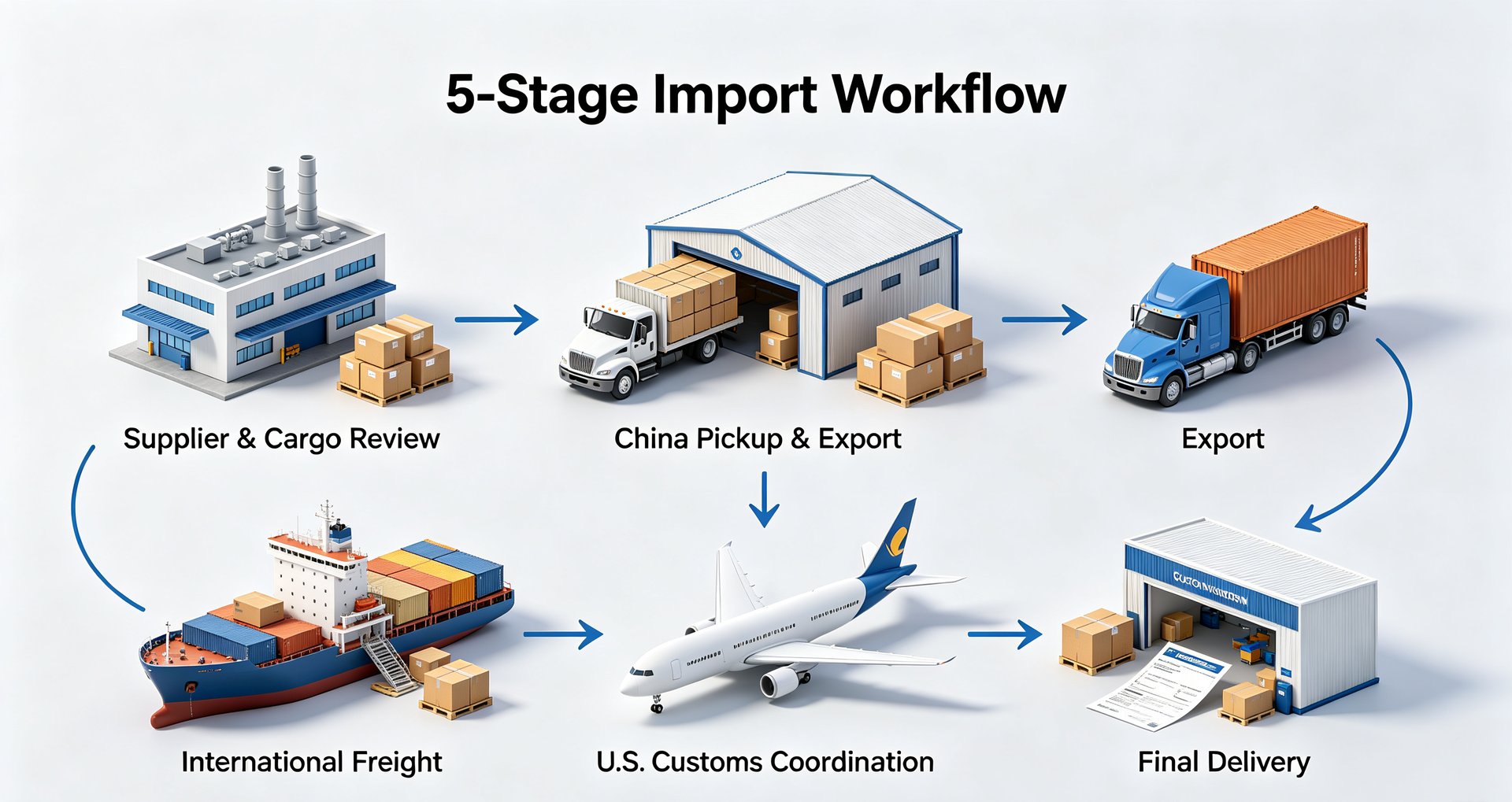
The main outcome of the project was not a claimed percentage reduction in freight cost or a specific number of days saved.
Instead, the customer gained a repeatable import workflow with 5 clearly defined stages.
The process could be reused for future shipments:
This structure made the import process easier for the customer to manage internally.
The supplier's product price and freight quotation do not necessarily represent the final landed cost.
Importers should consider the complete cost structure.
Waiting until cargo is already in transit to discover a product requirement can create unnecessary operational problems.
Product-specific requirements should be reviewed before production whenever possible.
The freight provider needs actual shipment information.
A complete quotation request should include:
Importers should know whether they are working directly with CBP, a licensed customs broker, or another logistics provider handling the relevant transportation and customs coordination.
CBP confirms that even when an importer uses a customs broker, the importer remains ultimately responsible for compliance.
A shipment that successfully leaves China and clears U.S. customs still needs an appropriate final-mile delivery plan.
This is especially important for ecommerce businesses using 3PLs or fulfillment centers.
Use this checklist before booking your first China-to-USA shipment.
Yes. A U.S. business can arrange commercial shipments from a Chinese supplier.
However, the importer should understand its responsibilities regarding transportation, customs, documentation, and applicable product regulations.
Not necessarily.
CBP states that U.S. law does not require every importer to hire a customs broker. Many importers use brokers because they can assist with customs entry and related procedures.
A useful quotation request should normally include:
It depends on your shipment.
Sea freight is generally considered for larger commercial cargo where the delivery schedule allows additional transit time.
Air freight may be appropriate when speed has a higher priority.
The correct choice should consider both freight cost and inventory requirements.
The answer depends on the service arrangement.
Some logistics providers coordinate customs clearance through licensed customs brokers, while other arrangements require the importer to appoint its own broker.
The quotation should clearly identify what customs services are included.
No.
Requirements depend on the specific product and the applicable U.S. regulations.
For example, certain children's products require third-party testing and certification under CPSC requirements.
Start with the complete landed-cost framework:
Product + Origin + International Freight + Applicable Duties/Fees + U.S. Delivery + Other Applicable Costs
Do not compare suppliers using factory price alone.
TransWorld provides international logistics services for businesses shipping from China to overseas markets.
For U.S. importers, the logistics process can include:
The exact service combination depends on the product, cargo volume, origin, destination, commercial terms, and delivery requirements.
For first-time importers, the objective is to make the logistics chain easier to understand and coordinate:
Supplier → China Pickup → Export → International Freight → U.S. Customs → Final Delivery
A first import from China involves more than finding a supplier and booking freight.
The importer needs to coordinate product information, compliance, classification, transportation, documentation, customs, and final delivery.
In this case, the most important improvement was establishing a structured 5-stage import workflow that could be reused for future orders.
For U.S. ecommerce sellers and other businesses sourcing from China, the practical approach is simple:
Plan the import before the cargo is ready, calculate the complete landed cost, verify product requirements, and define responsibility for every stage of the shipment.
That approach creates a stronger foundation for repeat international trade.






 Email: