
WORLDWIDE FREIGHT SERVICES
Email: jack@transworldcn.com

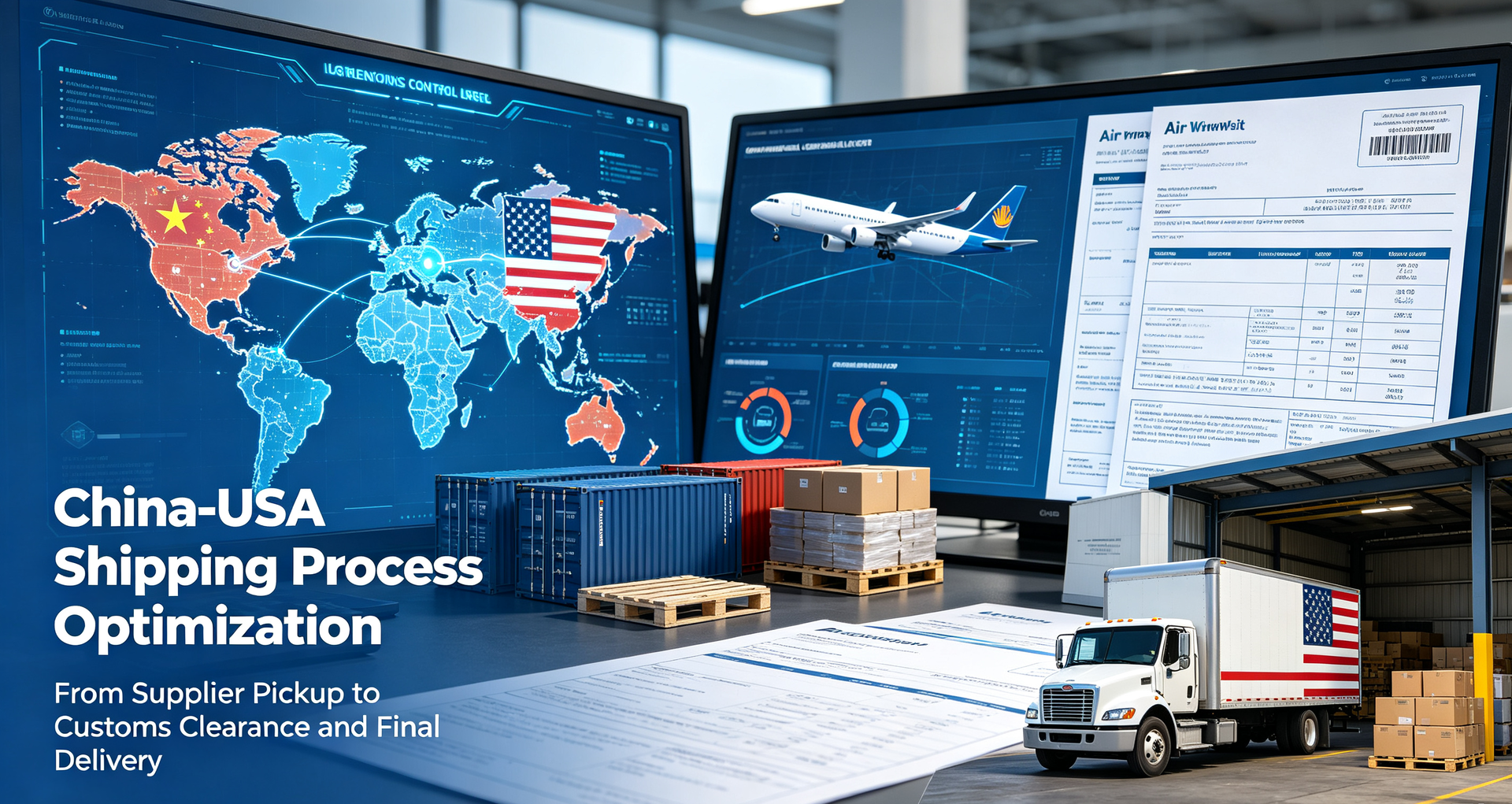
TL;DR: How Did The Importer Improve Its China-USA Shipping Process?
A growing US ecommerce importer sourcing products from China was facing a common logistics problem: different products, suppliers, and delivery requirements were being managed without a consistent shipping process.
TransWorld helped organize the customer's China-USA shipping workflow around five practical steps:
The objective was not to claim a specific percentage of cost savings without verified customer data. Instead, the project focused on making shipping decisions more consistent, improving supplier coordination, and giving the importer clearer visibility from cargo readiness through final delivery.
This approach is particularly relevant to US ecommerce sellers that source products from multiple suppliers in China.
The customer was a US-based ecommerce business sourcing consumer products from manufacturers in China.
The company worked with multiple suppliers and regularly needed to move inventory from China to the United States.
As the business developed, its logistics requirements became more complicated.
Different shipments had different:
The company therefore needed a logistics process that could handle more than a simple point-to-point shipment.
Its main requirements were:
The customer was looking for a repeatable process that could be applied to future shipments rather than handling every shipment as a separate logistics problem.
The customer purchased products from several Chinese suppliers.
Each supplier could have a different:
When cargo from different suppliers is not coordinated properly, businesses may face fragmented shipments and additional logistics communication.
The priority was therefore to establish a clearer supplier-to-shipment workflow.
The customer did not need every shipment to arrive at the same speed.
Some inventory could be planned, while other products required faster replenishment.
TransWorld therefore separated shipments according to their business requirements.
| Shipment Requirement | Potential Shipping Solution |
|---|---|
| Regular inventory | Sea freight |
| Larger commercial shipments | FCL or LCL sea freight |
| Time-sensitive inventory | Air freight |
| Samples and small parcels | Express shipping |
The purpose of this approach was not to claim that one method is always cheaper or faster. The appropriate method depends on cargo characteristics, delivery requirements, destination, and current freight conditions.
The customer also needed a more organized process for preparing shipment information.
Important information can include:
US Customs and Border Protection states that the importer of record has responsibilities related to entering, classifying, and valuing imported merchandise and providing information necessary for customs assessment and compliance.
This makes accurate product and shipment information an important part of the logistics process, rather than an administrative task to be handled only after the cargo arrives.
TransWorld first reviewed the shipment information provided by the customer's suppliers.
The team checked:
This information provided the basis for transportation planning.
Accurate dimensions and weight are particularly important because freight quotations depend on the characteristics of the cargo.
After reviewing the cargo, TransWorld matched each shipment with a suitable transportation option.
For planned inventory, sea freight could provide the capacity required for larger commercial shipments.
For urgent inventory, air freight could be considered when delivery speed was more important.
For samples or small parcels, express services could provide a simpler solution.
This created a more flexible transportation structure instead of automatically assigning the same shipping method to every shipment.
Once the transportation plan was established, TransWorld coordinated with the customer's suppliers.
The process included:
Supplier → Pickup → Warehouse / Consolidation → Export Handling → International Freight
When cargo from multiple suppliers was suitable for consolidation, coordinating the shipments through a logistics warehouse could make the overall process easier to manage.
The exact consolidation method depends on:
TransWorld coordinated shipment information before the cargo left China.
Typical documents may include:
The US Department of Commerce notes that import regulations and documentation requirements can vary depending on the destination market and product.
For this reason, importers should confirm requirements for their specific products rather than relying on a generic documentation checklist.
Product classification is an important part of US importing.
The United States uses the Harmonized Tariff Schedule (HTS) to classify imported merchandise and determine applicable tariff treatment.
The US International Trade Commission maintains the official HTS database and publishes revisions throughout the year. As of August 14, 2026, the USITC had published 2026 HTS Revision 16, demonstrating why importers should check the current tariff schedule rather than rely on an outdated classification reference.
Importers should confirm the appropriate classification and applicable requirements for their specific products.
TransWorld can coordinate logistics information and work with the relevant customs professionals, but the importer remains responsible for meeting applicable US import requirements.
After the cargo and documentation are ready, the shipment can move through the selected transportation channel.
For ocean freight:
China Supplier → China Port → Ocean Transportation → US Port
For air freight:
China Supplier → China Airport → Air Transportation → US Airport
The actual route depends on:
After arrival in the United States, the shipment enters the import and customs process.
CBP explains that imported merchandise is subject to entry requirements and may be subject to detention or examination for compliance with applicable laws and regulations.
Once customs procedures are completed, the cargo can move to its final destination.
Potential destinations include:
This completes the logistics chain:
China Supplier → Pickup → Export → International Freight → US Customs → Final Delivery

The main improvement was the creation of a more structured workflow.
The customer handled shipments largely according to individual shipment requirements.
This could create:
The logistics process was organized around a consistent workflow:
Cargo Information → Shipping Method → Supplier Pickup → Documentation → International Freight → Customs → Final Delivery
This gave the customer a clearer framework for future shipments.
Instead of selecting transportation based only on immediate availability, the customer could evaluate:
before booking.
Supplier pickup became part of the overall logistics plan.
This helped reduce unnecessary back-and-forth communication between the customer, suppliers, and logistics provider.
Shipment information was reviewed before departure instead of waiting until the cargo reached the destination.
This created a more controlled import workflow.
The customer gained a clearer view of the major stages:
For ecommerce businesses, this visibility can support better inventory planning.
The fastest shipping method is not automatically the best solution.
For example:
The correct decision depends on the business situation.
International shipping begins before cargo reaches the port or airport.
A complete process should connect:
Supplier → Pickup → Warehouse → Export → International Freight → Customs → Delivery
Managing these stages together can make the supply chain easier to control.
US importers should confirm product classification and applicable regulations before cargo leaves China.
The USITC provides the official HTS database, while CBP provides guidance on importing and customs entry requirements.
For regulated products, importers may also need to check requirements from the relevant US government agency.
There is no single best method for every shipment.
Sea freight is generally suitable for larger, planned shipments. Air freight is an option when delivery speed matters, while express services are commonly used for samples and small parcels.
Yes. A freight forwarder can coordinate supplier pickups and, when appropriate, consolidate cargo before international transportation.
The feasibility depends on supplier locations, cargo readiness, shipment size, and product characteristics.
A useful quotation normally requires:
Additional information may be required for special or regulated cargo.
Yes.
Using a freight forwarder or customs broker does not automatically transfer all importer responsibilities.
CBP states that the importer of record is responsible for entry, classification, valuation, and providing information required for customs assessment and compliance.
Importers should understand their responsibilities and work with qualified customs professionals when needed.
The HTS can be updated during the year.
The USITC's official database currently lists multiple 2026 revisions, including Revision 16 published on August 14, 2026.
Importers should verify the current HTS information applicable to their products before making import decisions.
TransWorld provides China-origin logistics solutions for:
Services include:
Our approach is to match the logistics solution with the customer's cargo characteristics, delivery requirements, and supply chain structure.
Rather than treating every shipment the same way, TransWorld can help importers evaluate the complete transportation process from supplier pickup in China to final delivery in the United States.
This China-USA ecommerce shipping case demonstrates an important principle: international logistics efficiency comes from process design, not simply from choosing a lower freight quotation.
For US businesses sourcing from China, an effective shipping workflow should connect:
Supplier Coordination → Cargo Preparation → Shipping Method Selection → Export Handling → International Transportation → Customs → Final Delivery
A structured process can help businesses make more consistent transportation decisions, improve communication with suppliers, and manage their import operations more effectively.
For businesses that are still developing their China-USA supply chain, working with an experienced freight forwarding partner can provide practical support across multiple stages of the shipping process.
Need a China-USA shipping solution? Contact TransWorld to discuss your cargo, origin, destination, and delivery requirements.






 Email: