

WORLDWIDE FREIGHT SERVICES
Email: jack@transworldcn.com
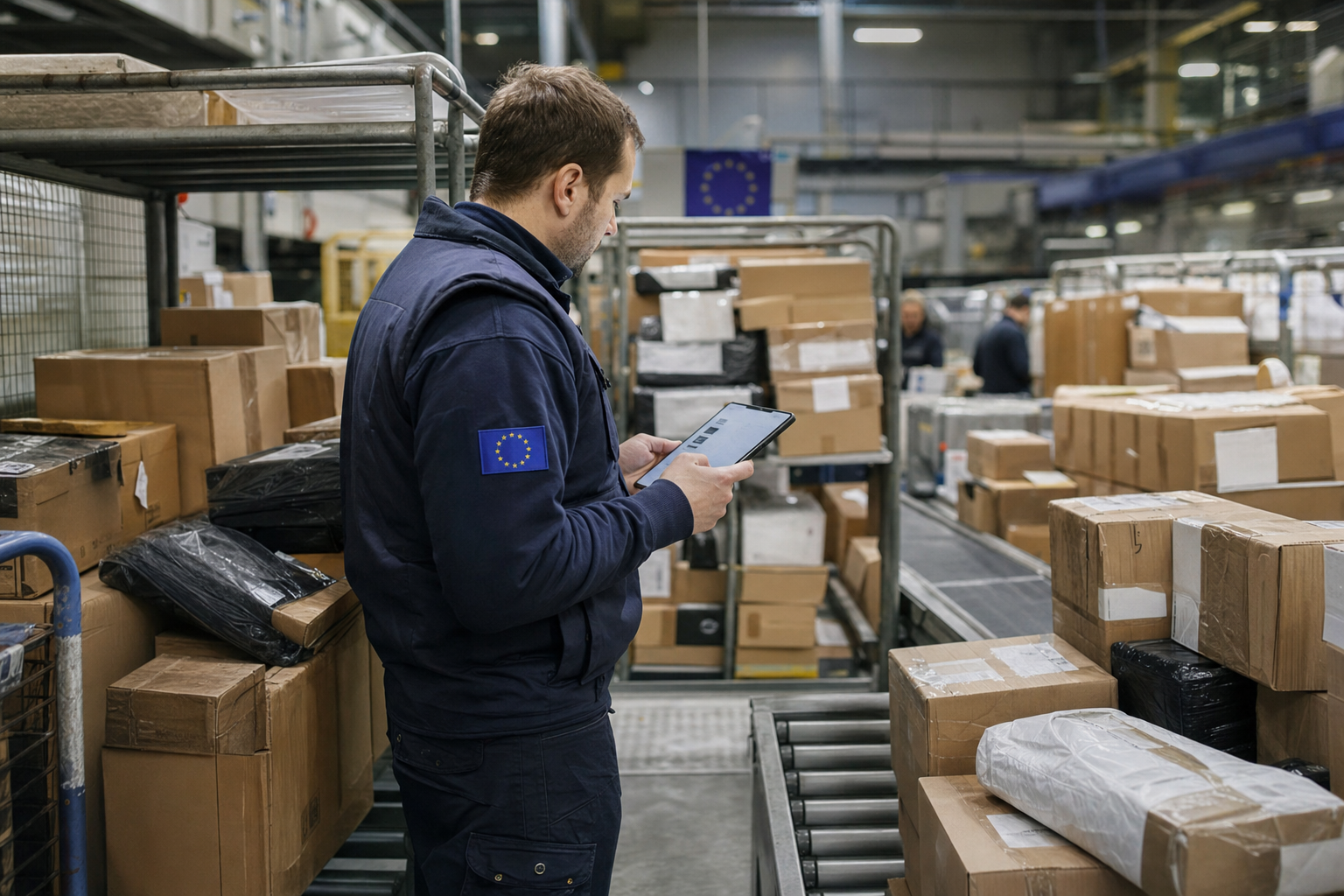
On May 22, 2026, Mike Parra, CEO of DHL Express Europe, Wouter Roels, President of FedEx Europe, and Daniel Carrera, President of UPS Europe, Middle East & Africa, jointly signed an open letter addressed to finance ministers of all EU member states.The core appeal: roll out the EU’s new regulatory framework for customs clearance of low-value cross-border parcels in phases instead of full blanket implementation starting July 1, 2026 as scheduled.
Stipulated under EU Regulation (EU)2026/382 formally approved in February 2026, the landmark reform abolishes long-standing duty exemption for inbound parcels valued below EUR 150.Statistics show the EU receives 4.6 billion low-value inbound parcels per annum, 91% of which originate from China, equivalent to around 12 million shipments daily. The bloc suffers roughly EUR 10 billion in annual tariff losses driven by under-declaration and split-shipment tax avoidance, while local retailers keep complaining about unfair competition from overseas low-cost goods.
Fixed flat-rate charges will be replaced by standard full tariff calculation in line with respective commodity HS codes; typical apparel products attract 12%–21% import duty.
The three logistics giants fully back the EU’s general direction of tightening customs oversight, boosting trade transparency and curbing illegal commodity circulation. However, multiple core supporting conditions for the new policy remain immature:
The carriers warn rigid full-scale launch on July 1 will trigger massive clearance backlogs, shipment detention, misdelivery and systemic cost surges, dealing a heavy blow to Europe’s whole cross-border logistics ecosystem.
表格
| Charge Item | Rate | Effective Date | Billing Rule |
|---|---|---|---|
| Fixed Customs Duty | EUR 3 per HS code | Jul 1, 2026 | Cumulative for multiple product categories in one parcel |
| Clearance Handling Fee | EUR 2 per shipment | Nov 1, 2026 | Charged per parcel regardless of SKU quantity |
| IOSS VAT | Country-specific tax rate | Already in force | Calculated based on declared cargo value |
| Total Incremental Cost | EUR 5–8 per piece | Post-Nov 2026 | Excludes original freight and platform service fees |
Case 1: Single-category consignmentProduct: Cotton T-shirt valued at EUR 50 under one single HS codeExtra cost: EUR3 fixed tariff + EUR2 clearance fee = EUR5 total cost increase, around 10% cost hike of original goods value.
Case 2: Mixed multi-item shipmentContents: Cotton T-shirt + Wool Scarf + Plastic Phone Case covering three distinct HS codesExtra cost: EUR3×3 + EUR2 = EUR11 extra expense, representing a 13.75% cost rise against an EUR80 declared value.
Parallel supplementary EU customs legislation enacted in March 2026 designates cross-border platforms including Shein, Temu and AliExpress as statutory importers. Platforms bear full legal liabilities covering import duty payment, product safety compliance and customs declaration; violations may incur fines equivalent to 1%–6% of annual global turnover. Consequently, platforms will tighten merchant access thresholds and pass incremental compliance costs onto downstream suppliers.
Current EU customs systems process 12 million inbound parcels daily via semi-automated workflows. New rules mandate item-by-item HS verification, categorized duty assessment and real-time data uploading, yet overall automation readiness stands below 60%. Heavy manual intervention will extend average clearance lead time from 1–2 working days to 5–7 days.
Prolonged detention leads to soaring warehousing surcharges, storage detention fines and redelivery fees; manual data amendment and error correction will add an extra EUR2–3 of operational expense per parcel.
Incomplete, mismatched or erroneous customs declarations will result in frequent cargo rejection, customs detention and financial penalties. Most small and medium-sized merchants and freight forwarders lack mature data management capability to satisfy strict EU filing requirements.
With Chinese-origin parcels accounting for 91% of EU low-value inbound shipments, low-ticket direct-mail businesses (unit price below EUR50) face nearly eliminated profit margins, forcing numerous small operators to withdraw from EU markets or restructure business models.

Core merits:
Recommended action: Prioritize overseas warehouse deployment in core EU markets including Germany, France and Spain; adopt small-batch multi-SKU stocking to control inventory capital occupancy.
Consolidate homogeneous commodities under unified HS codes where feasible to reduce cumulative fixed duty; split oversize mixed consignments reasonably to avoid excessive multi-category tariff accumulation.
Select logistics vendors proficient in EU new customs rules to standardize declaration data, reduce filing mistakes and lower the risk of customs hold-up and unexpected fines.
Phase out ultra-low-margin SKUs vulnerable to new tariff hikes; develop mid-range high-margin items to absorb incremental compliance and logistics costs.
Word count compliant with original Chinese SEO learning document; industry terminology aligned with international freight & customs standard expressions.






 Email: