

WORLDWIDE FREIGHT SERVICES
Email: jack@transworldcn.com
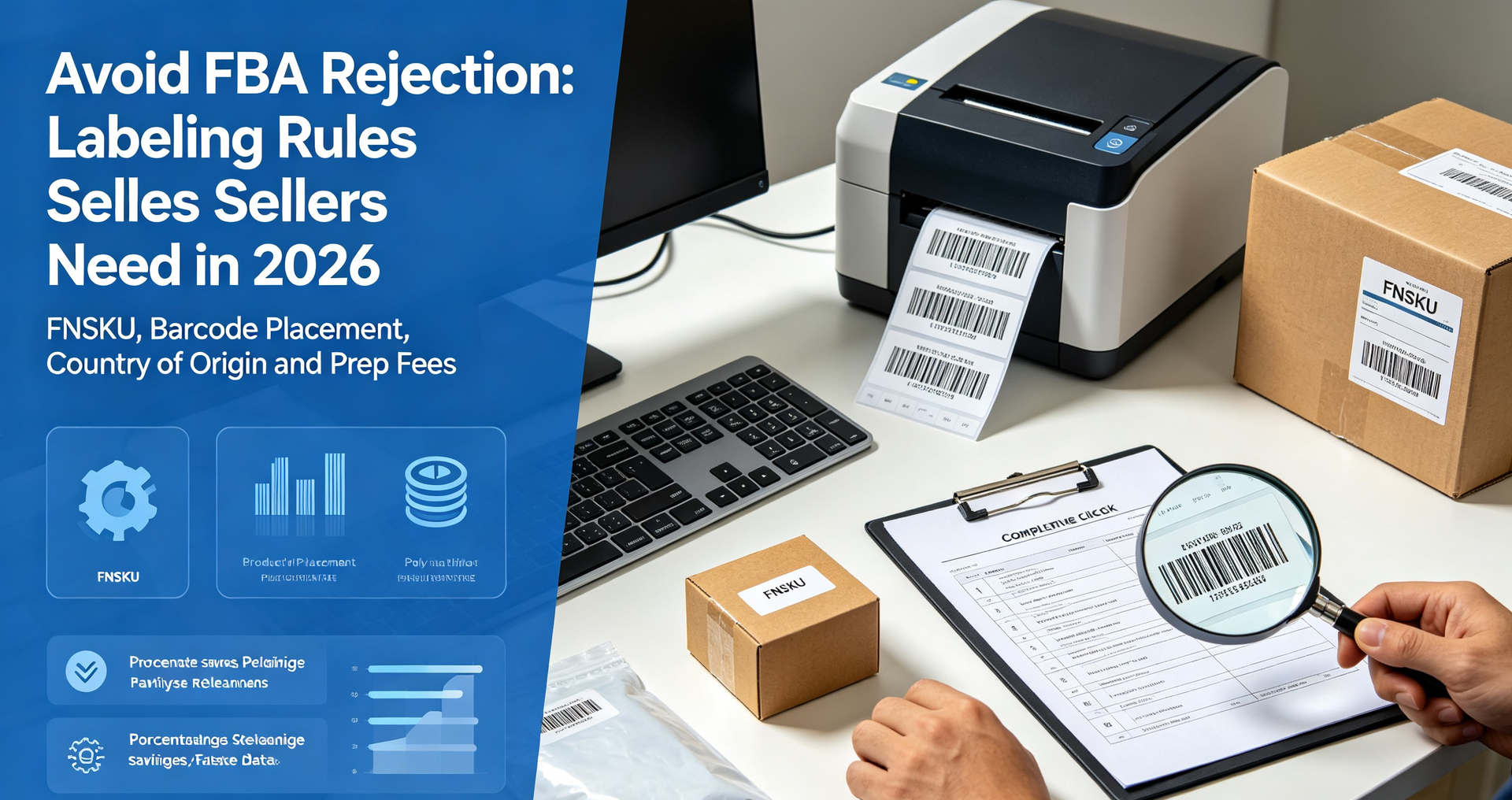
TL;DR – Key Takeaways for Amazon Sellers
FNSKU is now mandatory for most sellers: As of March 31, 2026, sellers not enrolled in Amazon Brand Registry must apply an FNSKU label to every unit – even if the product already carries a manufacturer barcode.
Unplanned prep fees cost $1.80–$2.40 per unit: A 1,000-unit shipment can incur $1,800–$2,400 in avoidable fees if labels are incorrect.
"Made in China" labeling is required for U.S. imports: Each unit and shipping carton must display the country of origin – missing labels can trigger U.S. Customs detention.
Label placement is as important as the label itself: Barcodes must be on flat surfaces, not on seams or edges. Poor placement can make scannable labels unreadable.
Supplier barcodes must be covered or removed: Amazon scanners must see only the FNSKU – visible supplier codes can cause inventory mis-routing
Shipping inventory to Amazon FBA should be straightforward. Yet labeling mistakes are one of the most common – and costly – pitfalls sellers face. Wrong labels, missing labels, or poorly placed labels can trigger warehouse rejections, delayed check-ins, and unexpected fees that eat into your margins
This guide covers everything you need to know about Amazon FBA labeling requirements in 2026: the critical FNSKU change, label types, placement rules, common mistakes, and strategies for sellers sourcing from China.
Effective March 31, 2026, Amazon has discontinued its longstanding practice of commingled inventory – where identical items from multiple sellers were treated as interchangeable using the original manufacturer barcode.
What this means: Sellers not enrolled in Amazon Brand Registry must now apply an Amazon-issued FNSKU barcode to every unit sent to an FBA fulfillment center, even when the product already carries a UPC, EAN, or GTIN barcode
Why Amazon made this change:
Counterfeit or non-compliant goods risked becoming mixed with legitimate stock
Brands faced quality and customer trust challenges
Sellers struggled with accurate attribution of returns and defects
By moving to FNSKU-only labeling for resellers, Amazon aims for unit-level traceability, ensuring every item can be linked back to the exact seller that supplied it.
| Identifier | Purpose |
| GTIN (UPC, EAN, etc.) | Identifies what the product is – the manufacturer's global identifier |
| FNSKU | Identifies which seller the product belongs to within Amazon's ecosystem |
Both can coexist – but for sellers outside Brand Registry, the FNSKU is now mandatory.
If you are not in Amazon Brand Registry, starting March 31, 2026, you must:
Apply an Amazon-specific FNSKU label to each item
Cover or avoid conflicting barcodes
Adjust fulfillment workflows, especially if using dropshipping or third-party prep centers
Every single unit sent through FBA must have a scannable FNSKU label. Amazon generates a unique FNSKU for each product when you create the listing in Seller Central.
FNSKU label requirements:
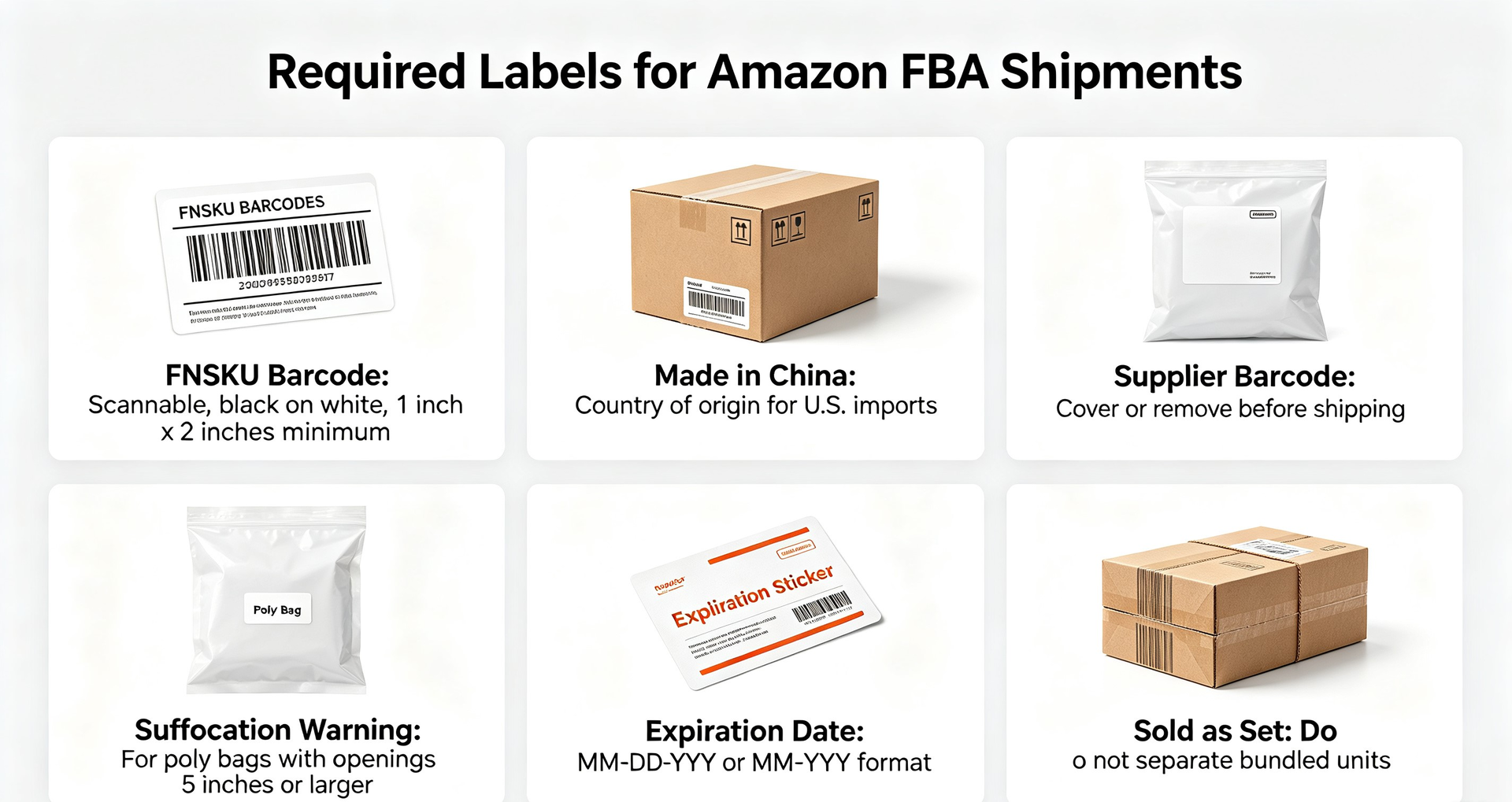
Minimum size: 1 inch x 2 inches
Printed using black ink on a white, non-reflective background
Must be scannable – high-contrast, no smudges or wrinkles
Must include: scannable barcode, FNSKU number, product name, and condition (new/used)
Label placement rules:
Place on the flattest, smoothest surface
Avoid seams, corners, edges, and curves
Do not place on a seam or opening – label will be damaged when box is opened
Must not wrap around edges
U.S. Customs requires every imported product to be marked with its country of origin. For FBA sellers, this means each unit – and often the outer shipping carton – needs a clear "Made in China" label
Consequence of non-compliance: Products without this marking can be detained by U.S. Customs, causing weeks of storage delays and fees.
Best practice: Apply the "Made in China" label alongside the FNSKU label, or ensure it is printed on the product packaging itself.
If your Chinese supplier places their own barcode on the product packaging, it must be removed or covered with a black marker. Amazon scanners must see only the FNSKU.
Why this matters: A visible supplier barcode can cause mis-scanning – Amazon might record the wrong product in their system, leading to inventory discrepancies.
How to fix: Cover the supplier barcode with a blank white label or black marker, ensuring it cannot be scanned. Then apply the FNSKU label over it or nearby.
Products packaged in poly bags with openings 5 inches or larger (measured when flat) require a suffocation warning label
Requirements:
Clearly visible on the outer package
Printed in a readable font
Minimum font size depends on bag size :
60″ or more: 24 pt
40–59″: 18 pt
30–39″: 14 pt
Less than 30″: 10 pt
Products with expiration dates (food, supplements, cosmetics, pet supplies) must display the date on both the individual unit and the outer carton.
Format requirements:
Must be MM-DD-YYYY or MM-YYYY
If packaging uses a different format, cover it with a correct label
For case packs, expiration date must be in 36-point font or larger on the outer carton
Consequence: Amazon automatically removes inventory with unreadable or missing expiration dates
If multiple items are sold as a single unit, they must be packaged together and labeled as a set to prevent them from being separated during fulfillment.
Label requirement: Apply a label stating "Sold as Set" or "Do Not Separate" on the outer package.
Each shipping carton requires a unique FBA box ID label generated from your shipment workflow in Seller Central.
Key rules:
Print the full set of labels – each label is unique; do not photocopy or reuse
Place both the FBA box ID label and the carrier label on a flat surface
Both labels must remain uncovered and scannable
Labels support a measurement of 3.33 x 4 inches
Don't place labels on a seam or opening – they will be damaged when the box is opened
For full truckload shipments, each pallet requires four labels – one on the top center of each side – showing the FBA fulfillment center address, pallet ID, and total carton count.
Additional requirements:
Pallets must be stretch-wrapped with labels visible through the wrap
Each pallet requires four pallet labels
Amazon uses FNSKUs to identify the seller, track units in the fulfillment network, and prevent commingling with other sellers' inventory. Warehouse scanners cannot scan or match inventory if the FNSKU label is wrong or missing.
Why this triggers rejection: Scanners cannot match the product to the seller's inventory record.
Avoidance tips:
Always generate the latest FNSKU in Seller Central for the exact product SKU
Ensure each unit has a clear, scannable label
Never cover a UPC or EAN unless you apply the FNSKU over it
Low print quality, bad placement, and poor label materials all contribute to unreadable barcodes
What goes wrong:
Low contrast or smudged ink
Wrinkled or creased labels
Placement over edges, seams, or curves
Avoidance tips:
Use high-quality thermal printing materials
Place labels on flat, smooth surfaces
Test scan before shipping
Shipments must show accurate carton and pallet information. Common mistakes include wrong unit counts, reusing old labels, or missing item details.
Why it matters: Incorrect carton content can confuse warehouse operations and cause inventory errors.
Avoidance tips: Verify SKU and unit counts, match packing lists to labels, and follow Amazon's labeling requirements
Having both a manufacturer barcode and FNSKU visible on the same unit can confuse scanners and cause mis-scanning.
Fix: Cover or remove the manufacturer barcode, leaving only the FNSKU visible.
Even a correctly printed label can fail if placed incorrectly. Labels on curved surfaces, over seams, or across openings may not scan
Best practice: Place labels on the flattest, largest surface. Maintain a 12mm "quiet zone" (clear space) around the barcode where possible.
Amazon charges unplanned prep fees of $1.80–$2.40 per unit when your inventory arrives without proper labeling. For a 1,000-unit shipment, that's $1,800–$2,400 in avoidable fees.
| Cost Type | Impact |
| Shipment rejection | Inventory returned to origin at seller's expense |
| Delayed check-in | Lost sales, stockouts, poor inventory velocity |
| Manual relabeling | Additional per-unit fees from Amazon |
| Storage fees | Extended holding while issues are resolved |
Step-by-Step Guide: Labeling Process for FBA Shipments from China
Step 1: Generate FNSKU Labels
Log in to Seller Central > Inventory > Manage Inventory
Select the product and request FNSKU labels
Download the label PDF for the exact SKU
Step 2: Verify Label Quality
Print using thermal transfer or a high-quality laser printer (minimum 300 DPI)
Test-scan each label before applying
Ensure adequate contrast and no smudges
Step 3: Apply FNSKU Labels to Each Unit
Place on a flat, smooth surface
Avoid seams, edges, curves
Cover or remove any supplier barcodes
Step 4: Apply Compliance Labels as Needed
"Made in China" label on each unit and carton
Suffocation warning labels on poly bags with openings 5″+
Expiration dates in MM-DD-YYYY format
"Sold as Set" labels for bundled items
Step 5: Apply Carton Labels
Print unique FBA box ID labels from Seller Central
Apply to flat surface of each box
Do not place over seams or openings
Step 6: Pallet Labeling (if applicable)
Apply four pallet labels – one on each side
Stretch wrap with labels visible
Step 7: Pre-Shipment Inspection
Book inspection at 80% production complete
Verify label compliance before container loading
A: FNSKU identifies both the product and the seller, keeping your inventory separate from other sellers. UPC identifies only the product. For private-label sellers, FNSKU is now mandatory for most sellers.
A: Amazon may print labels for you and charge a label fee, or the shipment may be rejected. It's best to ensure labels are scannable before shipping
A: Yes. U.S. Customs requires country of origin marking on all imported products. Missing labels can result in customs detention and storage fees.
A: Yes, you should cover or remove any supplier barcodes so Amazon scanners only see the FNSKU label.
A: March 31, 2026. Sellers not enrolled in Brand Registry must apply FNSKU labels to every unit, even if the product already carries a manufacturer barcode
A: Minimum 1 inch x 2 inches. The label must be printed with black ink on a white, non-reflective background.
A: No. Each FBA box ID label is unique – do not photocopy, reuse, or modify labels for use on additional boxes
Amazon FBA labeling is a deceptively simple task that, if done incorrectly, can trigger warehouse rejections, unplanned fees, and delayed inventory processing.
The key takeaways for 2026:
FNSKU is now mandatory for most sellers – manufacturer barcodes alone no longer work
"Made in China" labels are required for U.S. customs compliance
Placement matters – labels must be on flat surfaces, not seams or edges
Pre-shipment inspection can catch errors before they become costly problems






 Email: