

WORLDWIDE FREIGHT SERVICES
Email: jack@transworldcn.com
TL;DR – Key Takeaways for Importers
Shipping from China to Mexico is booming: Bilateral trade reached $109.4 billion in 2025, making China Mexico's second-largest trading partner, with over 1,400 product categories now subject to tariffs of 10–50%.
New direct routes cut transit times: A new MSC-operated route from Tianjin to Mexico's west coast reduces shipping time by 8–12 days, with total port-to-port transit now 20–32 days depending on origin.
Sea freight remains the most economical choice: FCL rates range from $2,400–4,400 per 40ft container**; LCL runs **$150–208 per CBM; air freight costs $5.30–8.50/kg.
Tariffs are the new reality: Mexico's 2026 tariff reforms impose 10–50% duties on over 1,400 Chinese product categories—verify your HS code and RFC tax ID before shipping.
DDP shipping requires careful vetting: DDP rates currently average $430–500/CBM, but terms vary widely—always confirm what's included.
Mexico has emerged as one of the fastest-growing markets for Chinese exports. With trade volumes reaching $109.4 billion in 2025 and China solidifying its position as Mexico's second-largest trading partner, the logistics corridor between the two nations is more important than ever.
But 2026 has brought significant changes. New tariff laws impose duties of 10–50% on over 1,400 Chinese product categories, and new direct shipping routes are transforming transit times. This guide covers everything you need to know: shipping costs, transit times, customs clearance, tariffs, and strategies for successful importing.
Starting January 1, 2026, Mexico implemented a permanent tariff increase on imports from countries without free trade agreements—including China. The reform covers 1,463 product categories with rates ranging from 10% to 50% across approximately 17 industries.
| Industry | Tariff Range | Key Products |
| Steel & Iron | 15–50% | 249 product categories |
| Automotive & Parts | 20–50% | 235 categories |
| Textiles & Apparel | 10–35% | 1,014 categories |
| Plastic Products | 10–35% | 81 categories |
| Furniture | 15–35% | 28 categories |
| Appliances | 15–30% | 18 categories |
| Toys | 10–25% | 37 categories |
| Leather & Footwear | 10–30% | 67 categories |
| Aluminum Products | 15–35% | 21 categories |
| Motorcycles | 20–40% | 8 categories |
Source: Mexico's General Import and Export Tax Law, effective January 1, 2026
In April 2026, Mexico extended additional tariffs on 185 product categories with rates of 5–35%, effective indefinitely. This includes:
Cosmetics: Up to 35% (e.g., monoethanolamine, diethanolamine)
Bicycles & parts: 35% on frames, forks, and parts
Automotive parts: 10–35% on bumpers, windshields, chassis
Graphic arts & maps: 25–35%
Wind turbines & parts: 5%
Trailers & parachutes: 35%
Products from the U.S., Canada, and the EU (countries with free trade agreements with Mexico) are exempt from these tariffs. This creates a strategic consideration for importers—some are routing goods through the U.S. to avoid Mexican tariffs on Chinese products.
Action step: Verify your product's HS code and tariff classification before placing orders. Misclassification is a leading cause of customs holds under Mexico's VUCEM (Single Window for Foreign Trade) system.
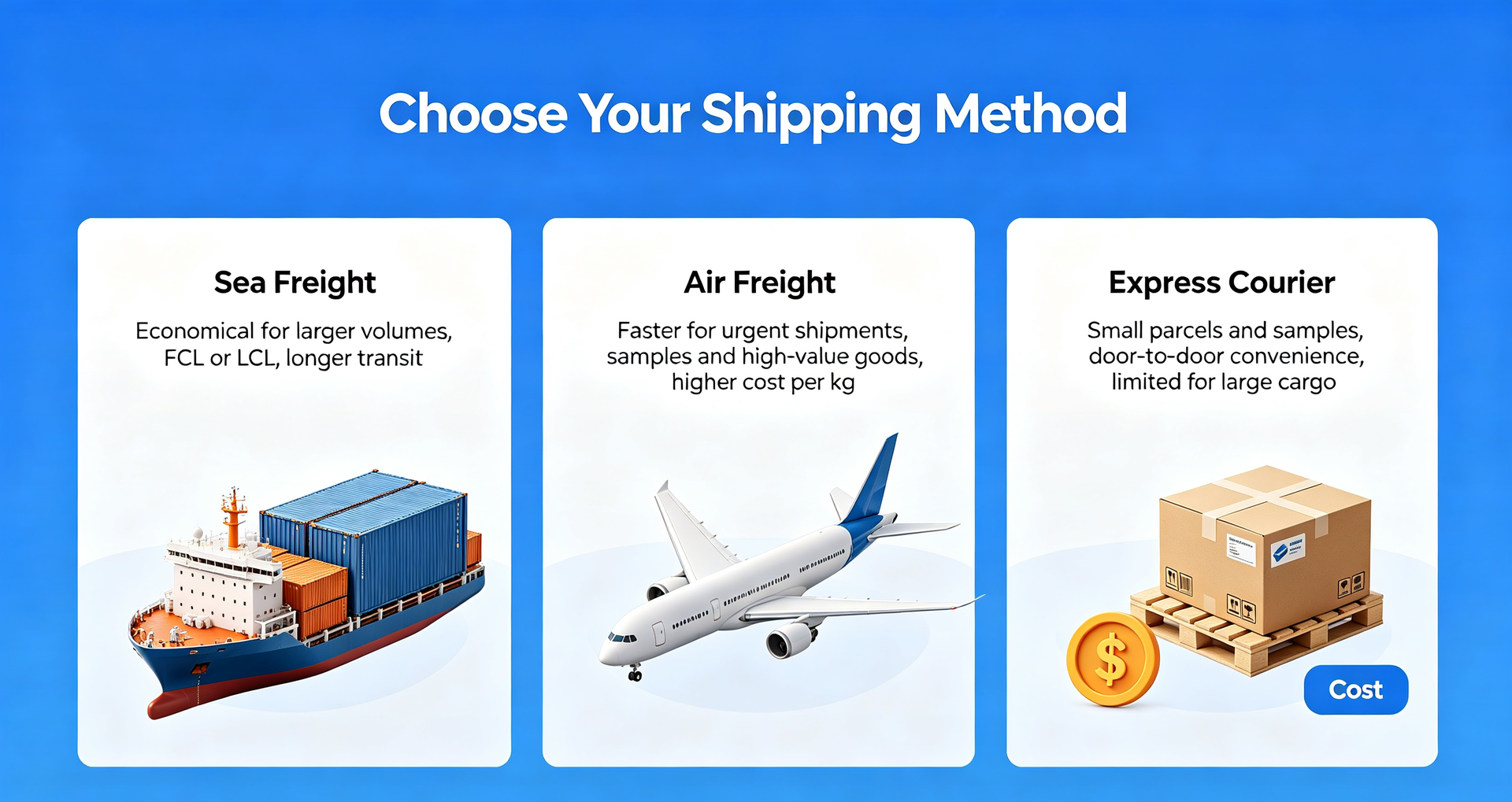
Sea freight is the most economical option for shipping from China to Mexico, especially for shipments over 1 CBM.
FCL (Full Container Load) Rates :
| Origin (China) | Destination (Mexico) | 20ft GP (USD) | 40ft HQ (USD) | Transit |
| Shenzhen/Guangzhou | Manzanillo | $2,400–3,000 | $3,400–4,300 | 22–28 days |
| Shanghai/Ningbo | Manzanillo | $2,450–2,950 | $3,450–4,250 | 22–27 days |
| Qingdao/Tianjin | LazaLázarodenas | $2,500–3,100 | $3,500–4,400 | 23–29 days |
| Shanghai/Shenzhen | Veracruz | $2,650–3,200 | $3,650–4,550 | 27–33 days |
LCL (Less than Container Load): Approximately $150–208 per CBM plus destination charges.
DDP Sea Freight: $430–500/CBM (all-in reference).
A common trap for new shippers is assuming LCL is always cheaper for smaller volumes. It rarely is
| Factor | FCL | LCL |
| Best for | >15 CBM | 1–15 CBM |
| Cost | Lower per unit | Higher per CBM |
| Transit | Faster (direct) | +3–7 days for consolidation |
| Hidden fees | Fewer | Destination handling, CFS fees |
Real-world example: A client shipped 12 CBM to Mexico via LCL to save money. After destination fees and delays, it was only 8% cheaper than FCL but took 10 days longer.
For urgent shipments, high-value goods, or samples, air freight delivers in days rather than weeks.
| Service | Transit Time | Cost (USD/kg) |
| Air Freight | 5–10 days | $5.30–8.50 |
| Express Courier | 2–4 days | $10–13 |
Port-to-Port transit times :
| Route | Transit Time |
| Shenzhen → Manzanillo | 16–33 days |
| Shanghai/Ningbo → Lázaro Cárdenas | 18–36 days |
| Qingdao/Tianjin → Manzanillo | 20–40 days |
Door-to-door realistic planning :
| Stage | Time |
| Ocean Transit | 25–35 days |
| Port Handling | 3–7 days |
| Customs Clearance | 2–5 days |
| Inland Delivery | 2–7 days |
| Total | 32–53 days |
In July 2026, Mediterranean Shipping Company (MSC) launched a new direct weekly route from Tianjin to Mexico, operating 7 vessels with 5,000 TEU capacity.
Key benefits:
Cuts transit time by 8–12 days compared to transshipment via Korea
Now 15–16 days from Tianjin to Mexico's west coast
Connects to Manzanillo, Lazaro Cardenas, and Ensenada
Expected to add 60,000 TEU annually to Tianjin's export volume
Expert Quote: "The new route's stable schedule and two-way cargo flow precisely matches the industrial needs of China and Mexico. Electronic products and auto parts from North China can now reach Mexico quickly, effectively reducing logistics costs." — Wang Zixin, China Tianjin Ocean Shipping Agency
The most common cause of customs delays is inconsistent documentation—especially mismatched RFC tax IDs or incorrect HS codes
Core documents required:
Commercial Invoice: Must include RFC (Mexican tax ID)
Packing List: Itemized by HS code
Bill of Lading: Matches invoice/packing list exactly
Certificate of Origin: Required for tariff determination
Import Declaration (Pedimento): Filed by your customs broker
Note: Mexico's VUCEM (Single Window for Foreign Trade) system cross-checks all documents. Inconsistent data triggers holds
| Tax/Fee | Rate | Notes |
| Import Duty (IGI) | 0–50% | Based on product HS code |
| IVA (VAT) | 16% | Applied to CIF + duty |
| DTA (Trade Fees) | Varies | Product-specific |
| Customs Broker Fee | Varies | Negotiable |
| Container Deposit (LoG) | $1,000–2,000 | Letter of Guarantee often required |
In Mexico, a Letter of Guarantee (LoG) waives container deposits. Most Chinese forwarders cannot issue one due to lack of local presence, insurance, or financial capacity, leading to higher freight costs or rejected requests.
Best practice: Work with a forwarder that has local presence in Mexico and can issue LoGs.
Peak season and carrier capacity can drive rates up significantly. Booking 3–4 weeks ahead secures better pricing and space
Misclassification is the #1 cause of customs holds. Verify your product's HS code and tariff rate before placing orders.
DDP shipping from China to Mexico can simplify the process, but terms vary widely :
Confirm what's included: IGI, IVA, DTA, broker fees, inspections, storage, final delivery
Verify importer of record status
Get the scope in writing
Because products from the U.S. are exempt from Mexican tariffs, some importers are routing goods through the U.S. before shipping to Mexico. This adds transit time but can reduce tariff exposure significantly.
Look for forwarders with:
Local offices in Mexico – Can issue LoGs and manage customs
Direct carrier contracts – Better rates and longer free detention times
Experience with your product category – Understands HS codes and compliance
A: Ocean freight: 20–40 days port-to-port, 32–53 days door-to-door. New direct Tianjin routes cut transit by 8–12 days. Air freight: 5–10 days
A: Sea FCL: $2,400–4,400 per 40ft; LCL: $150–208/CBM; air: $5.30–8.50/kg. Additional costs include tariffs (10–50%), VAT (16%), and destination handling.
A: Mexico imposed 10–50% tariffs on over 1,400 product categories effective January 1, 2026, with additional 5–35% tariffs on 185 categories effective April 2026
A: FCL (Full Container Load) is for shipments over 15 CBM—lower per-unit cost, faster transit. LCL (Less than Container Load) shares container space—best for smaller volumes but with hidden fees and longer transit.
A: Commercial Invoice (with RFC), Packing List, Bill of Lading, Certificate of Origin, and Import Declaration.
A: Approximately 15 CBM. Below this, LCL may be cheaper; above it, FCL offers lower per-unit cost and faster transit.
Shipping from China to Mexico in 2026 offers significant opportunities—but comes with new complexities. The key takeaways:
Tariffs are the new reality: Verify your HS code before ordering—rates range 1from 0–50% on Chinese goods.
New direct routes save time: Tianjin-to-Mexico direct shipping cuts transit by 8–12 days.
Choose FCL over LCL for shipments over 15 CBM—the hidden costs of LCL often outweigh the savings.s
Book 3–4 weeks ahead to secure better rates and space.
Work with a forwarder with local presence in Mexico to handle LoGs, customs, and compliance.






 Email: