

WORLDWIDE FREIGHT SERVICES
Email: jack@transworldcn.com

TL;DR – Key Takeaways for Importers
Start with the right HTS code: U.S. HTS codes differ from Chinese HS codes beyond the first 6 digits. Use the USITC HTS database to find the correct 10-digit code for your product before calculating duty.
The 2026 tariff stack is layered: Base MFN duty + old Section 301 tariffs (7.5–25%) + new Section 301 forced-labor tariffs (12.5%, effective July 24, 2026) + Section 232 tariffs for steel/aluminum/copper (25–50%).
De minimis is suspended: Shipments valued under $800 now face a flat fee structure – $80–$200 per postal package depending on tariff tier, plus potential ad valorem duties.
301 exemptions exist but have deadlines: Certain product categories are exempt from Section 301 tariffs through November 29, 2026. Check the exemption list before calculating.
Customs value is not the supplier's invoice: For U.S. imports, customs value must include freight, insurance, packing costs, and certain assists or royalties.
When you import goods from China to the United States, the price you pay your supplier is only the beginning. Once your goods arrive at the U.S. port, Customs and Border Protection (CBP) will assess duties based on the product's classification, declared value, and a growing stack of tariffs layered onto Chinese imports.
In 2026, the tariff landscape for Chinese imports is more complex than ever. A new 12.5% Section 301 "forced-labor" tariff took effect on July 24, 2026, stacking on top of existing 7.5–25% Section 301 tariffs. Meanwhile, the suspension of the de minimis exemption on August 29, 2025, means that even small parcels now incur duties.
This guide provides a practical framework for calculating customs duty when importing from China to the United States. It covers the formula, the key inputs, and the 2026 tariff landscape that every importer must navigate.
The first step in calculating duty is identifying the correct 10-digit Harmonized Tariff Schedule (HTS) code for your product. The U.S. uses HTS codes that differ from Chinese HS codes beyond the first 6 digits.
HTS codes are 10-digit numbers that classify imported products. The first 6 digits are internationally standardized (HS codes), while the last 4 digits are specific to the United States.
| Code Segment | Example (Roasted Coffee) | Meaning |
| 09 | Chapter | Coffee, Tea, Spices |
| 0901 | Heading | Coffee |
| 0901.21 | Subheading | Roasted, not decaffeinated |
| 0901.21.0010 | Full HTS | In containers ≤ 2 kg |
| Resource | Best For | Link |
| USITC HTS Database | Official U.S. HTS codes and duty rates | USITC website |
| Tariff Check | Free 2026 tariff search for 28,000+ HTS codes | tariff-check.com |
| Flexport Tariff Simulator | Real-time duty calculation with Section 301/232 rates | tariffs.flexport.com |
Pro Tip: Always verify your HTS code classification with a customs broker before importing. Misclassification can result in penalties and delayed shipments.
Once you have the correct HTS code, the first duty rate you will see is the Most Favored Nation (MFN) rate – the standard duty applied to imports from WTO member countries, including China.
Duty rates can be:
Ad Valorem: Percentage of product value (e.g., 3.2% means 3.2% of declared value)
Specific Duty: Fixed amount per unit (e.g., $0.32/kg)
Combination: Both ad valorem and specific
Example: For HTS code 8465.92.00 (woodworking machines), the MFN duty rate is approximately 3.2%.
Since 2018, the U.S. has imposed additional tariffs on Chinese goods under Section 301. In 2026, these tariffs are layered as follows:
| Tariff Layer | Rate | Effective Date | Notes |
| Old Section 301 (List 1–4) | 7.5–25% | 2018–2025 | Varies by product category |
| New Section 301 (Forced Labor) | 12.5% | July 24, 2026 | Applies to China, Vietnam, and 41 other economies; stacks on the old Section 301 |
Important: The new 12.5% "forced-labor" tariff is additive to the old Section 301 tariffs. If your product is subject to a 25% old Section 301 tariff, the combined additional tariff is 37.5% – plus the base MFN duty.
Example – Power Adapter (HTS 8504.40.85) :
Base MFN duty: ~2.5%
Old Section 301 (List 3): 25%
New Section 301 (Forced Labor): 12.5%
Total duty rate: 40%
Certain product categories face additional duties outside the Section 301 framework:
| Product Category | Tariff Rate | Notes |
| Steel & Aluminum | 25% | Section 232; not stacked with 301 |
| Vehicles & Parts | Up to 25% | Section 301 auto tariffs |
| Copper | 25% | Section 232 effective 2025 |
The 12.5% forced-labor duty does not stack with Section 232 tariffs.
Certain product categories are exempt from Section 301 tariffs through November 29, 2026. If your product falls under an exemption, you do not need to pay the 301 tariff layer – only the base MFN duty.
Exempted categories include:
Certain electronics and components
Medical supplies and equipment
Specific industrial machinery
Solar manufacturing equipment
Tip: Always check the current USTR exemption list before calculating duty.
The customs value (also called "transaction value") is not simply your supplier's invoice. Under U.S. law (19 U.S.C. § 1401a), it includes:
| Component | Included? |
| Price paid for goods | ✅ Yes |
| Packing costs | ✅ Yes |
| Selling commissions (buyer's agent) | ✅ Yes |
| Assists (materials/tools provided by buyer) | ✅ Yes |
| Royalties (condition of sale) | ✅ Yes |
| Freight & insurance | ✅ Yes |
| Advertising costs | ❌ No |
| Buyer's internal expenses | ❌ No |
Common Undervaluation Schemes to Avoid :
Falsified invoices: Listing values lower than the actual transaction price
Double invoicing: One true invoice, one reduced invoice for customs
Omitting required statutory additions: Excluding packing costs or assists
Risks of Undervaluation: Customs fraud can expose importers to back duties, civil penalties, loss of trusted trader status, and even criminal prosecution. The DOJ has identified customs fraud as a top enforcement priority.
Since August 29, 2025, the $800 de minimis exemption has been suspended for all countries.
For postal shipments, flat fees apply based on the country's tariff tier:
Under 16% tariffs: $80 per postal item
16–25% tariffs: $160 per postal item
Over 25% tariffs: $200 per postal item
For commercial shipments: All applicable tariffs, including Section 301 duties, apply regardless of value.
Final Formula:
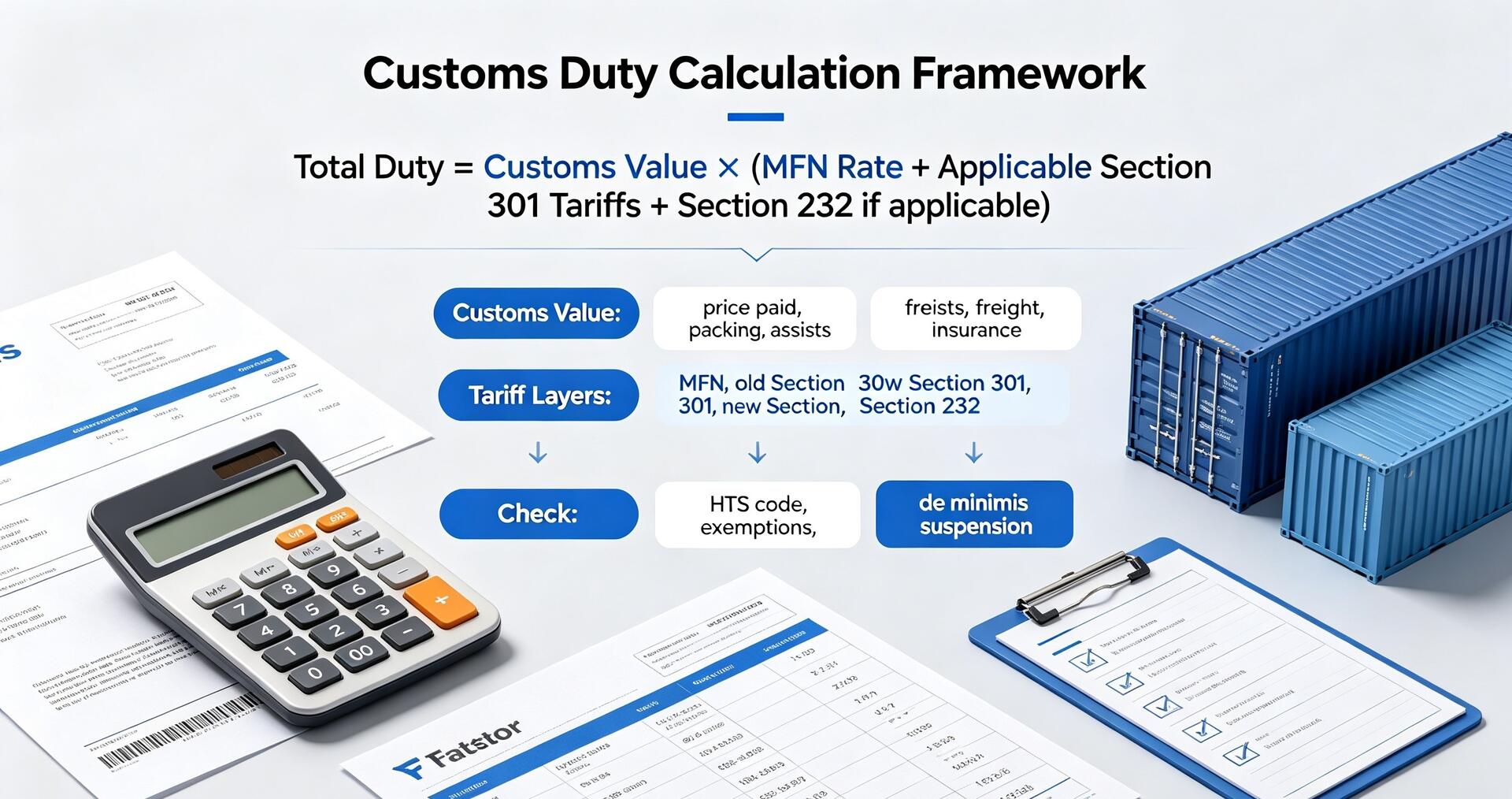
Total Duty = Customs Value × (MFN Rate + Applicable Section 301 Tariffs + Section 232 if applicable)
Complete Example: A power adapter (HTS 8504.40.85) with CIF value of $10,000:
Customs value: $10,000 (including freight and insurance)
MFN duty: $10,000 × 2.5% = $250
Old Section 301: $10,000 × 25% = $2,500
New Section 301: $10,000 × 12.5% = $1,250
Total Duty: $4,000 (40% effective rate)
Common Mistakes and How to Avoid Them
The first 6 digits match, but the full 10-digit code differs. Fix: Always verify the complete 10-digit U.S. HTS code.
U.S. customs value must include freight, insurance, packing costs, and assists. Fix: Include all required additions.
The 12.5% forced-labor tariff took effect July 24, 2026. Fix: Update duty calculations to include both old and new 301 tariffs.
Products containing steel or aluminum may face 25% Section 232 duties. Fix: Check if your product is subject to Section 232.
The $800 de minimis exemption was suspended on August 29, 2025. Fix: Budget for duties on all shipments.
Step 1: Identify Your Product
Describe your product accurately (material, function, specification)
Gather supplier specifications, material composition, and intended use
Step 2: Look Up HTS Code
Search the USITC HTS database by product description or the first 6 digits of the Chinese HS code.
Verify the 10-digit code is correct for your product
Step 3: Determine Base MFN Rate
Note the Column 1 (Normal) duty rate for your HTS code
Step 4: Check Section 301 Tariffs
Confirm if your product is subject to old Section 301 tariffs (7.5–25%)
Confirm if your product is subject tothe new 12.5% forced-labor tariff (China origin)
Check for any 301 exemptions
Step 5: Check Section 232 (if applicable)
For steel, aluminum, copper, or automotive products, confirm 25–50% Section 232 duties.
Step 6: Calculate Customs Value
Include price paid + packing + assists + freight + insurance
Verify with your supplier and forwarder
Step 7: Apply the Formula
Total Duty = Customs Value × (MFN + Section 301 + Section 232)
A: The first 6 digits are the same globally. Beyond that, the U.S. uses a 10-digit HTS code, while China uses an 8- to 10-digit HS code. Always use the U.S. HTS code for U.S. duty calculations.
A: Rates range from 7.5% to 25% for old Section 301 tariffs, with an additional 12.5% "forced-labor" Section 301 tariff effective July 24, 2026. The combined rate depends on your product classification.
A: Yes. Certain product categories are exempt through November 29, 2026. Check the current exemption list before calculating.
A: Customs value includes the transaction value (price paid) plus packing costs, selling commissions, assists (materials/tools provided by buyer), royalties, and freight/insurance.
A: Since August 29, 2025, the de minimis exemption is suspended. Postal shipments are subject to flat fees ($80–200 per package). Commercial shipments pay all applicable tariffs.
A: Customs fraud can lead to back duties, civil penalties, loss of trusted trader status, and criminal prosecution. The DOJ has identified customs fraud as a top enforcement priority.
A: No. Incoterms 2020 remains the current official version. The next revision is expected around 2030.
Calculating customs duty when importing from China to the U.S. requires attention to multiple layers: the base MFN rate, old Section 301 tariffs, new 12.5% forced-labor tariffs, potential Section 232 duties, and accurate customs value determination.
The most important advice for importers: verify your HTS code, check for exemptions, and declare accurate values. A small mistake in classification or valuation can lead to significant overpayment – or a customs audit with serious legal consequences.






 Email: