
WORLDWIDE FREIGHT SERVICES
Email: jack@transworldcn.com
DDP, DDU, and FOB are not interchangeable shipping terms. The biggest difference is who manages transportation, import clearance, duties, and risk at each stage.
ICC's current Incoterms® edition is Incoterms® 2020, which contains 11 rules. DDP and FOB are among those rules; DDU is not.
When importing from China, buyers often encounter terms such as DDP, DDU, and FOB on supplier quotations.
These three terms can create confusion because they determine different allocations of costs, responsibilities, delivery obligations, and risk between the seller and buyer.
The first point to understand is particularly important:
DDU is not an Incoterms® 2020 rule.
ICC explains that DDU was replaced in the earlier transition to Incoterms® 2000 by DAF, DES, DEQ, and DDP being reorganized into the newer framework, including DAP. Under Incoterms® 2020, the current rules include DAP, DPU, and DDP for any mode of transport, while FOB remains a rule specifically for sea and inland waterway transport.
Therefore, an importer should not simply compare “DDP vs DDU vs FOB” as though all three were current Incoterms® 2020 rules.
Instead, it is better to understand what each term means in commercial practice and then identify the appropriate current Incoterms® rule for the contract.
| Term | Current Incoterms® 2020 Rule? | Main Seller Responsibility | Import Clearance | Import Duties | Typical Buyer Responsibility |
| DDP | Yes | Transportation to named destination | Seller | Seller | Receive goods |
| DDU | No | Historically, delivery to destination, excluding import duties | Historically buyer | Buyer | Import formalities and duties |
| FOB | Yes | Export process and delivery on board vessel | Buyer | Buyer | Main freight, import clearance and destination costs |
This table is a practical overview rather than a substitute for the actual sales contract or Incoterms® 2020 rule.
ICC's tariff guidance confirms that under DDP, the seller is responsible for import clearance and tariffs, while under FOB, import clearance and tariffs are the buyer's responsibility.
DDP stands for Delivered Duty Paid.
Under Incoterms® 2020, the seller has a very high level of responsibility. The seller arranges transportation to the named destination and handles export, transit where applicable, and import clearance, including applicable duties and taxes within the scope of the rule.
ICC describes DDP as the Incoterms® rule imposing the maximum level of obligation on the seller.
A simplified DDP flow looks like this:
Supplier → China Pickup → Export → International Freight → Import Clearance → Duties/Taxes → Final Destination
This can be attractive to an importer who wants a more straightforward delivery arrangement.
For the buyer, DDP can offer:
However, DDP does not mean that the importer can ignore import regulations.
The seller's ability to perform import clearance depends on the destination country's legal and practical requirements. ICC itself cautions sellers about the high level of responsibility involved with DDP.
Before accepting a DDP quotation, ask:
What exactly is included in the quoted DDP price?
For example:
A quotation labeled “DDP” should be examined based on the actual agreed scope.
DDU stands for Delivered Duty Unpaid.
You will still see “DDU” used in supplier quotations, freight discussions, and older shipping documentation. However, DDU is not one of the 11 Incoterms® 2020 rules.
That distinction matters.
The modern Incoterms® framework includes DAP (Delivered at Place), which is often relevant when the commercial intention resembles what parties historically described as DDU.
Under DAP, the seller is responsible for transportation and risk up to the named destination, while the buyer handles import clearance and related import duties and taxes. ICC's current guidance specifically distinguishes DAP from DDP based on import clearance and duties.
International trade terminology often continues to use older expressions even after the official Incoterms® framework has changed.
Therefore, if a Chinese supplier tells you:
“We can ship DDU.”
Do not assume that both sides have the same understanding.
Ask the supplier to specify the actual responsibilities in writing and, where appropriate, use the current Incoterms® rule and a named place.
Clarify:
This prevents a commonly encountered problem: both sides think the other party is responsible for a destination charge or customs obligation.
FOB is an official Incoterms® 2020 rule, but it has an important limitation:
FOB is intended for sea and inland waterway transport.
ICC states that FOB means the seller delivers the goods on board the vessel nominated by the buyer at the named port of shipment. The risk of loss or damage transfers when the goods are on board the vessel.
A simplified FOB flow is:
Supplier → Export Handling → Loading On Board → Buyer Takes Main Transport Responsibility → Import Clearance → Final Delivery
Under FOB, the buyer generally has substantially more control over the international transportation than under DDP.
FOB can be useful for experienced importers because the buyer can:
This can be particularly relevant for established ecommerce companies importing regular volumes from China.
One common misunderstanding is that FOB means the seller pays everything until the destination.
That is incorrect.
The term Free On Board describes the seller's delivery obligation at the named port of shipment. Once the goods are delivered on board the vessel, risk transfers to the buyer, and the buyer bears costs from that point according to the rule.
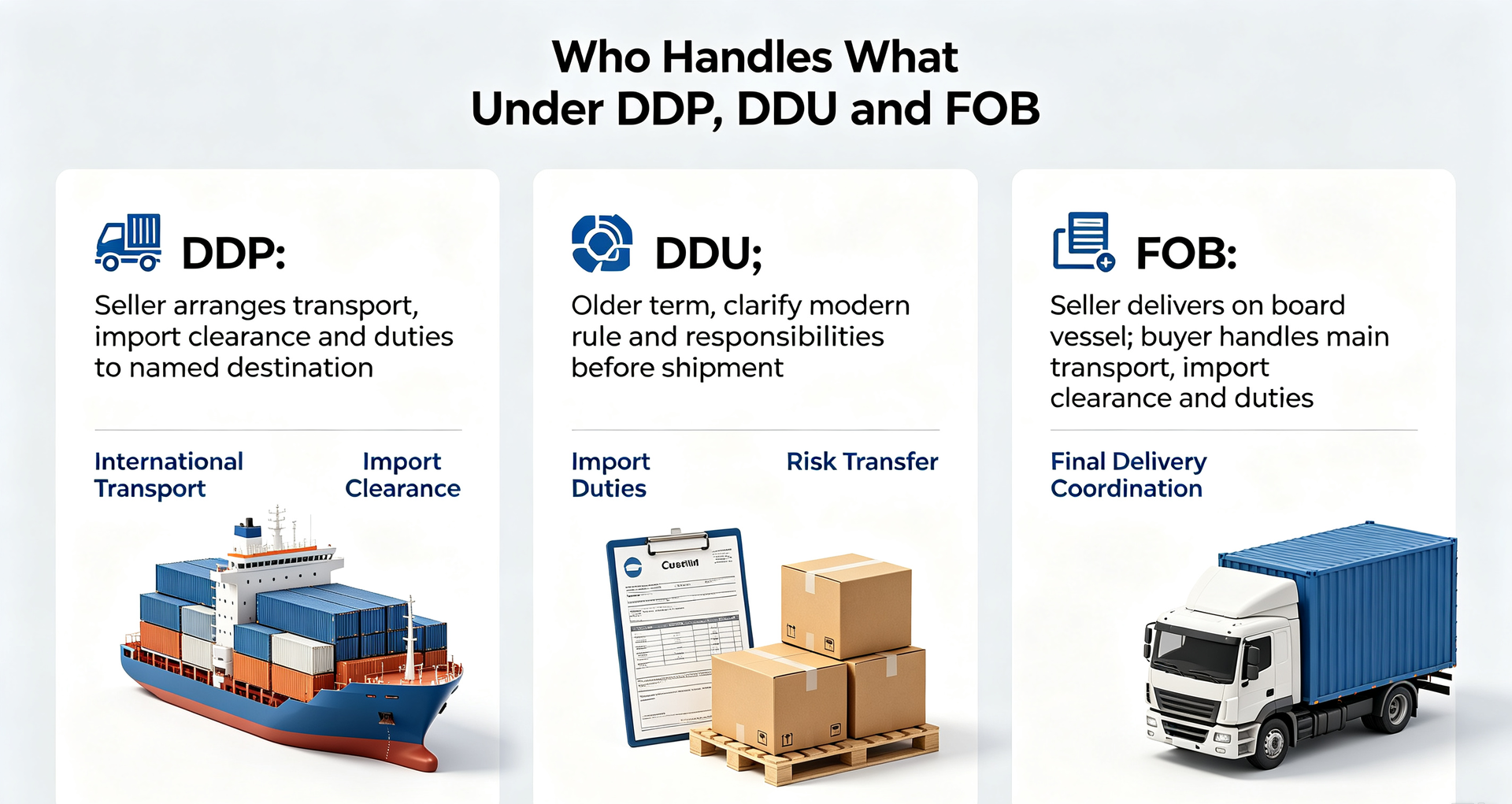
For an importer, one of the most useful ways to understand these terms is to separate transportation, customs, duties, and risk.
Under DDP, the seller arranges carriage to the named destination.
Under the historical DDU concept / modern DAP-type arrangement, the seller also arranges transportation to the named destination, while the buyer handles import formalities.
Under FOB, the seller's delivery obligation ends when the goods are delivered on board the vessel at the named port of shipment. The buyer arranges the main carriage.
This is one of the biggest differences.
DDP: Seller is responsible.
DAP / historical DDU-type arrangement: Buyer is responsible.
FOB: Buyer is responsible.
ICC's official tariff-risk guidance confirms this distinction.
Under DDP, the seller is responsible for applicable import duties and taxes within the scope of the rule.
Under DAP and FOB, the buyer is responsible for import clearance and applicable import duties and taxes.
This is particularly important when tariff rates or trade policies change.
An importer should therefore avoid evaluating DDP simply by comparing the quoted transportation price with an FOB freight quotation.
The two quotations may allocate substantially different costs and responsibilities.
There is no universally “best” Incoterms® rule.
The better option depends on the buyer's logistics capabilities and commercial requirements.
E-commerce businesses often have a different logistics profile from traditional wholesalers.
An e-commerce seller may need to move products from:
Chinese Factory → International Freight → U.S./Canadian Import → 3PL → Fulfillment → Customer
That means the Incoterms® choice should be considered together with the company's fulfillment model.
For example, a new seller shipping a relatively small number of orders may value operational simplicity.
An established seller with multiple suppliers, regular container shipments, and an existing customs broker may prefer greater control over freight and import procedures.
The decision should therefore consider:
Consider a U.S. e-commerce company purchasing products from a Chinese manufacturer.
The supplier offers three commercial options:
The supplier arranges transportation and import clearance and delivers the shipment to the agreed destination.
The buyer needs to carefully verify what the quotation includes.
The supplier arranges transportation to the agreed destination.
The buyer handles U.S. import clearance and applicable duties and taxes.
The supplier delivers the goods on board the buyer-nominated vessel at the named Chinese port.
The buyer then arranges the main international transportation and U.S. import process.
The important point is that the cheapest-looking quotation is not automatically the cheapest total solution.
The buyer should compare the full cost and responsibilities under each option.
DDU is not part of Incoterms® 2020.
If a supplier uses the term, ask what current rule and responsibilities the parties actually intend.
A DDP quotation and FOB quotation can include very different cost components.
Always compare:
Origin Charges + Freight + Customs + Duties + Destination Charges + Final Delivery
where applicable.
DDP has a broad seller responsibility, but the actual commercial quotation should still be reviewed carefully.
The named destination and agreed scope matter.
FOB is designed for sea and inland waterway transport.
ICC specifically notes that FOB is not appropriate when goods are handed over to a carrier before being placed on board the vessel, such as at a container terminal. In such cases, FCA may be more appropriate.
Even when a logistics provider or customs broker is involved, the importer should understand its own regulatory responsibilities.
A freight forwarder can coordinate transportation, but Incoterms® do not replace customs regulations or product compliance requirements.
Before agreeing to a shipping term, ask these six questions:
If the buyer wants control, FOB may be considered for appropriate ocean shipments.
If the seller should arrange transportation to the destination, DAP or DDP may be considered depending on import responsibilities.
This is one of the most important distinctions between DDP and DAP.
Under DDP, the seller bears the applicable import duties and taxes within the rule.
Under DAP and FOB, the buyer handles import clearance and applicable duties and taxes.
Do not confuse who pays for transportation with when risk transfers.
Incoterms rules address both cost and risk allocation, but they do not always transfer at the same point.
Always specify the relevant location clearly.
For example:
DDP [Named Place] Incoterms® 2020
or
FOB [Named Port] Incoterms® 2020
A three-letter abbreviation without a named place can leave important details unclear.
FOB is a sea and inland-waterway rule.
DDP and DAP can be used for any mode or combination of modes.
No. DDU is not one of the current Incoterms® 2020 rules.
It is still used informally in some commercial conversations, so buyers should clarify whether the parties actually intend a DAP-type arrangement or another delivery structure.
Not necessarily.
DDP provides a higher level of seller responsibility, while FOB gives the buyer more control over the main ocean transportation.
The better option depends on the importer's experience, logistics network, compliance capabilities, shipment characteristics, and commercial objectives.
The buyer is responsible for import clearance and applicable import duties and taxes under FOB. ICC's official guidance identifies FOB as a buyer-import arrangement for import clearance and tariffs.
The seller is responsible for import clearance and applicable import duties and taxes under DDP, subject to the actual scope and legal requirements of the transaction.
FOB is specifically intended for sea and inland waterway transport under Incoterms® 2020.
For cargo transported by air or multimodal containerized transportation, another Incoterms® rule such as FCA may be more appropriate depending on the transaction.
DDP requires the seller to deliver the goods to the named destination, cleared for import and ready for unloading. However, the exact delivery point should be stated clearly in the sales contract.
DDP can be useful when the seller or logistics provider can properly manage the required import process, and the buyer wants a more consolidated delivery arrangement.
However, importers should verify who is responsible for customs, duties, taxes, documentation, and compliance before accepting the quotation.
Choosing an Incoterms rule is a commercial decision, but the logistics consequences can affect the entire supply chain.
TransWorld works with businesses shipping from China to international destinations and can help customers evaluate logistics options based on:
Depending on the shipment, services may include:
Supplier Pickup → Warehousing → Consolidation → Sea Freight → Air Freight → Customs Coordination → Door-to-Door Delivery
For businesses comparing DDP, DAP, FOB, or other shipping arrangements, the important step is to define who is responsible for each cost, task, and risk before the shipment is booked.
The simplest way to remember the difference is:
DDP = Seller manages the shipment and import responsibility to the named destination.
DDU = Older terminology; clarify the intended modern rule, often DAP, rather than relying on “DDU” alone.
FOB = Seller delivers the goods on board the vessel at the named port; buyer takes responsibility from that point under the rule.
For importers, choosing the right shipping term is not simply about getting the lowest quoted price.
It is about understanding:
Cost + Risk + Customs + Duties + Control + Delivery
Before signing a purchase contract or accepting a freight quotation, make sure the Incoterms® rule, named place, transport mode, customs responsibilities, and cost allocation are clearly stated.
That clarity can prevent misunderstandings between suppliers, freight forwarders, customs brokers, and importers—and make the international shipping process much easier to manage.






 Email: