
WORLDWIDE FREIGHT SERVICES
Email: jack@transworldcn.com
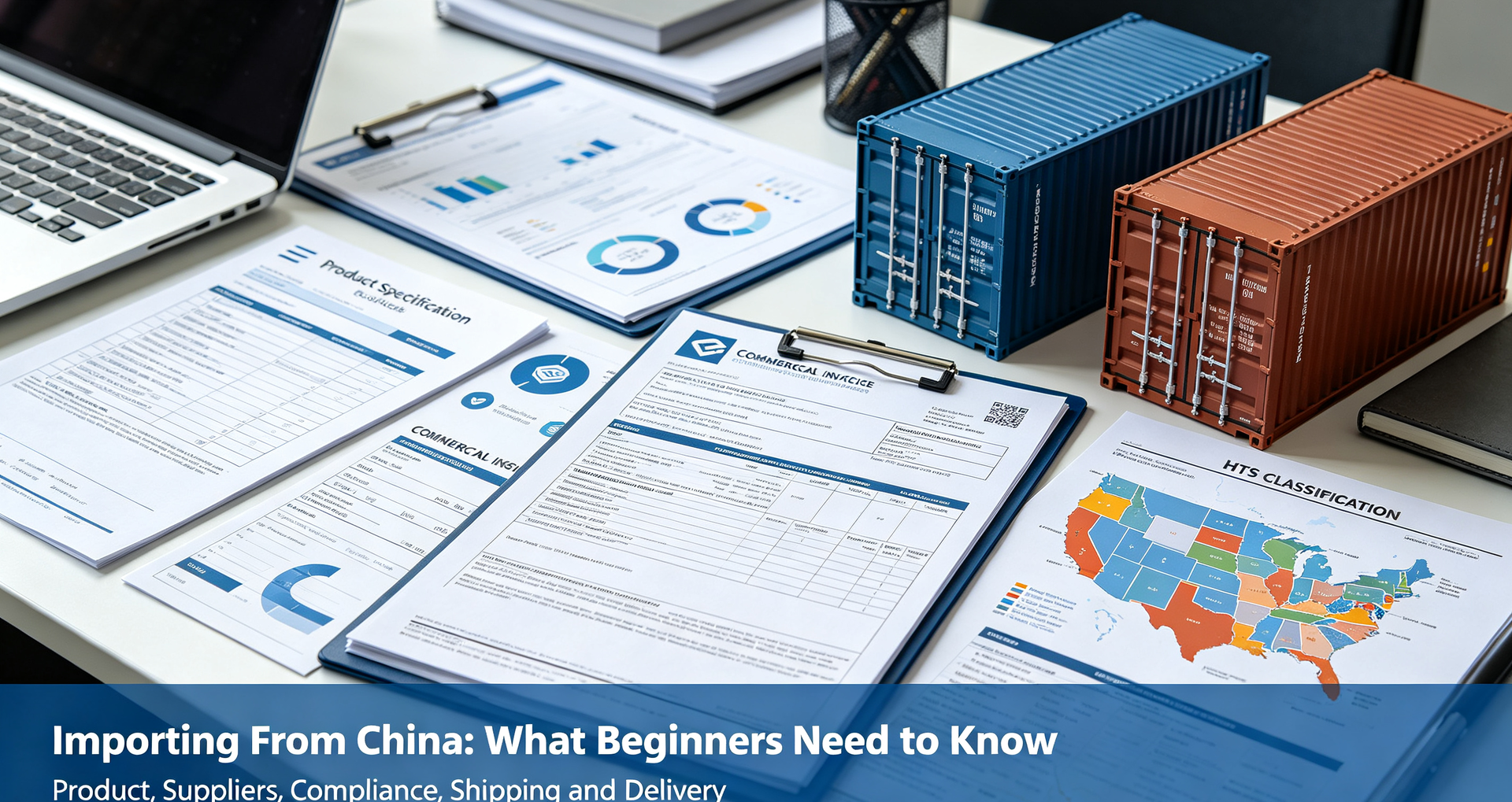
TL;DR: How Does Importing From China Work?
If you are importing from China for the first time, the process is easier to manage when you treat it as a complete supply-chain project rather than simply booking international freight.
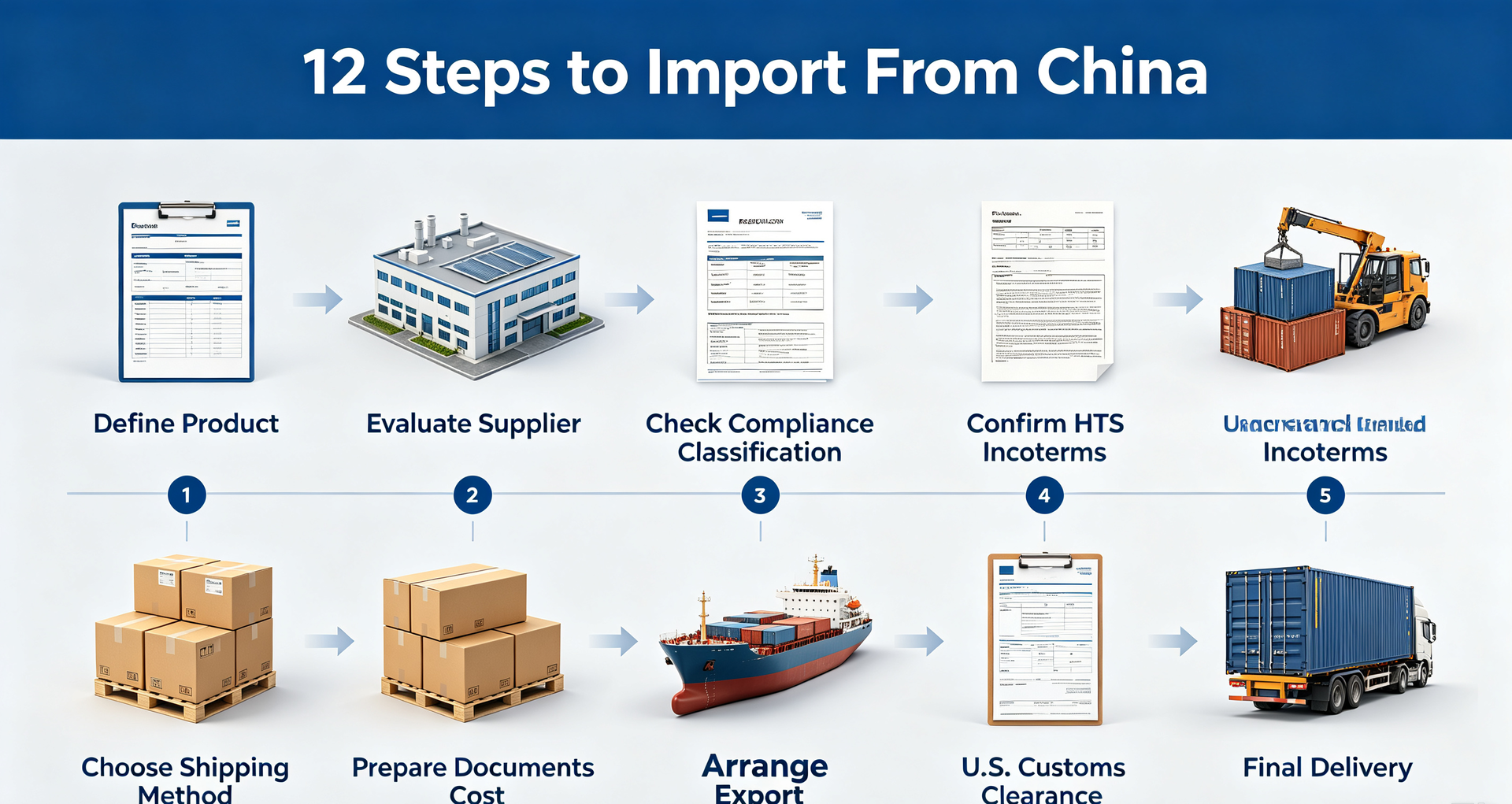
A typical import process follows these steps:
The most important point for first-time importers is to check compliance and total landed cost before production and shipment.
U.S. Customs and Border Protection (CBP) explains that importers share responsibility for understanding applicable laws and regulations, and that particular commodities may also be subject to requirements administered by Partner Government Agencies.
For tariff classification, importers should use the current U.S. Harmonized Tariff Schedule rather than relying on an old supplier-provided code. The USITC published multiple HTS revisions during 2026, including Revision 14 on July 31, 2026.
For regulated consumer products, additional testing, certification, or electronic filing requirements may apply. For example, CPSC states that applicable imported consumer products are subject to updated certificate eFiling requirements beginning July 8, 2026.
The simple rule: know what you are importing, who is responsible for each step, what the shipment will really cost, and what requirements must be met before the cargo leaves China.
The following workflow provides a practical starting point for a first-time importer.
| Stage | What To Do | Key Information |
| 1. Product | Define the merchandise | Product, material, use, specifications |
| 2. Supplier | Evaluate manufacturers | Price, MOQ, quality, lead time |
| 3. Compliance | Check U.S. requirements | HTS, testing, certification, labeling |
| 4. Purchase | Confirm commercial terms | Price, payment, Incoterms |
| 5. Cost | Calculate landed cost | Freight, duties, delivery, other charges |
| 6. Shipping | Select transportation | Sea, air, express |
| 7. Documents | Prepare paperwork | Invoice, packing list, transport documents |
| 8. Export | Move cargo from China | Pickup, consolidation, export |
| 9. Import | Complete U.S. entry | Customs clearance and applicable duties |
| 10. Delivery | Move cargo to destination | Warehouse, 3PL, fulfillment center |
This structure allows an importer to identify potential problems before they become shipment delays or unexpected costs.
Before contacting suppliers, prepare a clear product specification.
At minimum, document:
A description such as “plastic household product” may be too general for procurement, classification, compliance, and freight planning.
A better product description explains:
Product characteristics can affect:
For example, children's products can have specific third-party testing requirements. CPSC states that children's products subject to applicable federal safety requirements must be tested by a CPSC-accepted third-party laboratory.
That is why compliance should be considered before ordering, not after the cargo has already shipped.
Price should not be the only factor when choosing a supplier.
Evaluate suppliers based on several factors:
| Supplier Factor | Questions To Ask |
| Manufacturing capability | Can the factory produce the exact product? |
| MOQ | Is the minimum order suitable for your business? |
| Quality | What inspection process is available? |
| Lead time | How long does production normally take? |
| Packaging | Can packaging meet your requirements? |
| Communication | Can specifications be confirmed clearly? |
| Documentation | Can accurate product information be provided? |
| Previous experience | Does the supplier produce similar goods? |
A sample allows you to check:
For larger commercial orders, buyers may also consider a pre-shipment inspection or production quality-control process.
A sample approval should not be treated as a substitute for production inspection when the product or order value makes additional quality control appropriate.
This is one of the most important steps in an importing from China guide.
Not every imported product is subject to the same requirements.
Depending on the product, relevant U.S. government agencies may include:
CBP specifically notes that certain commodities may be subject to requirements administered by Partner Government Agencies.
For regulated consumer products, certification may be required.
CPSC explains that manufacturers and importers of applicable general-use consumer products may need a General Certificate of Conformity (GCC) based on testing or a reasonable testing program.
Beginning July 8, 2026, CPSC also requires importers of most regulated consumer products to electronically file applicable certificate information with CBP through the PGA Message Set.
If your product falls under FDA jurisdiction, additional requirements may apply.
Examples can include:
FDA import guidance identifies product-specific information that may be required for FDA-regulated shipments, including product and manufacturer information.
Do not assume that your freight forwarder or supplier has completed all regulatory requirements for you.
The importer should confirm the applicable requirements for the actual product being imported.
The U.S. uses the Harmonized Tariff Schedule of the United States (HTSUS) to classify imported merchandise.
The classification can affect:
The USITC maintains the official HTS information and publishes revisions throughout the year. The 2026 archive shows multiple revisions, including Revision 14 published July 31, 2026.
USITC — Harmonized Tariff Schedule
A supplier may provide an HS code as a starting point, but the importer should verify whether the classification is appropriate for the actual merchandise.
For products where classification is uncertain or could materially affect duties, consider obtaining professional customs advice.
Incoterms determine important responsibilities between the seller and buyer.
Common terms include:
For example, under EXW, the seller generally makes the goods available at a named place, while the buyer takes on more transportation responsibilities. ICC's official Incoterms 2020 rules explain the delivery and risk structure of EXW.
Never assume that “shipping included” means all import costs are covered.
Ask the supplier or logistics provider:
What costs are included in the quotation?
And:
Which costs will be paid separately by the importer?
This distinction is particularly important when comparing DDP, DAP, FOB, and EXW quotations.
A factory quotation is not the same as your final import cost.
A practical landed-cost model is:
Landed Cost = Product Cost + Origin Charges + International Freight + Applicable Duties/Fees + U.S. Delivery + Other Applicable Costs
Depending on the shipment, additional costs may include:
This template is intended for planning. Actual charges depend on the product, shipment, destination, commercial terms, and applicable regulations.
There is no universal “best” shipping method.
Your choice should consider:
| Method | Typical Use | Main Advantage | Main Consideration |
| FCL Sea Freight | Larger commercial shipments | Dedicated container space | Requires sufficient volume |
| LCL Sea Freight | Smaller commercial shipments | Shared container capacity | Additional handling |
| Air Freight | Time-sensitive cargo | Faster transportation | Higher freight cost |
| Express | Samples and small shipments | Convenient door-to-door service | Less suitable for large cargo |
For ecommerce businesses, shipping decisions should also consider inventory turnover and the cost of stockouts.
Before the cargo leaves China, review the documentation.
Common documents may include:
The commercial invoice normally identifies transaction information such as:
A packing list commonly provides:
Information across the documents should be consistent with the actual shipment.
Once production is completed, the logistics process moves into transportation.
A typical China-side workflow is:
Supplier → Pickup → Warehouse → Consolidation → Export Handling → Port/Airport
If goods are purchased from several suppliers, consolidation may reduce the need to manage multiple individual international shipments.
Before booking, provide the logistics provider with:
Accurate shipment information allows the forwarder to evaluate transportation requirements more effectively.
International transportation and customs compliance are not the same thing.
The importer should understand:
CBP states that there is no legal requirement to hire a customs broker, but many importers use brokers for convenience. CBP also states that the importer remains ultimately responsible for understanding applicable requirements and ensuring compliance.
CBP — Basic Importing And Exporting
CBP — Do I Need A Customs Broker?
This is particularly important for first-time importers because hiring a broker does not automatically transfer all legal responsibility away from the importer.
Country-of-origin marking can be another important consideration.
CBP regulations generally require articles of foreign origin to be marked with the English name of the country of origin unless an applicable exception applies. CBP rulings explain that the marking generally needs to be conspicuous, legible, and permanent as required by the applicable rules.
CBP — Country Of Origin Marking Rulings
This means product packaging should be reviewed before mass production.
Do not wait until goods are already packed and ready to ship to discover that labeling needs to be changed.
The logistics process does not end when the cargo reaches a U.S. port or airport.
The shipment still needs to reach its final destination.
Possible destinations include:
Before shipping, confirm:
A shipment can clear customs successfully and still experience delivery delays if the final-mile requirements were not planned.
Use this checklist before your first commercial shipment.






 Email: