

WORLDWIDE FREIGHT SERVICES
Email: jack@transworldcn.com

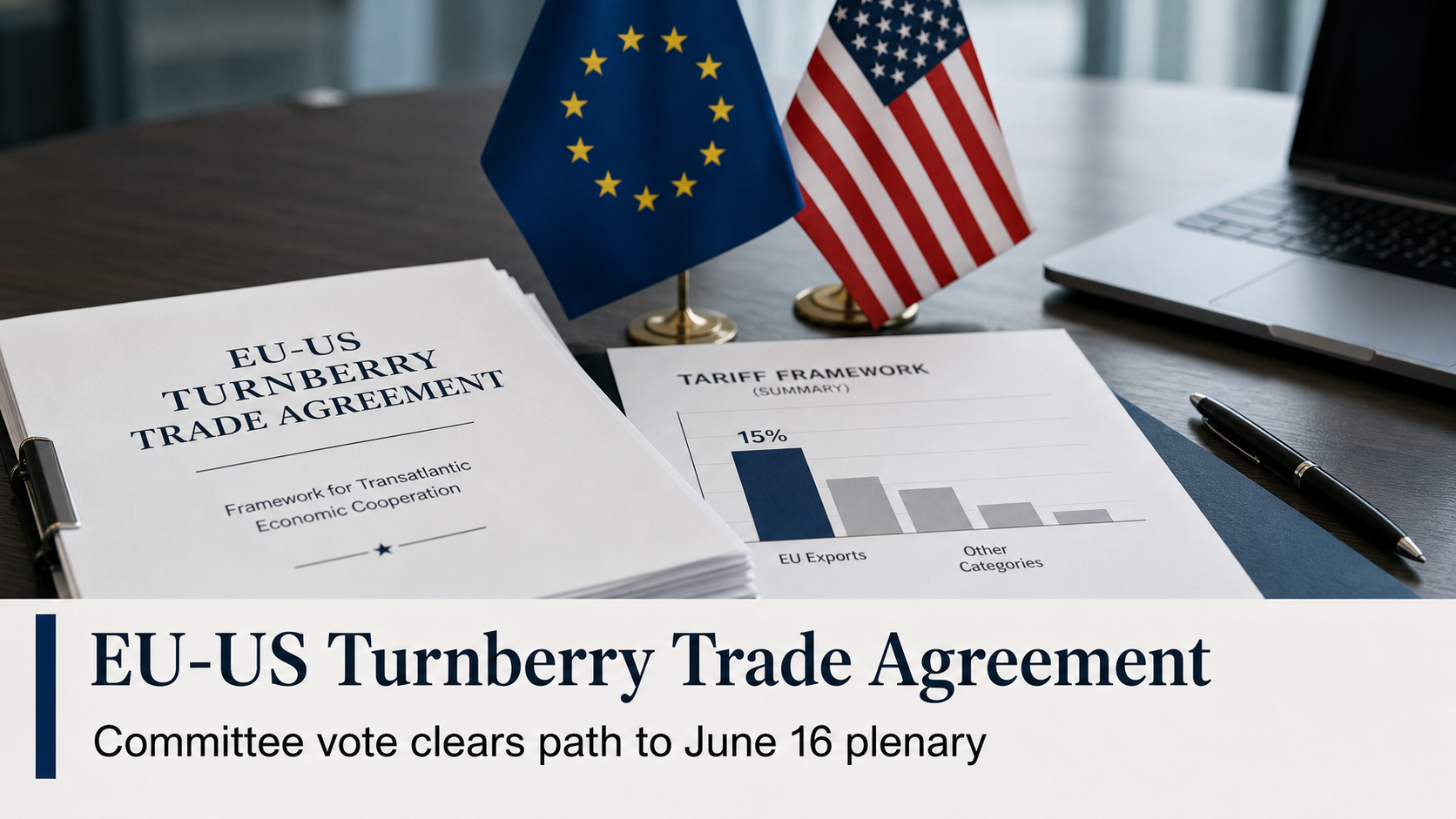
The EU-US Turnberry Trade Agreement moved a major step closer to final approval after the European Parliament’s International Trade Committee backed the provisional legislative text on June 2. The vote, passed by 31 in favor, 6 against and 3 abstentions, clears the way for a full European Parliament plenary vote scheduled for June 16.

The agreement is designed to prevent a new round of tariff escalation between the European Union and the United States, two of the world’s largest trading partners. At its core, the Turnberry Agreement would see the EU reduce tariffs on most US industrial goods to zero, while creating tariff-rate quotas for selected American agricultural and food products. In return, the United States would apply a 15% tariff rate to most EU goods exported to the US market.
Supporters of the EU-US trade deal argue that the compromise offers businesses greater predictability after months of tariff uncertainty. For European manufacturers, exporters and supply-chain operators, a stable tariff framework could reduce the risk of sudden cost increases and delayed investment decisions. For US producers, the agreement offers broader access to the EU market, especially in industrial and agri-food sectors.
However, the deal remains politically sensitive in Brussels. Critics say the agreement is uneven because the EU would lower many duties on US goods while European exports to the United States would still face a 15% tariff. This imbalance has prompted lawmakers to add safeguards intended to protect EU industries from unilateral US tariff action.
One of the most important safeguards concerns steel, aluminium and derivative products. If the United States has not reduced tariffs on relevant EU steel and aluminium derivative products to 15% or below by December 31, 2026, the EU would have the right to suspend tariff preferences granted under the agreement. This mechanism is intended to ensure that Washington follows through on its commitments and does not continue applying higher duties while benefiting from EU market access.
The legislative text also includes a sunset clause. The Turnberry Agreement is set to expire on December 31, 2029, unless it is renewed or replaced after further assessment. This gives EU institutions time to evaluate the impact of the agreement on European industry, small and medium-sized enterprises, workers and consumers.
The June 2 committee vote does not represent final adoption, but it is a critical procedural milestone. The European Parliament plenary vote on June 16 will determine whether the agreement can move into its final approval stage. If adopted, the deal could become a central pillar of EU-US trade relations through the end of the decade.
For businesses on both sides of the Atlantic, the key question is whether the agreement will deliver stability or simply lock in an uneasy compromise. Exporters, manufacturers, agricultural suppliers and logistics companies will be watching closely as the European Parliament prepares for its final vote.
SEO Keywords: EU-US trade agreement, Turnberry Agreement, European Parliament trade vote, EU US tariffs, transatlantic trade, 15% tariff, EU industrial goods, US agricultural products, European Parliament plenary vote, trade committee vote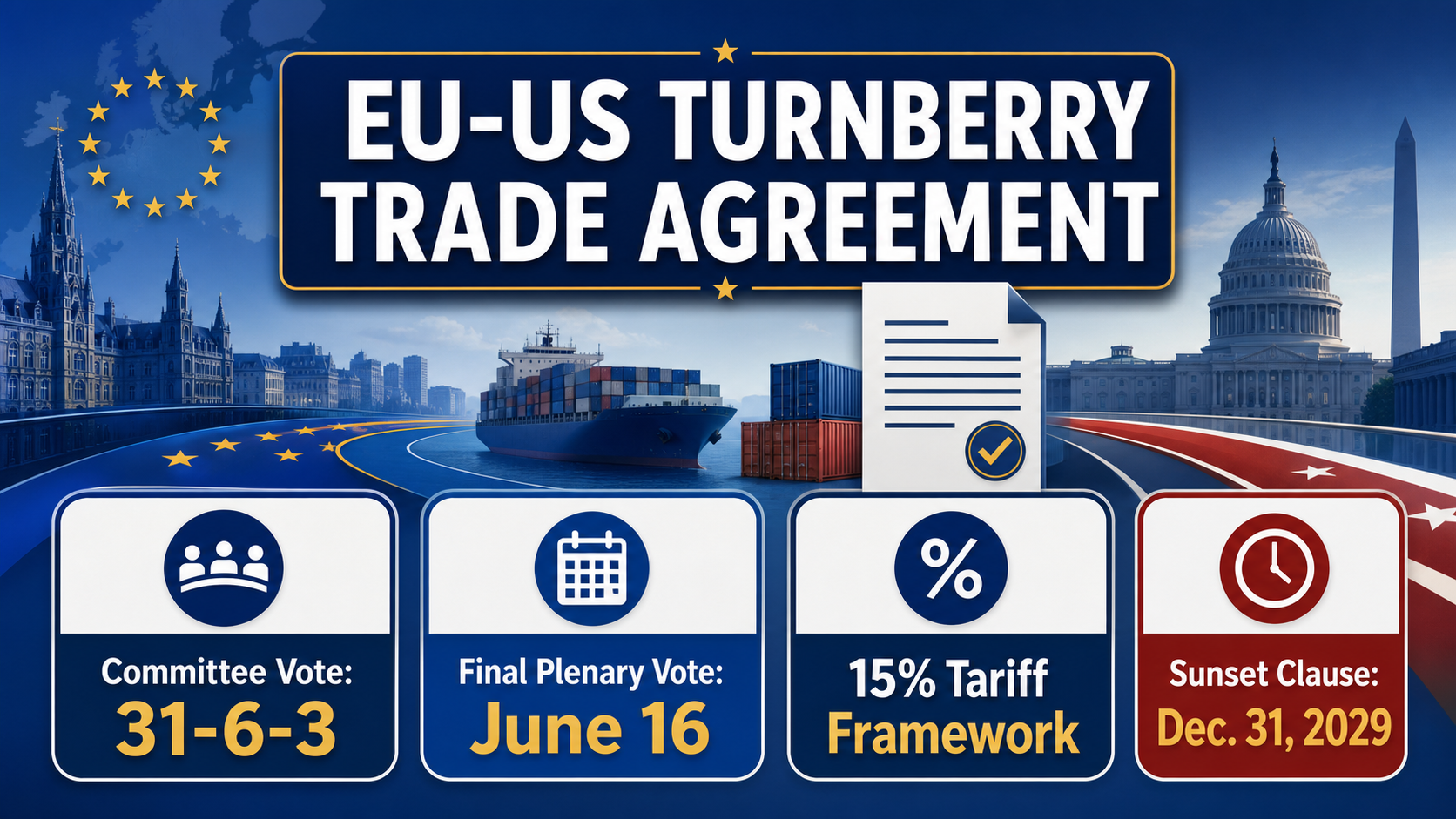
 +86 18126424455
 Email:jack@transworldcn.com
  Room 501-9, Building D, Longjing Technology Park, No. 335, Bulong Road, Ma'antang Community, Bantian Street, Longgang District, Shenzhen, China
 Shenzhen Transworld Supply Chain Co., LTD