
WORLDWIDE FREIGHT SERVICES
Email: jack@transworldcn.com
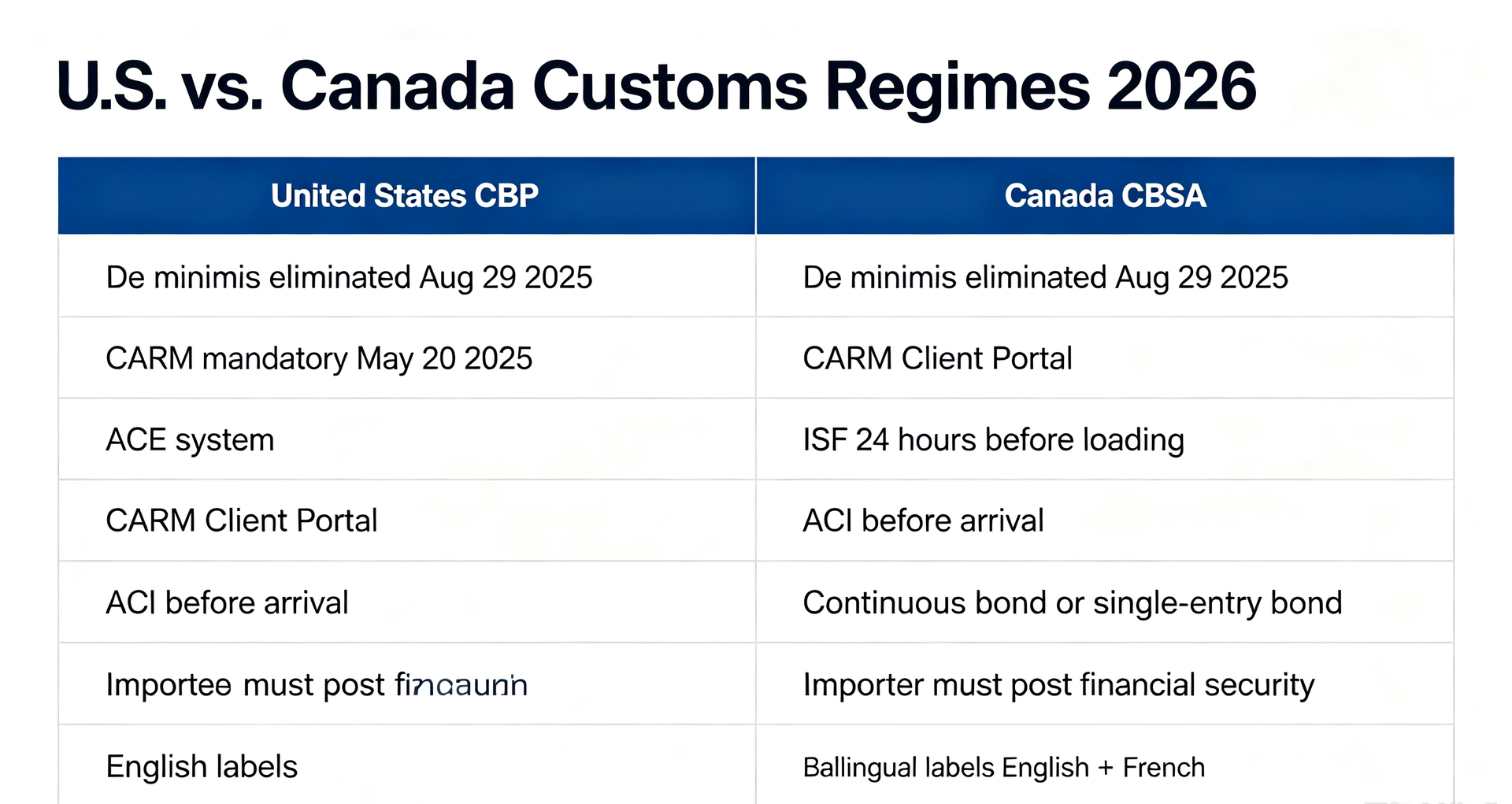
U.S. de minimis eliminated (effective Aug 29, 2025): All shipments now require formal customs processing and may incur duties, taxes, and brokerage fees.
CARM mandatory for Canada (May 20, 2025): Importers must register in the CARM Client Portal and post their own financial security.
ISF/AMS filing: U.S. requires ISF submission 24 hours before vessel loading; violations carry fines up to $5,000 per occurrence.
"Four documents must match": Invoice, packing list, bill of lading, and customs declaration must have identical core information or risk holds.
Choose DDP over DDU: DDP shifts duty/tax responsibility to the seller, reducing clearance risk; carriers are increasingly rejecting DDU shipents.
U.S. and Canada systems are independent: Separate IOR requirements, HS code systems, and certification regimes.
For e-commerce sellers and foreign trade businesses shipping to the United States and Canada, customs clearance is the single largest variable in supply chain predictability. A single clerical error can transform a profitable shipment into a financial disaster: detention fees, demurrage charges, penalty assessments, cargo holds, or even forced return to origin.
2026 has brought unprecedented regulatory changes. The elimination of the U.S. de minimis threshold (August 29, 2025) means every shipment—regardless of value—must now formally enter through U.S. Customs and Border Protection (CBP) and may be subject to duties, taxes, and brokerage fees . Meanwhile, Canada's CBSA has introduced the CARM (CBSA Assessment and Revenue Management) system, digitizing assessment and revenue management with stricter enforcement mechanisms .
This guide provides a practical, compliance-first roadmap for exporters shipping from China to the U.S. and Canada. It draws on regulatory requirements, documented enforcement patterns, and real-world data to help you avoid the most common customs errors in 2026.
Before examining specific errors, it is essential to recognize that the U.S. and Canada operate separate customs regimes with distinct requirements. Importers serving both markets cannot assume that a successful U.S. clearance translates to a smooth Canadian process.
| Dimension | United States (CBP) | Canada (CBSA) |
| Import Threshold | De minimis eliminated (Aug 2025); all shipments require formal processing | CAD 3,300 informal vs. formal entry threshold; CARM applies to all commercial goods regardless of value |
| Importer of Record (IOR) | U.S. IOR required; ISF filing via ACE system | Canadian BN (Business Number) required; Non-Resident Importers (NRI) can act as IOR |
| Required System | ACE (Automated Commercial Environment) | CARM Client Portal – mandatory for all importers |
| Security/Bond | Continuous bond or single-entry bond required | IOR must post own bond (50% of monthly A/R, ≥ CAD 5,000) or cash deposit |
| Key Certification Bodies | FCC (electronics), FDA (food/cosmetics), CPSC (toys) | ISED (electronics), CFIA (food), CCPSA (toys) |
| Language Requirement | English labels | Bilingual labels (English + French) for most consumer goods |
| Penalty System | CBP fines and liquidated damages | AMPS: CAD 150–25,000 per violation |
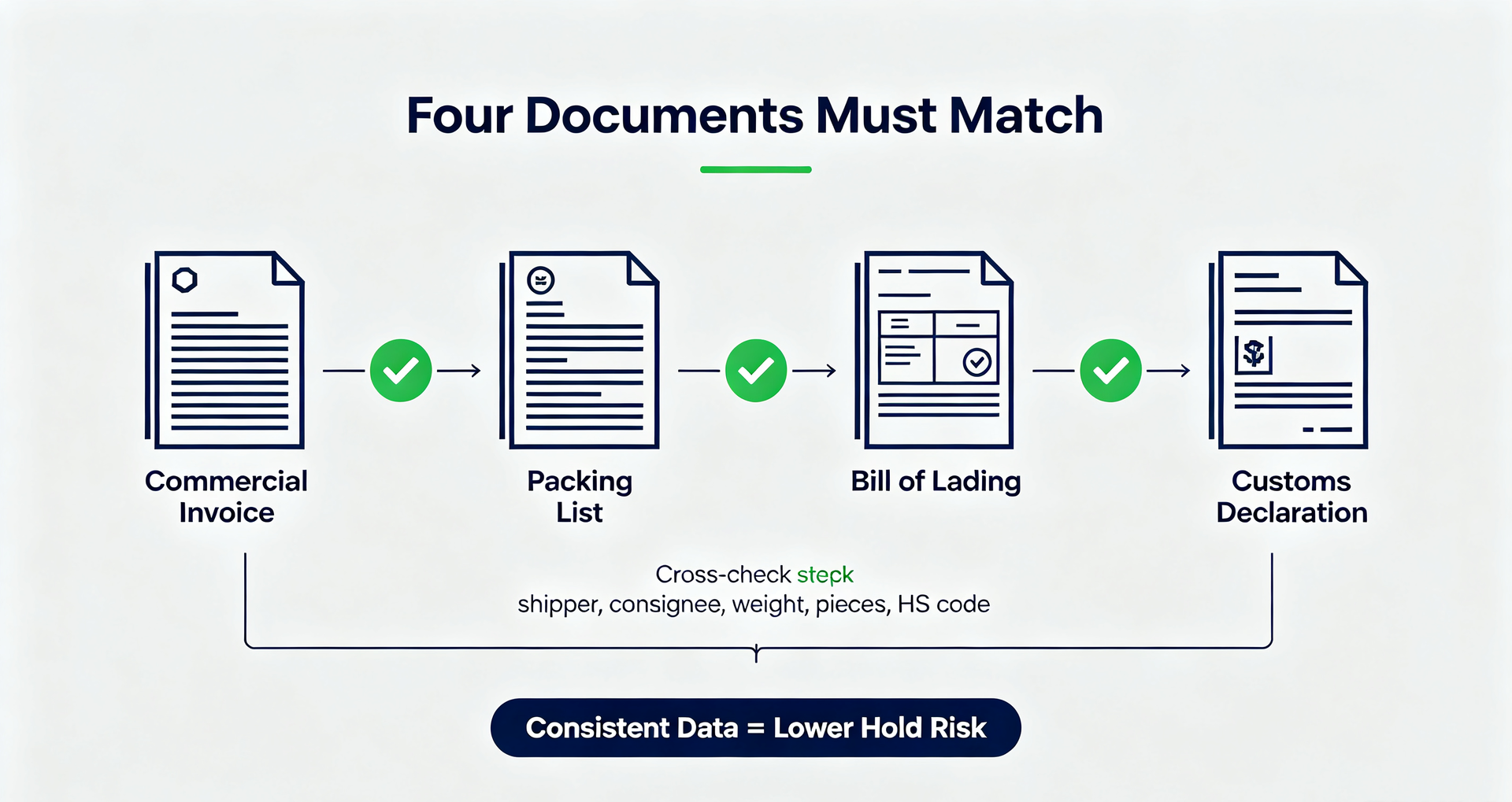
The Problem: Discrepancies between the commercial invoice, packing list, bill of lading, and customs declaration are a primary cause of customs delays. The Ministry of Transportation, Ontario, reports that 35% of drivers arrive at primary inspection with insufficient documentation—leading to delays .
The Risk: During a 5H inspection, CBP verifies document consistency, truthful declarations, valid IOR/Bond, and compliance certifications. Any mismatch leads to detention.
The Fix: Perform a pre-shipment document validation cross-check. Ensure shipper, consignee, gross weight, piece count, and HS code are identical across all four documents.
Best Practice: Work with a logistics provider that includes origin document validation as a standard service.
The Problem: Descriptions like "accessories," "miscellaneous goods," or "machine parts" are automatic "inspect me" flags for customs systems . CBSA and CBP use AI-powered cross-referencing that expects precise, detailed descriptions.
The Fix: Use a "material + function + specification" format. For example, instead of "electronics," write "Bluetooth headphones, model X, plastic housing, lithium battery ."
Canadian Note: Canada requires descriptions that align with the B3-3 Customs Coding Form. Vague entries trigger AMPS penalties.
The Problem: An incorrect HS code leads to incorrect duty assessment, customs delays, or fines. Both CBP and CBSA revise tariff schedules throughout the year—even slight modifications can delay clearance .
The Fix: Use the official tariff finder for each country:
U.S.: HTSUS (Harmonized Tariff Schedule of the United States)
Canada: Canada Tariff Finder
Pro Tip: For Canada, use 10-digit HS codes (six digits meets minimum, but 10-digit codes reduce clearance hold risk) .
The Problem: A single incorrect letter in the consignee name prevents destination agents from releasing cargo. For Canada, the receiver must provide a valid BN (Business Number) for commercial imports .
The Fix: Require customers to provide their full legal registered name and tax ID (U.S. EIN, Canada BN). Include email address and phone number—mandatory for customs communication.
U.S. Specific: The ISF filing requires buyer, seller, importer of record number, and consignee number(s) no later than 24 hours before cargo is laden .
The Problem: Providing only the commercial invoice without required product certifications leads to customs holds.
Critical U.S. Requirements:
Electronics: FCC certification
Toys: CPC (Children's Product Certificate)
Food/Cosmetics: FDA registration and Prior Notice
Wood packaging: ISPM 15-compliant IPPC marks
Critical Canada Requirements:
Electronics: ISED certification (separate from FCC ID)
Food: CFIA registration
Bilingual labels: English and French required for most consumer goods
The Problem: Unclear Incoterms result in uncertainty over who pays duties and taxes—and cargo being held until payment is made.
DDP (Delivery Duty Paid): The seller assumes all responsibilities and costs for delivering goods, including export/import formalities, fees, duties, and taxes . This improves customer experience by providing clarity during the buying process .
DDU (Delivery Duty Unpaid): The receiver is responsible for any duties, taxes, and fees . If the receiver does not pay, the carrier may recover outstanding amounts from the shipper .
2026 Update: Following the U.S. de minimis elimination, carriers including Canada Post have suspended DDU options . DDP is now the standard expectation for cross-border shipments.
The Fix: Select DDP for all North American shipments. If you do not have a carrier payment account, shipments may default to DDU .
The Problem: U.S. law requires ISF (Importer Security Filing) and AMS (Automated Manifest System) filings no later than 24 hours before cargo is laden aboard the vessel . Canada requires advance ACI (Advance Commercial Information) submissions before arrival.
The Fix: Ensure your forwarder files ISF/AMS within the window. ISF penalties start at $5,000 per violation .
ISF 10+2 Data Elements: The ISF requires seller, buyer, IOR number, consignee number(s), manufacturer (or supplier), ship to party, country of origin, and commodity HTSUS number—all submitted 24 hours before loading .
Step 1: Verify Importer of Record Status
U.S.: Confirm active IOR with ACE system access.
Canada: Obtain a valid BN 9 with RM import account and register in CARM Client Portal .
Step 2: Pre-Validate All Documentation
Cross-check all four documents: invoice, packing list, bill of lading, customs declaration.
Ensure product descriptions are precise and include full HS codes.
Step 3: Confirm Certifications and Labels
U.S.: Verify FCC, FDA, CPSC, ISPM 15 as applicable.
Canada: Verify ISED, CFIA, bilingual labeling requirements.
Step 4: File Advance Notices
U.S.: ISF/AMS 24 hours before vessel loading .
Canada: ACI submission before arrival.
Step 5: Select DDP Terms
Choose DDP to shift duty/tax responsibility to the seller and ensure smoother clearance .
Step 6: Partner with a Licensed Customs Broker
Work with a broker experienced in both U.S. and Canada clearance .
Ensure broker is registered in CARM for Canadian shipments .
A: No. The U.S. and Canada have separate customs regimes, separate IOR requirements, different HS code systems, and distinct certification regimes.
A: Effective August 29, 2025, de minimis was eliminated for all U.S. shipments regardless of origin or value. All shipments now require formal CBP entry and may incur duties, taxes, and brokerage fees . For postal shipments, temporary flat fees of $80–$200 per package apply until February 2026 .
A: CARM (CBSA Assessment and Revenue Management) is CBSA's new mandatory system for processing duties and taxes. All importers must register in the CARM Client Portal and post their own financial security. Unregistered importers cannot release goods through Canadian customs .
A: Missing the deadline can result in civil penalties starting at $5,000 per violation, cargo holds, and increased inspections .
A: DDP (Delivery Duty Paid) means the seller pays all duties, taxes, and fees. DDU (Delivery Duty Unpaid) means the receiver must pay. Following the 2025 de minimis elimination, carriers are increasingly rejecting DDU shipments .
A: Ensure accurate customs declarations, correct HS codes, complete documentation, and timely filings. AMPS penalties start at CAD 150 for minor infractions and escalate to CAD 25,000 for serious violations.
In 2026, cross-border customs compliance is no longer optional—it is a strategic necessity. The elimination of de minimis, CARM rollout, and intensified CBP and CBSA enforcement have permanently changed the risk landscape. Exporters who invest in compliance-first processes gain predictable delivery timelines, lower landed costs, and stronger relationships with North American buyers.
TransWorld's one-stop logistics solution includes origin document validation, customs brokerage, and DDP service to the U.S. and Canada—ensuring your shipments clear without surprises. By avoiding the seven common errors outlined in this guide, you can reduce customs risk and turn compliance into a competitive advantage.






 Email: